
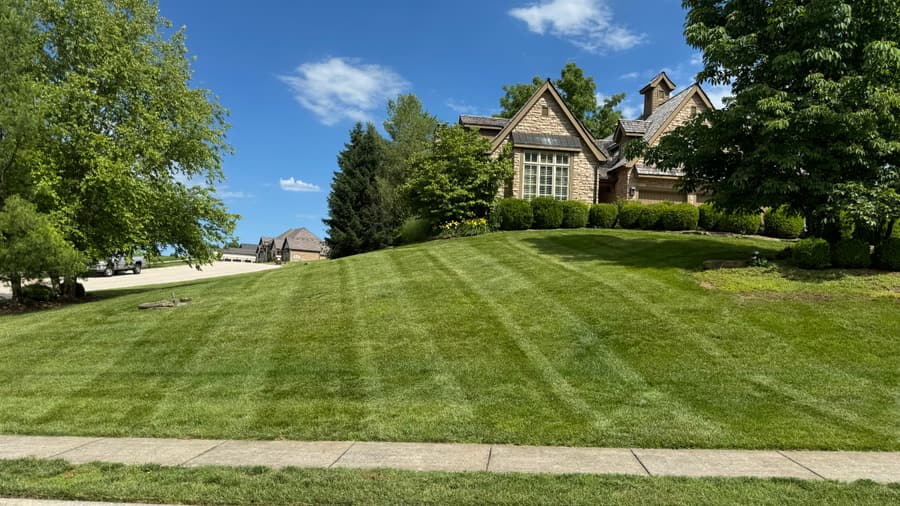
Cutting a lawn shorter does not make it healthier or eliminate mowing. In Southwest Missouri, the height of the cut is one of the biggest differences between turf that survives summer and turf that becomes thin, weedy, and stressed.
Start by identifying the grass
Tall fescue is common across Nixa, Ozark, and Springfield because it handles Missouri's transition-zone conditions better than many other cool-season grasses. Kentucky bluegrass, fine fescues, ryegrass, zoysia, and mixed lawns need somewhat different care, so the correct height starts with knowing what is growing.
For tall fescue, we generally aim for a finished height near 3.5 to 4 inches during summer stress. MU Extension lists a broader seasonal range, but also recommends taller summer mowing. A lawn in shade, drought, or heat usually benefits from keeping more leaf surface rather than less.
Why taller turf performs better
Grass leaves manufacture the energy that supports roots. Removing too much leaf area reduces the plant's ability to recover and can create a shallow root system. Taller turf also shades the soil, slows moisture loss, and makes it harder for many weed seedlings to get established.
That does not mean letting the lawn become overgrown. The goal is a consistent mowing schedule that maintains an intentional height without repeatedly scalping high spots or cutting into crowns on uneven ground.
- Use a deck setting that produces the measured height you want; the number on the lever is not always an inch measurement.
- Measure from the soil surface to the top of the standing leaf after mowing.
- Raise the cut during hot, dry periods and on shaded turf.
- Avoid mowing wet ground when tires can rut soil or clippings will clump.
The signs that a lawn is being cut too short
A pale or brown cast immediately after mowing, visible stems, repeated scalped spots, fast moisture loss, and an increase in summer weeds can all point to a cut that is too aggressive. A dull blade can make the color look worse by tearing leaf tips instead of cutting them cleanly.
If a lawn is already too tall, do not force it back to the target height in one pass. Reduce it in stages over several days so the plant keeps enough green leaf area to recover.
Our practical Missouri rule
For most maintained tall fescue lawns, a clean, sharp cut around 3.5 inches is a strong starting point, with adjustments for the season, grass type, property conditions, and customer preference. Consistency matters as much as the exact number.
Related Lawn Guide chapters
Useful gear for this topic
Measure the cut before changing the deck
These tools help confirm the lawn's real finished height and rule out common mower-setup problems that can make one side cut lower than the other.
As an Amazon Associate, Pebble Creek earns from qualifying purchases. Your price is not increased. How we choose recommendations.
Mower deck and grass-height gauge
Best for: Checking the real finished height instead of relying only on the deck lever number.
See current Amazon options ↗Grass-height measuring ruler
Best for: Watching growth between visits and applying the one-third rule consistently.
See current Amazon options ↗Mower deck leveling gauge
Best for: Comparing blade-tip height from side to side and front to back before blaming the turf for an uneven cut.
Use the mower manufacturer's leveling procedure and secure the equipment before reaching beneath the deck.See current Amazon options ↗Low-pressure mower tire gauge
Best for: Keeping mower tires evenly inflated so the deck does not sit lower on one side.
See current Amazon options ↗Sources and further reading
- MU Extension: Cool-Season Grasses Lawn Maintenance Calendar ↗
- MU Extension: Mowing Too Short Can Harm Your Lawn ↗
This chapter provides general educational information. Site conditions vary, and product labels and equipment manuals control whenever a product or machine is used.