
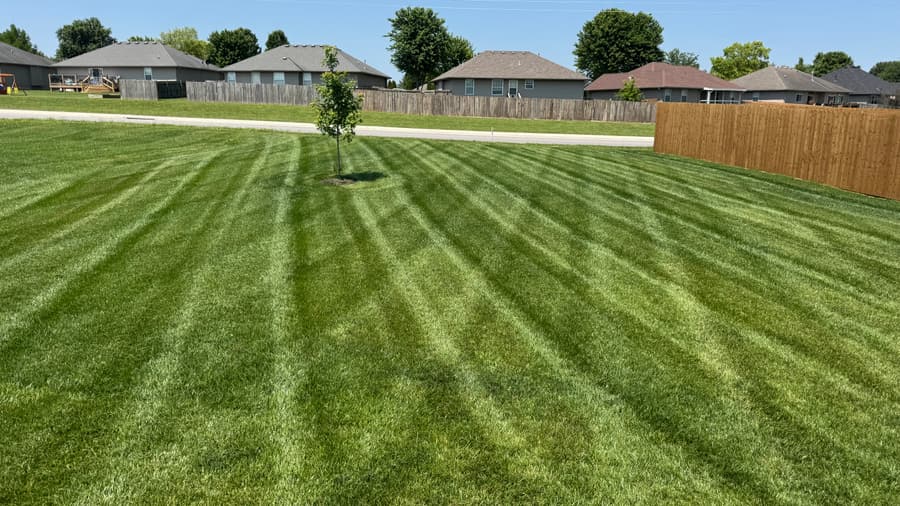
Weekly mowing is a useful schedule, but grass does not own a calendar. Temperature, rainfall, fertilizer, irrigation, shade, and the season all change how quickly a lawn grows. The one-third rule gives Southwest Missouri homeowners a better way to decide when a cut is due—and a better explanation for why the same lawn may need different attention in April, July, and October.
What the one-third rule means
Avoid removing more than one-third of the living grass blade in a single mowing. Put another way, about two-thirds of the blade should remain after the cut. This protects the leaf area the plant uses to make energy and reduces the stress caused by an aggressive mowing.
The rule is a plant-health guideline, not a demand for mathematical perfection. Its value is that it prevents the repeated cycle of letting turf become very tall and then cutting it extremely short. That cycle may make the property look briefly reset, but it often leaves cool-season grass pale, clumpy, and slower to recover.
A simple way to calculate the next mowing
Start with the finished height you want and multiply it by 1.5. If the target height is 3.5 inches, mow before the lawn grows much beyond about 5.25 inches. If the target is 4 inches during summer stress, the one-third threshold is about 6 inches.
Those numbers are checkpoints, not a reason to carry a ruler around the entire yard. Measure a few representative areas, learn how the property grows, and watch for high-growth zones near drainage paths, fertilized beds, shaded edges, and irrigated sections. The fastest-growing part of the lawn often determines when the whole property is ready.
- 3-inch finished height: mow by about 4.5 inches.
- 3.5-inch finished height: mow by about 5.25 inches.
- 4-inch finished height: mow by about 6 inches.
Why mowing frequency changes during the year
Tall fescue and other cool-season lawns often grow fastest during mild, wet spring weather and again when temperatures moderate in fall. MU Extension notes that spring growth can justify mowing every five or six days. Growth can slow sharply during the hottest and driest part of summer, especially on lawns without irrigation.
Fertilized or irrigated lawns may need more frequent attention during growth flushes. Shaded areas can stay wet longer but may also grow more slowly. Low areas may be too soft to mow safely even while sunny slopes are ready. A professional schedule has to balance plant needs, property appearance, weather, route consistency, and responsible access.
- Do not mow merely because the lawn is wet and the scheduled day arrived.
- Do not lower the deck to compensate for a missed visit.
- When turf is badly overgrown, return it to height in stages.
- Keep the discharge path clear of people, vehicles, windows, and roads.
What to do if you miss a mowing
Set the mower higher for the first pass and remove only part of the excess growth. MU Extension recommends cutting an overgrown lawn partway back toward the intended height, then returning a couple of days later. Thick windrows of clippings should be redistributed or collected so they do not shade and smother the turf beneath them.
Do not lower the deck because the lawn looks tall or because the next visit is a week away. That removes even more living tissue at the moment the grass is already under stress. A staged correction takes longer, but it produces a better result than one low cut that leaves the property yellow and rough.
When clippings tell you the schedule is off
Short, dry clippings normally filter into the lawn and decompose. Heavy piles, ropes, or windrows are often a sign that the turf was too tall, too wet, or moving through the deck faster than the mower could process it. The problem is not automatically that clippings were returned; it is often that too much material was created at once.
After mowing, look across the property from several angles. Visible clumps should be dispersed with another pass, blown into the turf, or collected. Streets, driveways, sidewalks, and landscape beds should be left clean. The one-third rule supports both turf health and a more finished-looking visit.
The practical scheduling takeaway
A dependable mowing plan should be regular enough to stay near the one-third rule while remaining flexible around growth and weather. In a Southwest Missouri spring, that may mean the lawn could biologically use attention sooner than seven days. During a dry summer stretch, the same property may have very little safe growth to remove.
For most maintained residential properties, recurring weekly service provides the most consistent starting point. It keeps the lawn from repeatedly becoming a rescue job, makes clipping management easier, and gives the crew a chance to notice changing property conditions. Frequency can still be adjusted when the season, grass type, and written service plan justify it.
Related Lawn Guide chapters
Useful gear for this topic
Make the one-third rule easier to follow
A few simple measurements make it easier to respond to actual grass growth instead of mowing too low just because the scheduled day arrived.
As an Amazon Associate, Pebble Creek earns from qualifying purchases. Your price is not increased. How we choose recommendations.
Grass-height measuring ruler
Best for: Watching growth between visits and applying the one-third rule consistently.
See current Amazon options ↗Mower deck and grass-height gauge
Best for: Checking the real finished height instead of relying only on the deck lever number.
See current Amazon options ↗Inductive mower hour meter
Best for: Tracking mowing time and building repeatable blade-inspection and maintenance intervals.
See current Amazon options ↗Simple outdoor rain gauge
Best for: Tracking rainfall before deciding whether the lawn needs additional irrigation.
See current Amazon options ↗Sources and further reading
- MU Extension: Natural Lawn Care ↗
- MU Extension: Don't Bag It Lawn Care ↗
- MU Extension: Cool-Season Grasses Lawn Maintenance Calendar ↗
This chapter provides general educational information. Site conditions vary, and product labels and equipment manuals control whenever a product or machine is used.