
If you plan to seed your Nixa lawn, choose the seed date before choosing a crabgrass preventer. Some products can interfere with new grass for months; others are labeled for seeding particular grasses under specific conditions. The name on the front of the bag is not enough. This guide gives you a label comparison and a short planning worksheet so weed prevention does not undermine the lawn repair you actually want.
1. Put the grass and seed date first
Start with three facts: what grass you want to grow, which part of the yard needs seed and when you intend to plant it. A tall-fescue repair and a zoysia lawn are not interchangeable situations. Mark the repair area on a simple yard sketch; a treatment planned for established turf must not accidentally become a treatment over a seedbed.
For cool-season lawns, MU Extension identifies August 25 through October 10 as the preferred Missouri seeding window, with earlier fall establishment generally having more time to fill in. Spring seeding faces greater weed competition and summer stress. These are planning guidelines, not a promise that every day in that range suits every yard.
This guide was released October 16. That does not mean you should rush out and seed today, or apply a spring crabgrass treatment now. If you are making a late-season repair, discuss current conditions and establishment options with a local professional. For next year's plan, set the intended seed window now and check each proposed treatment against it.
2. Compare the restrictions—not just the brand
The following are two specific US manufacturer-label examples checked October 16, 2026. They illustrate why products cannot be swapped by brand name. They are not recommendations to buy either one, and this table is not the complete label. Read the label attached to your exact container, including its grass species, rate, application limits, watering, safety and environmental directions.
If the wording on your bag differs, stop and resolve the difference with the manufacturer before using it. Keep a photograph of the full product name, active ingredient panel and EPA registration number. A shopping-page title or an old receipt does not establish which formulation was actually applied.
| Exact product example | Seeding-related restriction | What it means for your plan |
|---|---|---|
| Scotts Halts Crabgrass & Grassy Weed Preventer — EPA Reg. No. 538-192 | Do not plant grass seed for four growing months after use; do not apply to newly seeded grass until after its fourth mowing. | Do not treat this as a seed-day product. Confirm how the growing-month restriction fits your conditions rather than counting winter months automatically. |
| Scotts Turf Builder Triple Action Built For Seeding — EPA Reg. No. 538-317 | Apply before the first watering of newly planted grass; tall fescue is among the listed grasses. Zoysiagrass and bermudagrass are excluded. | Only consider the exact labeled grass and use pattern. Other products called Triple Action are not automatically equivalent. |
| An unknown product or missing application record | The restriction cannot be verified. | Recover the label and treatment details before adding seed or another herbicide. |
3. Time prevention from conditions, not a holiday
MU Extension explains that crabgrass prevention must be timed before weed emergence. Its spring guidance uses mean soil temperature at a one-inch depth: 50–55°F for five consecutive days as a preventive timing signal, before the warmer conditions associated with germination. That is not an afternoon air-temperature reading or a universal instruction to apply on a particular March weekend.
The Extension article was published in April 2023. Its 'now is the time' headline refers to that date, not today's weather. When spring approaches, check current local soil-temperature information, its measurement depth and the product's directions. Do not copy a date from an old article into the coming season's work order.
Ask two separate questions: is this the appropriate prevention window, and is this product compatible with my seed plan? A yes to the first does not answer the second. If a lawn-care provider is already treating the property, get its plan before buying a second product. One shared record is more useful than two people independently trying to improve the same patch.
4. Use this seed-and-treatment worksheet
Create one note for each area you will treat. Fill it out before purchasing material, then give the same note to anyone doing the work. The worksheet is a coordination tool, not an application prescription. Leave uncertain fields marked unknown; a blank application date must not be interpreted as proof that no treatment occurred.
Keep the label photograph with the note instead of copying a single sentence without context. Record the decision as proceed under the label, change the plan, or obtain clarification. If the date or product changes, revisit the decision rather than assuming the previous answer still applies.
- Area and grass: name the front lawn, back lawn or repair patch; identify existing grass and intended seed species. Record the measured area and the edges that must be avoided.
- Seed plan: write the intended planting date or window, the reason for repair and who will prepare, seed and water the area.
- Previous treatment: obtain the exact product, application date, amount or rate, treated area and applicator's record. Include any fertilizer/herbicide combination already used.
- Label check: record the EPA registration number, active ingredients, seeding wait, new-grass restrictions and whether the intended species is listed. Check all other restrictions in the complete label.
- Conflict check: write the proposed prevention date beside the seed date. If the restriction uses growing months or another unclear condition, ask the manufacturer or a qualified adviser to explain it for your plan.
- Decision and handoff: name who confirmed the plan, what remains unresolved and who will make the next application. Save the final application record afterward so fall planning does not start from memory.
5. What to do in three common situations
Planning spring prevention and fall overseeding: give the provider your intended fall seed window before approving the spring program. Ask it to check the complete sequence, including later applications, against that date. Do not assume that a spring application makes every follow-up treatment safe for fall seed. The useful deliverable is a written compatible schedule, not simply a promise to 'spray for weeds.'
Seed already planted: share the species, sowing date, first watering and mowing history before anyone applies another product. A product labeled for use at seeding may have a particular application stage; discovering it later does not rewind the lawn to that stage. Ask for the next appropriate option instead of applying a remembered seed-day recommendation.
Preventer already applied and the product is unknown: recover the bag, invoice or applicator record first. Tell the adviser where you need seed and why. Do not guess a waiting interval, double the seed rate or try to rake away a chemical treatment. If the record cannot be recovered, ask for a site-specific plan that acknowledges the uncertainty rather than treating the lawn as untreated.
6. Confirm the weed and leave a clear next step
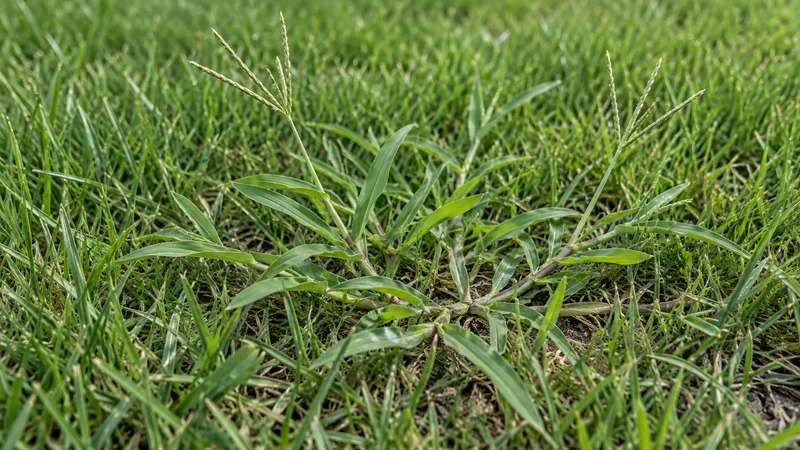
A low, spreading grassy weed is a reason to identify the plant, not sufficient evidence to buy a crabgrass product. Our cover is an illustration and should not be used to identify a specimen. For Nixa homeowners, MU Extension in Christian County offers plant identification and diagnostic assistance. Ask what photographs or samples it needs; include a whole-plant view and the surrounding lawn.
Once the plant and treatment history are known, decide what you need help with: identification, a seed-compatible treatment plan, lawn establishment or ongoing maintenance. Those are different requests. For a Pebble Creek lawn-care inquiry, include the address, affected area, photographs and worksheet. Say explicitly that you intend to seed, even if the appointment is initially about mowing.
The goal is a denser, better-managed lawn, not an ever-longer product list. MU Extension includes appropriate mowing, watering and fertility among the practices that help turf compete with weeds. Our related overseeding and bare-spot guides cover establishment separately; use them after the timing conflict is resolved. Southwest Missouri guidance applies across nearby city boundaries, but your grass, treatment record and repair area determine the actual decision.
Related Lawn Guide chapters
Useful gear for this topic
Compare spreaders only after the treatment plan is settled
An existing suitable spreader may be all you need. If replacing one, compare compact and larger walk-behind models by reliable shutoff, edge control, manageable loaded weight and material-specific calibration instructions. This optional equipment comparison does not recommend a herbicide.
As an Amazon Associate, Pebble Creek earns from qualifying purchases. Your price is not increased. How we choose recommendations.
Walk-behind broadcast spreader
Best for: Choosing practical shutoff and edge control for a measured lawn area after the seed-and-treatment plan has been checked.
Match the exact material label and spreader manual, calibrate the amount and keep granules away from hard surfaces and drains. A generic setting or a larger hopper does not establish the correct rate or seeding compatibility. No firsthand testing of these listings is claimed.See current Amazon options ↗Sources and further reading
- MU Extension: Spring preemergent timing (April 2023 guidance, not current weather) ↗
- MU Extension: Cool-Season Grasses—Lawn Establishment and Renovation ↗
- Scotts Halts: manufacturer label, EPA Reg. No. 538-192 (PDF) ↗
- Scotts Triple Action Built For Seeding: manufacturer label, EPA Reg. No. 538-317 (PDF) ↗
- MU Extension in Christian County: plant identification and diagnostic services ↗
This chapter provides general educational information. Site conditions vary, and product labels and equipment manuals control whenever a product or machine is used.