
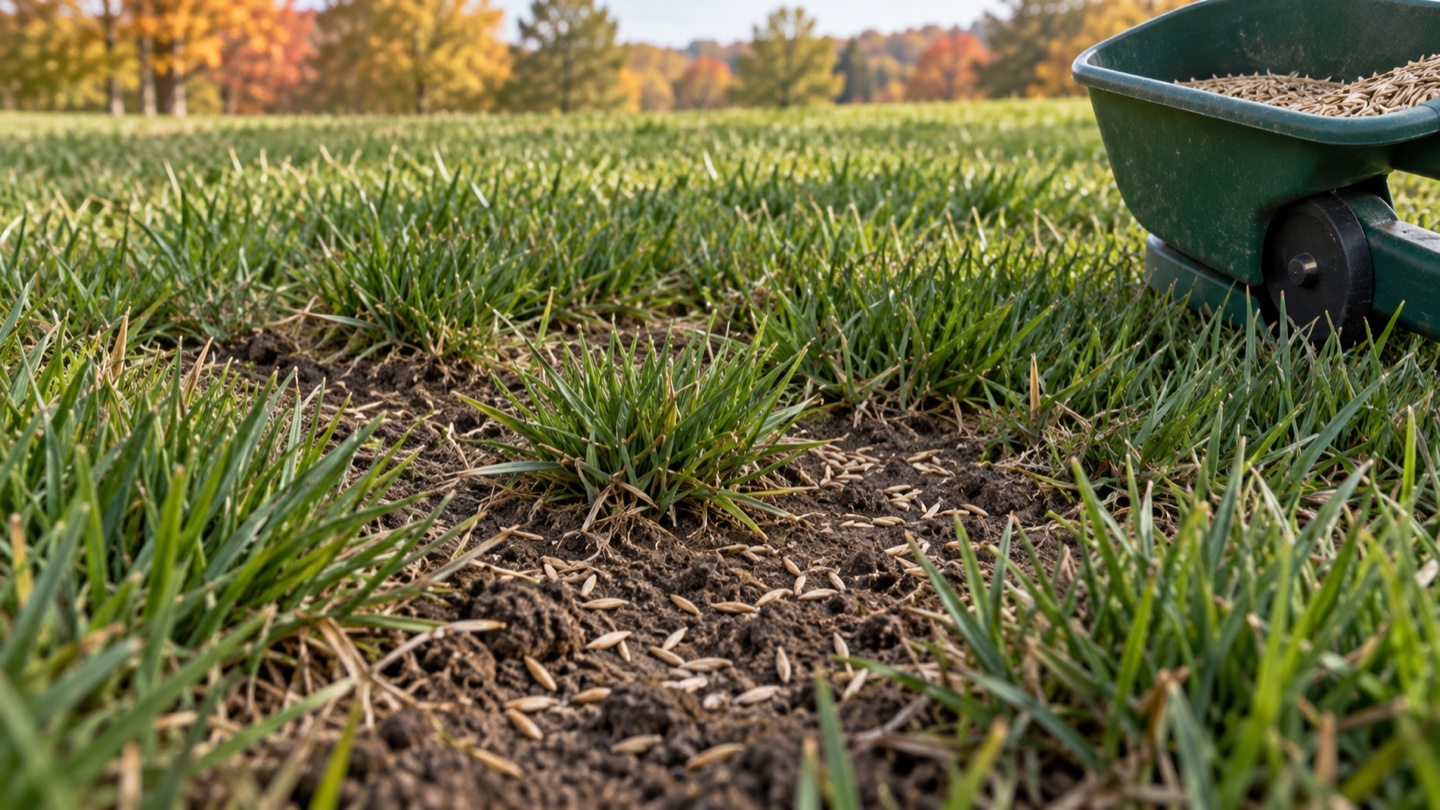
A thin lawn does not always need to be replaced. Overseeding adds grass seed to the lawn you already have, aiming to fill gaps while keeping healthy turf. For Southwest Missouri tall fescue, September is the practical starting point—not a promise that any September day will work. The seed needs prepared soil, dependable moisture, and time to establish. A bag spread over a hard, dry lawn without an aftercare plan is not a complete renovation.
The short answer: plan around September
University of Missouri guidance identifies September as the best month for seeding cool-season lawns. Early fall gives tall fescue an establishment period before winter and another growing season before the next summer's heat. Spring seeding is possible, but young plants face summer sooner and may compete with more germinating weeds.
Use that seasonal advantage without treating the calendar as a guarantee. A September heat wave, saturated ground, or an inability to water can make a particular weekend a poor choice. If it is already late fall, ask for a property-specific assessment rather than assuming extra seed or fertilizer will replace the growing time that has been lost. Our seasonal calendar gives the broader picture; this article focuses on the seeding decision.
Check why the lawn is thin before buying seed
Walk the property and separate living but stressed turf from genuinely bare areas. Note where thinning repeats: under dense shade, beside a downspout, along a worn shortcut, or in compacted ground. Seed cannot by itself fix a continuing drainage or traffic problem. A lawn with healthy coverage may need spot repair rather than blanket overseeding.
For a Pebble Creek estimate, photos of both the whole lawn and the thin spots are more useful than a close-up alone. Tell us which areas receive irrigation and whether you want selected patches repaired or the entire lawn evaluated. This helps define the work instead of treating every brown patch as the same problem.
- Locate the water source and test sprinkler coverage before choosing a service date.
- Keep the names and application dates of recent lawn treatments.
- Plan how people and pets will avoid the seeded areas during establishment.
Prepare a place for the seed to reach soil
Overseeding is not the same as killing and rebuilding an entire lawn. Keep the healthy grass, remove loose debris, and expose soil where seed will be placed. Depending on the condition, preparation may involve light raking, core aeration, or a slit seeder. Thick debris or a dense thatch layer can prevent scattered seed from reaching the soil.
Prepare soil when it is workable rather than muddy or baked hard. MU's establishment guidance emphasizes seed-to-soil contact and shallow coverage, about one-eighth to one-quarter inch; deeply burying lawn seed is not the goal. Follow equipment instructions and identify irrigation heads and other obstacles before mechanized work.
Review herbicide labels before seeding, including weed-and-feed products and preemergents. Reseeding restrictions depend on the exact product, not just whether it was called weed control. Also check when a product may be used on new seedlings. Use a soil test to guide amendments rather than adding lime or multiple fertilizers just because seeding is planned.
Choose the seed by its label, not just its bag
Look for a turf-type tall-fescue blend suited to the site's growing conditions. Read the seed analysis: grass species and varieties, purity, germination percentage, weed seed, and test date. A marketing phrase such as quick repair does not tell you what will actually grow. Compare the label on the exact product you receive, not only a retailer's listing title.
MU's overseeding guidance uses roughly 3–4 pounds of pure live tall-fescue seed per 1,000 square feet. That is not automatically the same as 3–4 pounds of material from any bag: coatings and other ingredients change the relationship. Follow the product's overseeding instructions and account for its seed analysis. Bare-ground establishment is a different rate.
Measure only the lawn area being treated. At a hypothetical labeled rate of 4 pounds of product per 1,000 square feet, a 2,500-square-foot area would need 10 pounds total. Split that total between two crossing passes instead of applying the full amount twice. Calibrate the spreader for the exact seed; a fertilizer setting is not a seed setting.
Water the seedbed differently from an established lawn
Before germination, the surface needs to remain moist without puddles or runoff. Light, frequent watering may be necessary; the right number of cycles depends on weather, soil, shade, and sprinkler output. Check the seeded surface, including sunny edges, rather than copying a neighbor's timer settings. Rain can reduce or eliminate a watering cycle.
After germination, gradually lengthen the interval and water more deeply as the roots develop. Do not abruptly switch tiny seedlings to an established lawn's deep, infrequent routine, and do not keep the ground continuously waterlogged. Check coverage with simple catch containers and adjust for missed corners or excessive overlap.
A scheduled seeding visit is only the start. Decide who will inspect moisture each day and who will adjust watering when the forecast changes. If reliable aftercare is not possible, discuss a smaller repair area or a different plan before investing in seed.
Coordinate mowing and cleanup while seedlings establish
MU's natural lawn-care guidance recommends the first mowing when new grass reaches about 3–4 inches. Use a sharp blade, follow the one-third rule, and wait until the ground can support the equipment without rutting. Avoid abrupt turns that disturb tender grass. Existing grass may grow faster than the new seedlings, so tell the mowing crew exactly which areas were seeded.
Do not let fallen leaves bury the repair area, but avoid aggressive cleanup that pulls out seedlings. Tell everyone maintaining the property that the watering and mowing plan has temporarily changed. Keep a simple record of the seeding date, product, area, and first mowing so future work does not rely on a guess.
A simple plan for a Southwest Missouri property
Before the visit: confirm the thin areas, measure them, check treatment restrictions, choose the seed, and test watering coverage. On the visit: prepare the surface, apply the measured amount evenly, and begin the agreed watering plan. Afterward: check moisture and emergence, coordinate mowing, and review any areas that are not filling in.
For properties around Springfield, Nixa, Ozark, and the surrounding service area, the useful question is not simply whether September has arrived. It is whether this lawn is ready and whether someone can support the seed afterward. Ask Pebble Creek to review the property and clarify the scope of the estimate. The goal is a practical repair plan—not buying more seed than the lawn needs.
Related Lawn Guide chapters
Useful gear for this topic
Compare seed and a spreader for the area you actually need to repair
These two category comparisons support the preparation plan above; they are not products we claim to have used or tested. A suitable spreader you already own may be enough. Check the actual seed label before choosing a blend.
As an Amazon Associate, Pebble Creek earns from qualifying purchases. Your price is not increased. How we choose recommendations.
Handheld or walk-behind seed spreader
Best for: Comparing a handheld spreader for small repair areas with a walk-behind model for larger lawns. Look for controllable flow, a reliable shutoff, and seed-specific calibration guidance.
Check that the spreader handles your exact seed and calibrate it to the label rate. Split the total seed between passes, not a full rate on each pass. A spreader distributes seed but does not create soil contact; we do not claim to have tested these listings.See current Amazon options ↗Turf-type tall-fescue seed blends
Best for: Comparing grass varieties, germination, purity, and the seed analysis on blends intended for lawns. Choose for the property's conditions, not quick-green packaging claims.
Verify the exact seed tag, test date, weed content, and overseeding rate. Coated seed and seed-fertilizer mixes are not equivalent pound for pound to plain seed. Search results may include unsuitable mixtures or forage seed; read the label before buying. These are comparisons, not firsthand product endorsements.See current Amazon options ↗Sources and further reading
- MU: Lawn Seeding Best in September ↗
- MU Extension: Lawn Establishment and Renovation ↗
- MU: Replenish Your Lawn With More Lawn ↗
- MU Extension: Natural Lawn Care ↗
- MU Extension: Home Lawn Watering Guide ↗
- MU Extension: Protecting Water Quality During Lawn Establishment and Renovation ↗
This chapter provides general educational information. Site conditions vary, and product labels and equipment manuals control whenever a product or machine is used.