
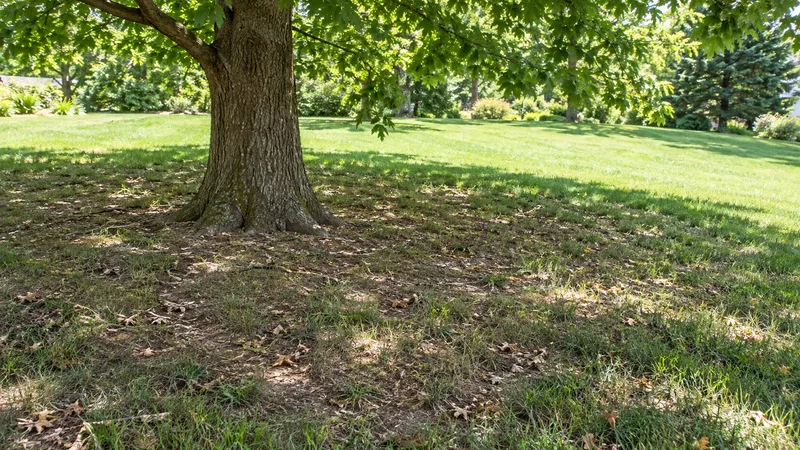
If grass keeps disappearing beneath a tree in your Springfield yard, another bag of seed is not automatically the answer. First decide whether the site can support turf without harming the tree. A small grass trial can make sense in moderate shade; a properly planned mulch bed or shade planting may be a better long-term choice where turf repeatedly fails. Here is how to choose what belongs under the tree.
1. Find the constraint before choosing a surface
MU Extension explains that tree shade changes the light available to grass, while roots compete for water and nutrients. Weak turf can also be affected by wear and accumulated leaves. That does not mean every thin patch beneath a tree has the same cause, or that shade automatically means the soil is wet.
Make a simple sketch showing the trunk, visible roots, thin grass and the nearest healthy turf. Add the route people or pets actually use. Take a wide photograph with the tree in view and a close photograph of the failing area. For our Southwest Missouri lawn-care and landscape planning, these are more useful starting details than a request for the strongest grass seed.
Look at the space with leaves on the tree, not only after fall leaf drop. Record whether it receives direct sun, shifting filtered light or persistent shade. Check whether the ground is dry, damp or holding water before deciding to increase irrigation. These observations are a screening step, not a diagnosis from a photograph.
Also decide what the space must do. A quiet planting bed and the daily shortcut to a gate are different projects. Write down your nonnegotiable need—walking access, open play space, a tidy view or less maintenance—before comparing the choices below.
2. Match the option to the way you use the yard
Use this comparison to narrow the project, not as a promise that one treatment works under every tree. Keep the healthy lawn outside the problem area if it already does its job. You do not need to redesign the whole yard to stop repeatedly repairing one difficult corner.
Before choosing, circle the option you would accept even if the tree canopy stays exactly as it is. That gives you a realistic fallback instead of making the entire plan depend on aggressive pruning.
| What you find | Option to consider | Important limit |
|---|---|---|
| Moderate shade, some surviving turf and light traffic | A small, monitored grass trial | Shade-tolerant seed is not shade-proof; review local species suitability. |
| Repeated turf failure or exposed roots where mowing is difficult | A broad, shallow organic mulch bed | Keep the trunk clear; do not bury roots under a raised mound. |
| An ornamental area with room between roots | A site-matched shade planting | Match moisture and mature size; do not cut roots to fit large plants. |
| A frequently used shortcut through the thin patch | Relocate the route or have an access path assessed | Groundcover is not automatically walkable; excavation near roots needs care. |
| Standing water, tree damage or an unclear cause | Get the problem assessed before installing anything | Seed, mulch and plants do not repair every drainage or tree-health problem. |
3. If you try grass, make it a limited trial
MU lists fine fescues as relatively shade tolerant and turf-type tall fescue as an option in moderate shade. Neither is a guarantee beneath a dense canopy. Ask a Missouri seed supplier or Extension adviser which species and cultivars fit the actual light, moisture and use of your site.
Compare the seed-analysis tag rather than the words dense shade on the front. MU's lawn-management guide identifies species, variety, purity, germination, weed content and test date as useful label information. A forage-type fescue is not the same selection as a turf-type lawn blend. Keep a photograph of the exact bag label with your trial notes.
Measure one manageable area and use the exact label rate for that repair. Record the sowing date, seed mix and care plan. MU favors late-summer to early-fall establishment for cool-season lawns; by mid-October, the remaining establishment window deserves a local check rather than a blanket go-ahead. Do not promise success from the calendar alone.
Keep traffic off the trial while it establishes. Avoid scalping, excessive fertilizer and unnecessary watering in shade. Use our bare-spot repair and soil-moisture guides for those separate tasks. Review the trial through the leaf-on growing season, not just the first flush of germination. If it thins again, revisit the site instead of automatically enlarging the reseeding project.
4. A mulch bed can be the simpler answer
A defined mulch bed removes the expectation that grass must grow right up to the trunk. Maryland Extension describes shallow organic mulch as useful for moisture conservation and protecting trees from mower and trimmer damage. Plan a shape that fits the existing lawn edge and leaves an obvious route for people to walk around it.
For bark or wood chips, that guidance specifies a shallow 1–3-inch layer and keeping mulch about 3 inches away from the trunk. Check the mulch already present before adding more. Keep the root flare visible; do not make a cone against the bark or construct a deep raised bed over the roots.
Wisconsin Extension warns that cutting surface roots or striking them with a mower can seriously harm a tree. Do not rototill under the canopy or shave roots to make the lawn smoother. Discuss any root-zone digging, grading or substantial pruning with a qualified tree professional before work starts.
Ask a contractor to show the proposed bed boundary, preparation method and finished mulch depth in the estimate. Include how existing weeds will be managed and how edging will avoid roots. A drawing and those few specifications make two proposals easier to compare than simply asking for a load of mulch.
5. Choose shade plants for the site—not just the word shade
Groundcover is a living planting, not maintenance-free carpet. Maryland Extension recommends evaluating light, soil moisture, root competition, browsing and spreading behavior. Many groundcovers will not tolerate regular foot traffic. Leave an access route rather than expecting new plants to withstand the same shortcut that wore out the lawn.
Missouri's Department of Conservation lists columbine for shade or sun in average-to-moist soil and cardinal flower for moist sites, with watering needed through dry periods if its site is not moist. These are examples of how different shade plants can be—not a two-plant prescription for every tree. Cardinal flower is not an automatic answer to dry shade.
Choose a planting palette with local advice, checking mature height, spread, moisture needs and invasive behavior before purchase. Ask what the bed will look like after flowering and during winter. Start with the amount you can realistically water and weed while it establishes; a small finished bed is easier to evaluate than scattered plants across the entire canopy.
Wisconsin's root-protection guidance favors small, hand-dug planting pockets between roots instead of tilling. If a plant will not fit without cutting a root, change the placement or choose a smaller plant. Where roots leave no workable space, return to the shallow-mulch option rather than forcing a planting.
6. Turn the choice into a Springfield project plan
Your finished plan should fit on one page: the area to change, the reason, the chosen surface, the root-protection limits and who will handle establishment care. For example, you might keep the healthy outer lawn, convert the root-filled center to a shallow mulch bed and move the walking route around it. That is a planning example, not a claim about a particular customer's yard.
For local identification or soil questions, MU Extension's Greene County services page lists the Master Gardener Hotline Room inside the Springfield Botanical Center at 2400 S. Scenic Avenue. Call 417-874-2963 to confirm current sample and consultation arrangements before visiting. A soil test can inform amendments; it cannot create sunlight.
When requesting a Pebble Creek landscape estimate, send your sketch, photographs, approximate dimensions and preferred option. Tell us whether preserving walking access or reducing upkeep matters most. Include any previous seed attempts so the estimate can address what needs to change rather than repeat the same work.
Springfield is this guide's audience, not a promise of citywide recurring mowing. Landscaping project requests can be assessed through our Springfield landscaping page; routine lawn-care coverage is limited to the listed South Springfield area west of Highway 65 and other published communities. Check the service area for your address.
Keep the baseline photograph and the agreed scope after installation. At follow-up, compare the result with the purpose you chose: usable access, protected roots or a planting that suits the site. A successful project does not have to end with grass beneath every branch.
Related Lawn Guide chapters
Useful gear for this topic
Compare seed only if a grass trial fits the site
Compare the analysis tag on a fine-fescue mixture with a turf-type tall-fescue blend and ask which suits your conditions. Dense-shade marketing is not evidence of local suitability. This optional category comparison is not a tested endorsement; choosing mulch or planting instead may mean buying no grass seed at all.
As an Amazon Associate, Pebble Creek earns from qualifying purchases. Your price is not increased. How we choose recommendations.
Shade-tolerant fescue lawn seed
Best for: Comparing fine-fescue mixtures and turf-type tall-fescue blends for a locally assessed small trial in suitable shade.
Read the exact seed-analysis tag: species, cultivars, purity, germination, weed content and test date. Verify Missouri suitability, light and moisture needs, the correct seeding rate and any treatment or reseeding restrictions. No seed fixes deep shade or root competition, and no firsthand use of these listings is claimed.See current Amazon options ↗Sources and further reading
- MU Extension: Grasses in Shade—light, species suitability and turf-care limits ↗
- MU Extension: Managing Lawns and Turfgrass—seed labels and cool-season establishment ↗
- University of Maryland Extension: Mulching Trees and Shrubs—depth and trunk clearance ↗
- University of Wisconsin Extension: How to Deal with Surface Tree Roots—avoid root injury and tilling ↗
- University of Maryland Extension: Groundcovers—site selection and traffic limitations ↗
- Missouri Department of Conservation: Native Plants for Shade—plant-specific moisture requirements ↗
- MU Extension Greene County: local plant-identification and soil-testing services ↗
This chapter provides general educational information. Site conditions vary, and product labels and equipment manuals control whenever a product or machine is used.