
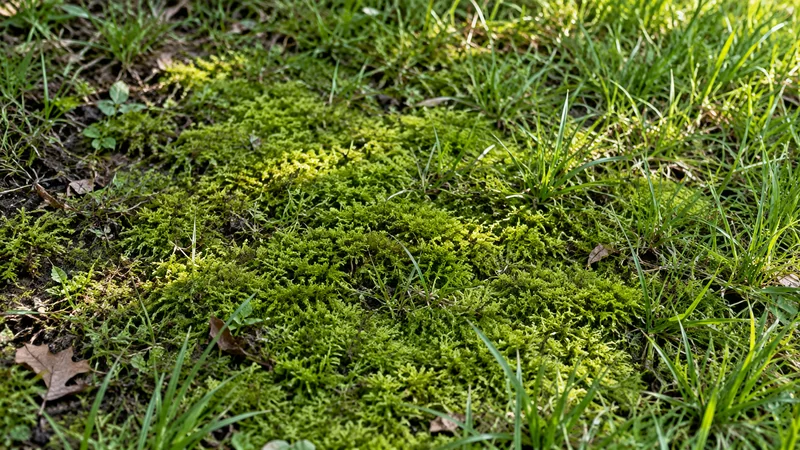
A green moss patch is not a soil-test result. If moss keeps appearing in your Ozark lawn, the useful question is why grass is struggling in that particular spot—not how many bags of lime to spread. Start with a short site inspection, then use a laboratory test for the soil questions. This guide helps you decide what to investigate, what to change and whether that corner should remain lawn.
1. Identify the growth before treating the lawn
Moss forms a low mat of small plants between or in place of turf. Missouri Botanical Garden describes it as nonparasitic: it is not feeding on the grass. A shaded, poorly drained or compacted site can favor moss while putting turf at a disadvantage. Removing the visible mat without addressing the site can leave the same opening for it to return.
Not every green surface growth is moss. University of Maryland Extension distinguishes moss from algae and jelly-like nostoc, which can look quite different when wet. Take a close photograph and a wider view before disturbing the patch. If identification is uncertain, ask an Extension office rather than selecting a product from color alone.
Give the location a name in your phone notes—back fence, north wall or gate corner—and estimate its size. Record whether it is new, expanding or simply more noticeable now that nearby grass is thin. Use the same photograph position on later visits so you can compare a defined area instead of the whole yard.
2. Use a five-part site checklist
Visit the patch at more than one time of day and again after rain or normal irrigation. One sunny afternoon or one wet morning is only a snapshot. The checklist below separates observations from conclusions; several conditions may be operating together.
For each row, write down an observation and one question to resolve. For example: back-fence patch stays wet after the rest of the lawn dries; check whether the sprinkler still reaches it twice. That is more useful than writing bad soil and buying several treatments.
| Check | What to record | What it does not prove |
|---|---|---|
| Light | Direct sun and shade at morning, midday and afternoon; note buildings and leaf cover. | A shade-tolerant seed label does not guarantee grass will grow in deep shade. |
| Water | Where runoff enters, sprinkler overlap and how the patch compares with nearby soil after rain. | Moss alone does not identify a drainage defect or set a watering schedule. |
| Traffic and soil surface | Footpaths, mower turns, exposed roots and a hard or worn surface. | Do not assume every firm patch needs aggressive digging or aeration. |
| Grass care | Grass type, mowing damage, accumulated leaves and previous repair attempts. | A new bag of seed will not correct unchanged growing conditions. |
| Soil report | Sample area, collection date, pH and the lab's lime/nutrient recommendation. | Neither moss color nor a photograph tells you a lime dose. |
3. Test before adding lime—use the Ozark submission route
Some moss occurs in acidic conditions, but different mosses tolerate different environments. Its presence alone does not establish low pH. MU Extension says not to apply lime unless it is recommended by the soil test. Lime changes soil chemistry; it does not create sunlight or remove excess water.
For an Ozark property, MU Extension in Christian County provides a local route for soil testing and plant-problem help. Ask for current submission instructions and explain that you are investigating a mossy lawn area. If the question is identification rather than fertility, ask which photographs or plant material they need instead of sending only soil.
MU's established-lawn sampling guidance uses a 4-inch depth and at least 12 cores from the area being tested, mixed after removing live plant material and thatch. Keep a distinctly different problem area separate from the rest of the lawn. Use a clean plastic collection bucket and follow the receiving laboratory's instructions, including different requirements before seeding.
Label the sample to match your site notes. When the report arrives, keep its recommendation with that patch record. If no lime is recommended, leave lime out of the repair plan. Our related lime guide explains how to read the recommendation; there is no need to repeat a full application calculation here.
4. Correct the limiting condition before removing moss
In shade, MU Extension cautions against overwatering, excessive nitrogen and scalping. Tree roots also compete with grass for water and nutrients, so shaded does not always mean wet. Check the actual soil and existing irrigation pattern instead of giving this area the same extra water as a sunny slope.
If repeat observations point to water collecting at the patch, trace its source. Note a downspout, an overlapping sprinkler or a low area for assessment. Do not respond by piling soil against a building or making an unplanned outlet onto another property. Ask for a drainage evaluation when the appropriate correction is unclear.
Where wear or compaction is suspected, first change the repeated traffic you can control. Maryland Extension describes core aeration as removal of soil plugs; a solid spike is not equivalent. Confirm whether aeration fits the site, season and underground clearance. It is not a substitute for evaluating a larger grading or drainage problem.
Do not cut substantial tree roots or remove a healthy tree simply to rescue a lawn patch. If improved light would help, have appropriate pruning assessed with tree health in mind. When shade cannot reasonably be changed, compare a different planting or mulched bed with another round of turf repair.
5. Remove selectively, then choose repair or a different surface
For a small area where turf is still the goal, manual raking can lift moss. Missouri Botanical Garden also lists lawn-labeled moss-control products, but warns that products intended for roofs or other surfaces are not automatically suitable for grass. Read the exact permitted site, grass restrictions and directions; do not substitute a household cleaning recipe.
Chemical removal is optional, not the first requirement in this plan. Before using any lawn treatment, check protective equipment, access restrictions, application conditions and any reseeding interval on its label. Keep the label and date in your repair record. A product that removes moss has not demonstrated that the underlying problem is solved.
Once the site is suitable, use a repair method and grass matched to the location. Our bare-spot guide covers preparation and establishment care; choose local timing for your grass rather than assuming any mild day is a seeding window. Do not scatter seed over an intact moss mat and call the repair finished.
If turf repeatedly fails in a deeply shaded area, MU suggests shade-tolerant groundcovers or a mulched bed. Maryland also recognizes naturally occurring moss as a possible groundcover. Decide what the space needs to do: support regular access, frame a bed or simply stay covered. The answer need not be the same everywhere in the yard.
6. Keep one simple action plan and review the result
Before spending money, finish this sentence: I am changing ___ because I observed ___. Then list the missing evidence, the person responsible for the next step and when you will check again. A useful plan might be to verify sprinkler overlap, submit the separate soil sample and postpone reseeding until the water question is resolved.
Compare photographs after a similar rain or watering event and as the surrounding grass grows. Record what changed, not just whether the patch looks greener. Moss itself can be green, so color alone is a poor measure of successful turf repair. If the original condition remains, revisit that condition before repeating the same treatment.
For a Pebble Creek landscaping assessment in Ozark, send the wide view, close-up, approximate patch size and your observations. Explain whether you want turf restored or are open to a landscape alternative. Ozark requests are for landscaping and one-time projects, not a promise of routine mowing coverage.
Across Southwest Missouri, this is a property-specific decision. The city name does not tell us your soil pH, drainage or sunlight. A short record and the right test make the next conversation more useful than a guess based on moss alone.
Related Lawn Guide chapters
Useful gear for this topic
Compare a sampling tool only if you need one
A clean shovel accepted by your laboratory may already do the job. If a probe would make sampling easier, compare open-sided and T-handle designs by usable depth, core removal and cleaning access. This is an optional category comparison, not a tested endorsement or a recommendation to buy lime.
As an Amazon Associate, Pebble Creek earns from qualifying purchases. Your price is not increased. How we choose recommendations.
Soil-sample probe
Best for: Collecting consistent cores from the separately labeled mossy area under your laboratory's current lawn-sampling instructions.
A probe collects soil; it does not measure pH or diagnose drainage. Verify usable sampling depth and the tool manual, avoid buried utilities and irrigation lines, and never force it against rocks or hard ground. Follow the laboratory's instructions. No firsthand use of these listings is claimed.See current Amazon options ↗Sources and further reading
- Missouri Botanical Garden: Moss in Lawns—conditions, manual removal and lawn-label cautions ↗
- MU Extension: Soil Testing for Lawns—sampling and test-based lime decisions ↗
- MU Extension: Grasses in Shade—light, turf care and alternatives ↗
- University of Maryland Extension: Improving a Struggling Lawn—moss is not a soil diagnosis ↗
- MU Extension in Christian County: Local soil-testing and diagnostic services ↗
This chapter provides general educational information. Site conditions vary, and product labels and equipment manuals control whenever a product or machine is used.