
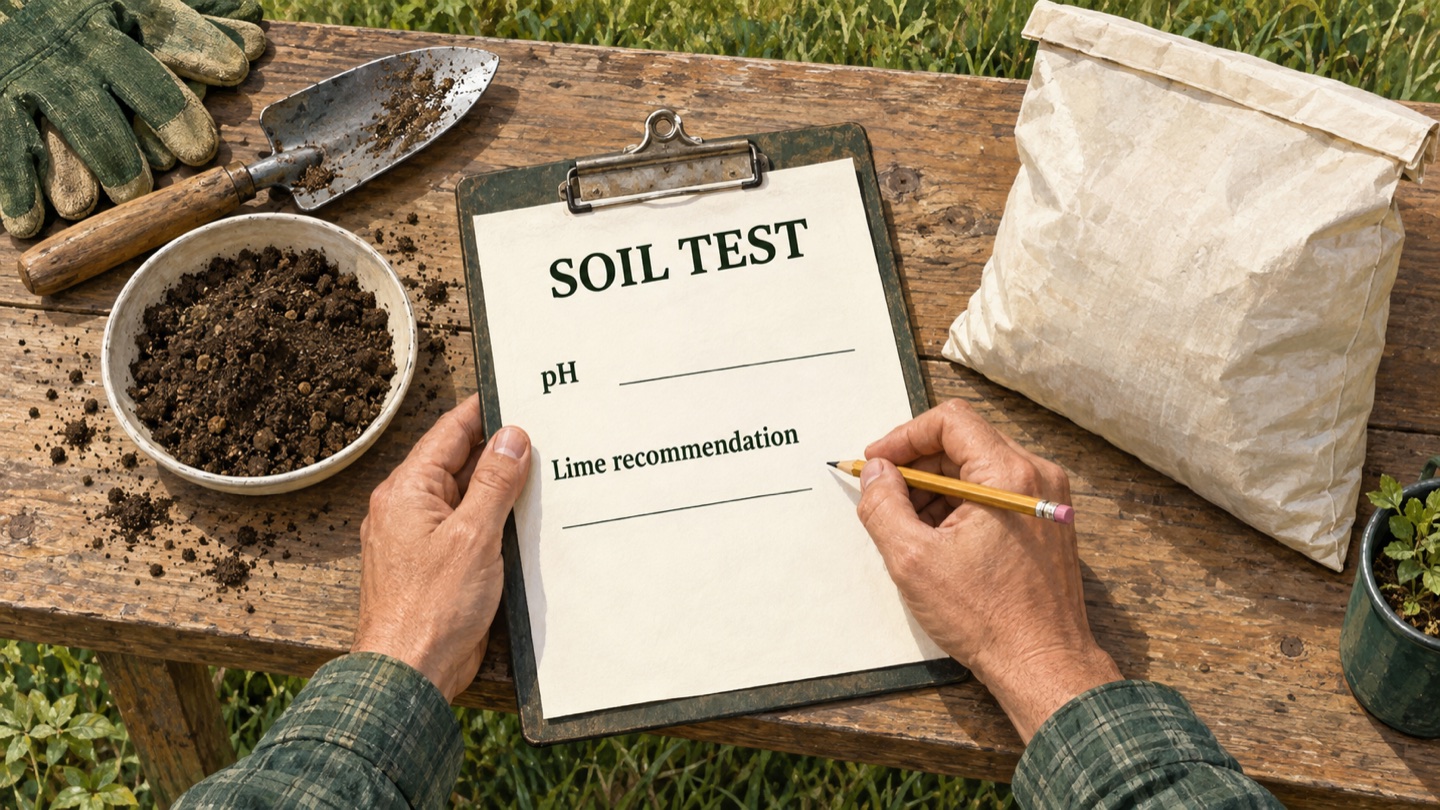
Does a lawn in Nixa need lime every fall? No. The useful question is whether a laboratory soil test recommends it for that lawn. Lime raises soil pH; it is not a general-purpose lawn tonic. Before loading a spreader, use this guide to decide whether to apply anything, what to ask about the report, and what to keep in your property-care records.
Start with a Nixa testing resource, not a shopping list
For Nixa homeowners, MU Extension in Christian County provides a local starting point: its soil-testing service includes fertilizer and lime recommendations. The county services link in the sources below explains the service. Confirm current submission arrangements with the office and ask for a lawn recommendation, not a vegetable-garden or pasture recommendation.
Before contacting the office, write down the grass type if known, which part of the yard concerns you, and any recent fertilizer or lime applications. Ask what information and sample the lab needs. A sample representing a different area cannot answer the question for this one. Our next guide covers collecting a lawn soil sample; this article focuses on the decision after the test.
Read the recommendation before interpreting a single pH number
Check the report's sample name, turf category, lime recommendation and application units together. MU's current reports distinguish soil pH measured in salt solution from a water-pH value. Do not compare one measurement with a target intended for the other. If an online chart and your report seem to disagree, ask the lab to explain its recommendation before changing anything.
Also, soil pH is not a dose calculator. Buffer pH and neutralizable acidity help the lab estimate how much lime a soil needs. Two lawns with similar pH can require different amounts. Use the lawn-specific recommendation and its application limits rather than a rule such as one bag per yard.
Three decisions: apply, skip, or ask
MU's lawn-testing guidance identifies roughly pH 6.0–7.5 as a suitable turf range and advises against lime unless a test recommends it. Read that alongside the measurement method on your report. More lime is not extra protection: raising an already suitable pH can create another problem.
Use these three outcomes to keep the decision straightforward. A zero recommendation is a useful answer, not a failed test. It means the lime budget can stay unspent while you investigate what actually needs attention.
- Apply only when the lawn report recommends lime and you understand the material, quantity and timing.
- Skip lime when the report calls for none. Do not override that because a neighbor treats their yard annually.
- Ask the lab when the sample description is wrong, units are unclear, recent treatment is missing, or the recommendation does not match the area you sampled.
Match the product to the report
Ground agricultural limestone is a common turf liming material. Dolomitic limestone also supplies magnesium and is useful when the report supports that need. Pelletized limestone is ground limestone formed into larger particles for easier handling; the pellet form alone does not prove that it is the right choice or that less is required.
Penn State's turf guidance cautions against quicklime and hydrated lime for turf and explains that gypsum is not a liming material. Product names are not interchangeable. Show the exact label to the lab or your lawn professional if you cannot match its analysis to the recommendation.
Missouri agricultural limestone may be described by effective neutralizing material, or ENM. MU's limestone-quality guide explains that this accounts for neutralizing strength and particle-size effectiveness. An ENM requirement is not automatically the same as pounds of bagged product. Request a conversion for your specific product rather than treating a farm-scale rate as a lawn instruction.
Calculate the lawn area, then plan separate applications if needed
Once the lab or adviser confirms a product rate in pounds per 1,000 square feet, multiply it by the measured treatment area divided by 1,000. Hypothetical example only: a confirmed rate of 20 pounds for a 2,500-square-foot turf area means 20 × 2.5 = 50 pounds of that product. This demonstrates arithmetic, not a recommended rate for your yard. Exclude the house, driveway and landscape beds from the measurement.
For established lawns, MU advises no more than 50 pounds per 1,000 square feet in one application, with cool spring or fall conditions, core aeration and watering-in helping the treatment. Follow any lower limit or other direction on your report and product label. If the total requirement is larger, get a split-application plan; do not apply the whole amount in one pass.
Before work starts, put the report, product label and area measurement together. Have the person doing the application confirm the same area and amount. This avoids the very ordinary mistake of quoting one section of lawn but treating the entire property.
Keep the lime decision separate from fertilizer and sampling
MU's lawn-and-garden testing service provides recommendations by plant group, including cool-season and warm-season turf. Tell the lab what is growing, or ask for help identifying it. A recommendation for lawn grass should not be carried straight into a nearby planting bed.
The lab also calls for separate samples from meaningfully different areas rather than mixing everything into one result. Keep those area names on your treatment notes. If the front yard and back yard have separate reports, do not average the lime recommendations and spread that average everywhere.
Pebble Creek's Nixa lawn-care page covers ongoing property care. For the separate question of when to feed established cool-season turf, continue to guide 3.1 below. Keep its fertilizer calendar separate from this lime decision: a calendar date alone is not permission to add a soil amendment.
Your follow-up checklist
Save a one-page record for the treated area. It should be possible for you, another household member or a future lawn professional to tell what was decided without relying on memory. If the correct decision was no lime, record that too.
Ask the lab when to retest after any recommended correction. Do not schedule another bag simply because the first application did not create an immediate visual change. The next decision should start with the treatment record and follow-up guidance, not another guess.
- Save the sample ID, lawn area and report date.
- Record the recommendation, exact product and measured area.
- Log the actual application date and amount, or note that no lime was recommended.
- Write down any remaining split application and the agreed retest timing.
- Keep photos of the concern with your notes, without using lawn color alone as a pH test.
Related Lawn Guide chapters
Useful gear for this topic
Compare a sampling tool—not a lime prescription
An open-sided probe can simplify soil collection, but a suitable clean shovel you own may be enough. This is an optional category comparison, not a tested-product endorsement. We are not recommending a bag of lime before your report shows a need.
As an Amazon Associate, Pebble Creek earns from qualifying purchases. Your price is not increased. How we choose recommendations.
Soil-sample probe
Best for: Comparing T-handle and open-sided soil probes by core-removal design, usable sampling depth, handle comfort and suitability for your soil. The tool collects a sample; the laboratory interprets it.
Follow the laboratory's lawn-sampling instructions. Check the tool dimensions and manufacturer guidance, avoid buried utilities and irrigation, and never force a probe into hard ground. A probe does not measure pH or calculate a lime dose. No firsthand use of these listings is claimed.See current Amazon options ↗Sources and further reading
- MU Extension: Soil Testing for Lawns ↗
- MU Extension: Christian County soil-testing services ↗
- MU Extension: Understanding Your Soil Test Report (2026) ↗
- MU Extension: Missouri Limestone Quality—What Is ENM? ↗
- Penn State Extension: Liming Turfgrass Areas ↗
- MU Extension: Garden, landscape and lawn soil testing ↗
This chapter provides general educational information. Site conditions vary, and product labels and equipment manuals control whenever a product or machine is used.