
For an established tall-fescue lawn in Southwest Missouri, put the main fertilizer planning in fall—not on a monthly shopping schedule. Spring feeding can be useful, but a bag applied just because the yard looks pale can miss the real problem. Start with the grass you have, the area you actually maintain and what has already been applied. This overview helps you plan the year; the exact product label and your lawn's needs determine each application.
1. Start with the right lawn and a short record
This schedule is for cool-season turf such as tall fescue. Zoysia and Bermuda have a different growth cycle and should not receive the same fall-centered program. If you are unsure what is growing in different parts of the yard, identify those areas before buying a treatment.
Create one record for the property: measured lawn area, grass type, last soil-test date, fertilizer already used and any planned seeding. Ask a lawn-service provider for the product and application date before adding your own bag. Two people following separate calendars can unintentionally treat the same area twice.
- Measure maintained grass, excluding the house, driveway and landscape beds.
- Keep the exact product label or a readable photo, not just the brand name.
- Record amounts and areas separately when the front and back lawns receive different care.
2. Use this fall-first seasonal schedule
MU Extension's calendar is a starting point, not a promise that the same date fits every Nixa, Ozark or Springfield lawn. Its timing is approximate for central Missouri and can shift by two weeks or more with location and weather. Use the following checkpoints to decide what needs attention.
- Winter: review records and plan testing; do not apply to frozen or snow-covered ground.
- Early to mid-April: consider a lighter feeding only if needed. MU lists a reduced spring rate of about 0.5–0.75 pound of actual nitrogen per 1,000 square feet; a good fall program can remove the need for this application.
- Late spring and summer: avoid chasing quick color with heavy nitrogen. Do not feed heat-stressed or dormant turf as though fertilizer will wake it up.
- September: prioritize the main fall feeding once the lawn is growing and conditions allow. This is MU's preferred window if only one annual application is planned.
- October: reassess the lawn and previous applications; mid-October is an opportunity for a second fall feeding when the program calls for it.
- November: a later application may fit some programs, but it is not an automatic extra bag. Review total nutrients, turf activity, weather and label directions first.
3. Why more spring growth is not always better
MU's turf specialists warn that late-spring nitrogen can favor rapid leaf growth over deeper rooting and increase the risk of diseases such as brown patch and Pythium blight. A dramatic green-up is not the same thing as preparing tall fescue for a hot Missouri summer.
Do not convert every thin or off-color spot into a fertilizer request. Note whether the issue follows shade, traffic, standing water or a dry area. Tell your provider when it started and whether the entire lawn changed or only one patch. That makes the next visit more useful than simply asking for something stronger.
For a practical maintenance plan, decide what level of appearance and growth you can support with mowing and watering. A program should fit that goal. Keep the summer-heat and dormancy guides alongside this one so the feeding schedule does not work against the rest of the lawn's care.
4. Use a soil test for the nutrients it can actually assess
MU recommends routine testing on established lawns about every three years, with more frequent testing when correcting a deficiency or changing pH. A laboratory report helps evaluate phosphorus, potassium and acidity. It is not a direct, stable measurement of the season's nitrogen requirement; nitrogen planning also depends on grass type and management.
Use the report to choose what is missing rather than assuming a bag with all three nutrients must be better. MU's discussion of incomplete fertilizers explains why established turf may need nitrogen without additional phosphorus. Organic-based products can contain phosphorus too, so the word organic does not remove the need to read the analysis.
If you plan to seed, say so when requesting recommendations. Establishment and routine maintenance are different situations. Save the report with your service records, and ask for any unclear recommendation to be explained in pounds of nutrient and pounds of product for your measured area.
5. Turn the nitrogen target into the right amount of product
The three bag numbers give percentages by weight of nitrogen, phosphate and potash. Pounds of fertilizer are not pounds of nitrogen. To calculate product amount, divide the desired nitrogen rate by the nitrogen percentage written as a decimal, then multiply by the number of 1,000-square-foot units you will treat.
For a math example—not a prescription—suppose an appropriate plan calls for 0.5 pound of nitrogen per 1,000 square feet and the selected fertilizer contains 20% nitrogen. The calculation is 0.5 ÷ 0.20 = 2.5 pounds of product per 1,000 square feet. A 4,000-square-foot lawn would need 10 pounds of that product, provided its label permits that application.
Changing to a different analysis changes the product amount. Do not reuse last season's scoop count or spreader setting without checking. Keep a running nitrogen total from every fertilizer-containing treatment, including combination products, and compare it with the agreed annual plan.
6. Compare products and calibrate before applying
Quick-release and slow-release nitrogen behave differently. Slow-release sources generally supply nitrogen over a longer period, while readily soluble sources are available more quickly and can burn turf more easily when misused. Read the guaranteed analysis and release information; bag color and words such as winterizer do not explain what is inside.
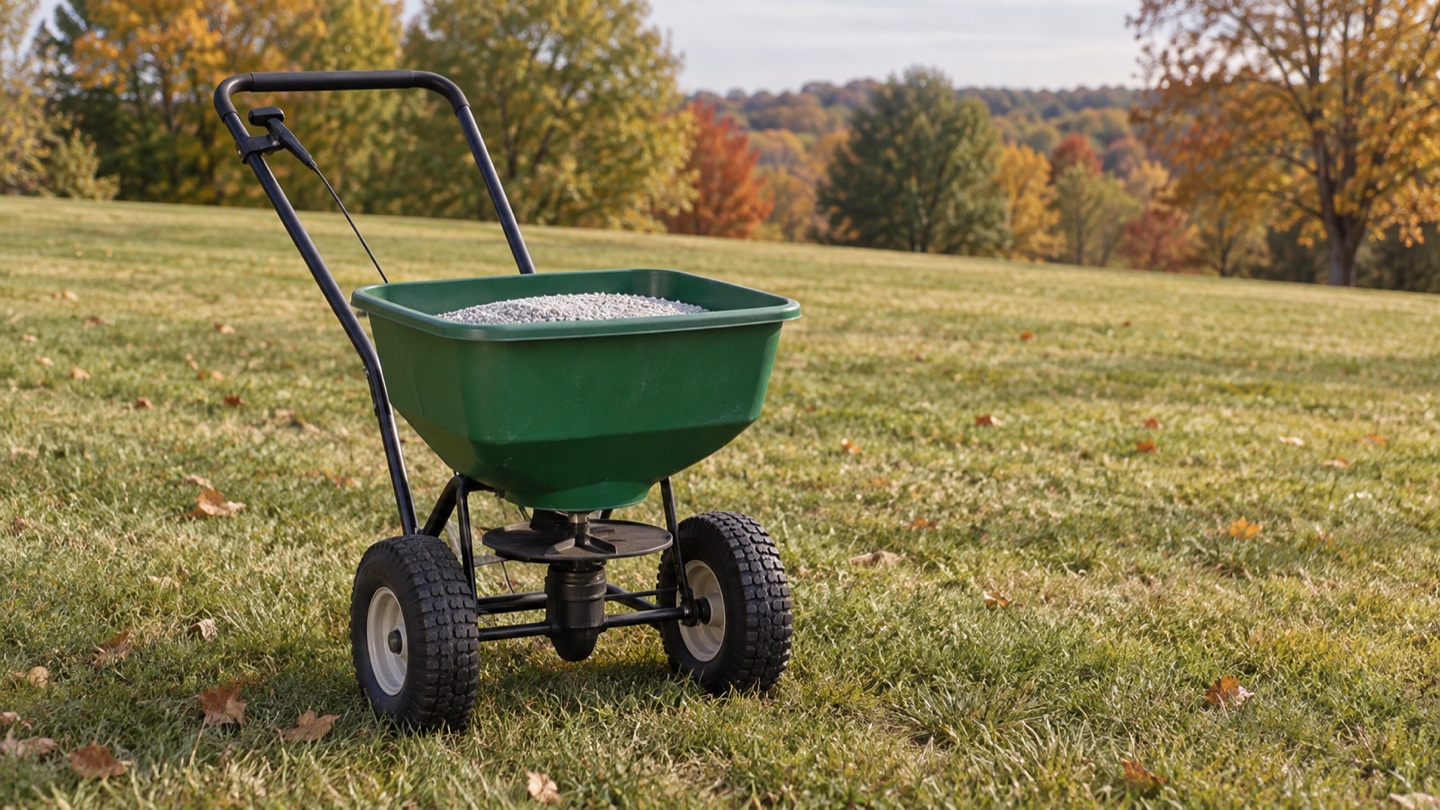
For the spreader, look for a reliable shutoff, controllable edges and clear calibration instructions. Check the manual for the exact machine and the label for the exact material. A dial number is not a universal application rate. The comparisons below help you examine those features; they are not claims that Pebble Creek has tested the listed products.
Plain fertilizer and weed-and-feed are not interchangeable. If a product contains an herbicide, verify the target weed, grass suitability, seeding restrictions and all application directions before choosing it. Do not add a weed treatment merely because it comes in the same bag.
7. Make application day and follow-up part of the plan
Postpone when the ground is frozen, snow-covered or saturated, or when heavy rain could move material off the lawn. Follow the product's watering-in instructions rather than assuming a downpour is helpful. Keep granules out of drains and off pavement; collect spills instead of washing them into the street.
Write down the date, measured area, product analysis, quantity and any change from the original plan. Afterward, compare growth and mowing needs rather than judging only the immediate color. Before the next feeding, check the record so a delayed treatment does not get followed too closely by the next scheduled one.
For a Pebble Creek estimate, include your location, grass type if known, lawn area, recent treatments and whether you want ongoing care or help with a specific concern. Share a soil report if you have one. The next article covers lime: what it changes and why it belongs in a soil-based decision, not an automatic annual routine.
Related Lawn Guide chapters
Useful gear for this topic
Compare fertilizer labels and spreader control
Choose a nutrient plan before shopping. These are category comparisons, not firsthand product endorsements. Reuse a suitable spreader you own; an Amazon result does not establish that a fertilizer fits your soil, grass or season.
As an Amazon Associate, Pebble Creek earns from qualifying purchases. Your price is not increased. How we choose recommendations.
Walk-behind broadcast spreader
Best for: Comparing compact and larger walk-behind models by shutoff reliability, edge control, calibration instructions and manageable loaded weight for your measured lawn.
Use the exact spreader manual and fertilizer label. Calibrate with the chosen material; settings and swath widths are not universal. Avoid skips, overlapping excess, pavement and drains. No firsthand testing of these listings is claimed.See current Amazon options ↗Lawn fertilizer matched to your nutrient plan
Best for: Comparing guaranteed analysis, slow-release nitrogen content, labeled grass types, coverage and application intervals rather than judging by bag size or a seasonal marketing name.
Read the exact label before purchase and application. Match nutrients to the lawn plan and soil report; check for added herbicides and reseeding restrictions. Search results can include unsuitable combination products. No exact product is claimed to be tested or right for every lawn.See current Amazon options ↗Sources and further reading
- MU Extension: Cool-Season Grasses—Lawn Maintenance Calendar ↗
- University of Missouri: Seeding and Fertilizing Missouri Lawns ↗
- MU Extension: Soil Testing for Lawns ↗
- University of Missouri: The Case for Taking an Incomplete ↗
- Penn State Extension: Turfgrass Fertilization—A Basic Guide ↗
- MU Extension: Managing Lawns and Turfgrass ↗
This chapter provides general educational information. Site conditions vary, and product labels and equipment manuals control whenever a product or machine is used.