
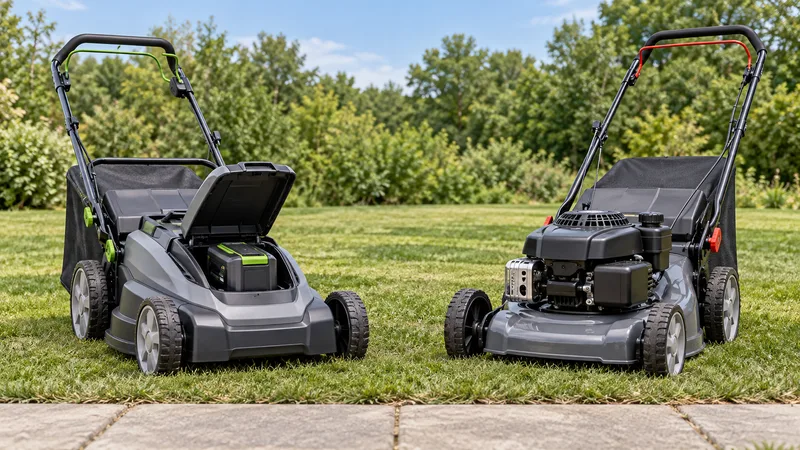
Battery equipment is a strong option when its usable runtime and charging plan cover the job you actually need to finish. Gas can remain practical for long sessions or work away from a dependable charging location. A mixed setup can make sense too: you do not have to replace a good mower just to switch your trimmer. For Southwest Missouri properties, compare the whole work session rather than choosing a side in a battery-versus-gas argument.
Write down the job before choosing the power source
Time mowing, trimming and blowing separately over a few representative visits. Record the amount of work, the conditions, whether you bag or mulch, and the time you spend moving equipment. A neat lawn maintained regularly and an overgrown property are different jobs even if their acreage is identical. Use a demanding normal visit for planning, not your easiest cut of the year.
Pebble Creek's recurring mowing work is organized around visits across properties. That makes finishing the day's route important to us. A homeowner working at one address may instead be comfortable splitting a longer session. Our scheduling needs are not a reason for every homeowner to buy a professional gas machine or a large battery fleet.
On your Southwest Missouri checklist, include the practical seasonal questions: what happens when you miss a cut, when the lawn needs more passes, and when fall cleanup adds blower work? Also measure gates, storage space and turning areas. Power source does not fix a mower that is too wide, difficult to handle or unsuitable for a slope. The related mower-selection guide covers those property-fit decisions.
Treat advertised runtime as a condition—not a guarantee
One current manufacturer example makes the issue concrete. As checked October 22, 2026, EGO lists up to 60 minutes of runtime for its LM2135SP with the recommended 7.5Ah battery, and approximately 60 minutes to charge that battery with its Rapid Charger. Those are the manufacturer's figures for that configuration, not Pebble Creek measurements or a promise for every lawn.
The same product family includes differently equipped kits and a tool-only version. Compare the exact model suffix, included battery and charger, cutting setup and manufacturer's runtime conditions. A listing that says 60 minutes without identifying the battery is missing information you need. Check what the warranty covers for your intended use, including the battery separately.
Do not turn an advertised maximum into a tightly packed schedule. If your mowing normally takes 55 minutes, a claimed maximum of 60 does not establish that one charge is enough with reserve. Ask for a suitable demonstration or a clear return policy and verify runtime on your actual task. A test on short dry grass does not settle a heavy cleanup question.
Compare battery capacity within a documented compatible system rather than ranking tools by the largest voltage printed on the box. Amp-hours alone are not a cross-platform performance score. The useful purchase question is how much of your work the specified tool-and-pack combination completes, at an acceptable pace and finish.
Plan the battery queue across every tool
Shared batteries can reduce duplicate purchases, but sharing does not create extra runtime. If the mower drains the only compatible pack, the trimmer cannot use that pack while it is charging. Nor does the same brand name guarantee interchangeability: STIHL explicitly says AK and AP batteries cannot be swapped between those two tool systems. Confirm the tool, pack and charger model numbers together.
The worksheet below is a deliberately hypothetical plan for one person with two interchangeable packs. Assume each pack provides 40 usable mowing minutes, takes 60 minutes to recharge, and starts fully charged. These are made-up planning inputs, not the EGO figures above, measured results or a recommendation for a specific kit.
Pack A runs from minute 0 to 40, then charges until minute 100. Pack B runs from minute 40 to 80. If the job needs 100 mowing minutes, there is a 20-minute charging gap before the last 20 minutes can be cut. The mower finishes at minute 120, not minute 100. A third compatible charged pack or a longer planned break could change that timeline; price the actual solution.
A cooling delay, unavailable outlet or slower charger makes the gap longer. EGO's published hot/cold charging troubleshooting illustrates why a pack may wait for an acceptable temperature before charging begins; check your own model's instructions. Do not count on charging in a vehicle or at a customer's outlet unless the equipment, electrical supply and permission are all suitable.
Add trimming and blowing as separate rows using their own observed pack consumption. Forty mower minutes do not mean forty blower minutes. If two people work simultaneously, each tool needs its own available compatible power source. Ask whether a multi-port charger charges packs together or in sequence before assuming it solves the problem.
| Elapsed time | Mowing | Battery position |
|---|---|---|
| 0–40 minutes | 40 minutes on pack A | Pack B remains fully charged |
| 40–80 minutes | 40 minutes on pack B | Pack A charging; ready at minute 100 |
| 80–100 minutes | 20-minute waiting gap | Both packs depleted or charging |
| 100–120 minutes | Final 20 minutes on pack A | Pack B can charge if an appropriate charger is free |
| Total | 100 mowing minutes | 120 elapsed minutes before trimming or cleanup |
Compare noise and maintenance without overselling either option
Battery does not mean silent or automatically safe without hearing protection. A NIOSH-authored landscaping field study published in 2025 found lower noise exposure with battery versions of several handheld tools, but mean exposure during battery blower, string-trimmer and hedge-trimmer tasks still exceeded its recommended limit. That is evidence from the studied tasks—not a decibel rating for every mower or a guarantee about your exposure.
Read each tool's protective-equipment instructions and compare noise specifications measured on the same basis. A bystander sound-pressure figure and an operator-ear measurement are not interchangeable. Keep considerate work hours even if a tool sounds quieter; this guide does not claim any city-specific noise exemption.
Battery tools remove the gasoline-engine service tasks from that tool, but blades, guards, cutting line, fasteners and cleaning still need attention. Budget for the work both systems share. Ask about replacement packs and service support instead of assuming a battery tool is disposable or maintenance-free.
Gas equipment needs the correct fuel and its engine-specific service routine. Briggs & Stratton's mower fuel guidance permits gasoline with no more than 10% ethanol for its covered small engines and rejects E15–E85. Follow the exact equipment manual: a four-cycle mower and a two-cycle trimmer do not necessarily use the same fuel preparation. Do not improvise a mixture or treat fuel treatment as a cure for a neglected engine.
Include charging space, storage and replacement costs
Before buying, identify a dry, suitable charging location and read the battery and charger manuals for temperatures, ventilation, electrical supply and supervision. Do not assume an enclosed trailer or unconditioned shed will stay within the specified limits. Use approved batteries and chargers; an adapter that physically fits is not proof of an approved combination.
Storage instructions can differ by platform and battery type. STIHL's US removable-battery guide, for example, recommends a clean, dry pack out of sunlight and gives 50–68°F and a partial charge as its preferred long-term conditions. That is an example to check against your exact manual, not a universal target for every brand or a rule to store all packs fully charged.
Do not charge or keep using a damaged pack. Get instructions from its manufacturer and the receiving recycling facility. EPA says lithium-ion batteries do not belong in household trash or curbside recycling; damaged batteries need special handling advice. Arrange the proper route rather than dropping a questionable pack into a general collection box.
Price a complete usable system: tool, required packs, charger, any extra charging capacity, protective equipment, service and eventual replacements. For gas, include fuel, approved storage equipment and engine maintenance. Use your actual electricity rate and measured charging energy if estimating operating cost. There is no honest universal payback period without purchase quotes, usage and replacement assumptions.
A simple purchasing sheet should list the ready-to-work total, expected work per session, recharge or refueling interruption, local repair route, and separate battery/tool warranty terms. A lower bare-tool price may not be the lower finished-system cost. You do not need a new battery storage organizer if your existing arrangement already meets the manufacturer's instructions.
Choose a setup that finishes your work—not a universal winner
For a homeowner who can complete mowing with reserve and charge between visits, a compatible battery mower, trimmer and blower can be worth comparing. Verify the actual kit contents and handling with the battery installed. For short touch-ups, a battery handheld tool may fit well even when the main mower remains gas.
For larger properties, multiple addresses or long uninterrupted sessions, compare a proven pack-and-charger rotation against a suitable gas setup. Professional battery systems exist; the right question is whether the exact system and infrastructure cover the workload. Conversely, owning gas equipment does not remove the need for safe refueling breaks, maintenance or a backup plan.
Keep a mixed setup when it solves the real constraint. For example, a hypothetical owner may retain a reliable gas mower while replacing a hard-starting trimmer with a compatible battery kit. Another may choose battery mowing but hire out unusually heavy cleanup. These are decision examples, not claims about Pebble Creek customers or products we tested.
Take your workload sheet and charging timeline to the dealer. Ask them to identify the exact tool, packs and charger that satisfy it, then check the manuals and written quote. If buying another system is not the best use of your time, use Pebble Creek's service-area page and request an onsite estimate for mowing or project help.
Related Lawn Guide chapters
Useful gear for this topic
Compare a complete system—not just a bare-tool price
This optional category comparison supports the workload worksheet. Keep equipment that already fits your needs, and check the exact manufacturer specifications before buying. Pebble Creek has not tested the products in these search results.
As an Amazon Associate, Pebble Creek earns from qualifying purchases. Your price is not increased. How we choose recommendations.
Battery mower kits with battery and charger
Best for: Comparing documented tool, battery and charger combinations against your workload sheet, including kit contents, compatible handheld tools and charging gaps.
Verify the exact model suffix, included pack count and capacity, charger, runtime conditions, terrain limits and warranty for your use. Same-brand batteries may belong to incompatible systems. Search results can include bare tools or unrelated products. Use approved batteries and chargers; no adapters or universal fit assumed. No firsthand testing, measured runtime or brand-wide recommendation is claimed.See current Amazon options ↗Sources and further reading
- EGO: LM2135SP runtime, kit configurations and charge-time specifications ↗
- STIHL: AK and AP tool-system battery compatibility ↗
- EGO support: hot/cold battery charging limitations ↗
- NIOSH authors: landscaping exposure study, published 2025 ↗
- Briggs & Stratton: mower fuel selection guidance ↗
- STIHL USA: battery storage guidance and manual limitations ↗
- US EPA: used lithium-ion batteries and disposal precautions ↗
This chapter provides general educational information. Site conditions vary, and product labels and equipment manuals control whenever a product or machine is used.