
Start a mower shortlist with the yard, not the machine on sale. A mower that cannot fit the gate, safely handle the terrain or be stored at home is the wrong purchase even if its advertised capacity looks impressive. For a Southwest Missouri homeowner, the useful question is: which machine can handle my actual mowing route, and what will owning it require?
Measure the lawn you actually mow
Your property’s acreage is not the same as its mowable area. Sketch the grass separately from the house, driveway, beds and wooded ground. Divide irregular lawns into rough rectangles and record their dimensions. The estimate does not need survey accuracy; it needs to distinguish a mostly open mowing area from several small areas connected by narrow passages.
Next, walk the route from storage to every section of lawn. Measure the narrowest clear gate opening, not the distance between fence posts. Include turns beside sheds, raised edging, tree roots, retaining walls and places where a mower would need to reverse. Photograph troublesome access points for the dealer. A broad front lawn does not cancel out a tight backyard gate.
Record how long mowing takes now and separate cutting time from trimming, moving obstacles and handling clippings. If most of an hour goes into working around beds and toys, a larger deck will not remove those tasks. Use your current routine as a baseline rather than relying on an advertised acres-per-hour figure.
Fill out this six-point mower-buying worksheet
Take this worksheet to a dealer or keep it beside you while comparing exact model specifications. Put a question mark beside anything you have not measured or confirmed. An unanswered safety or access question is a reason to postpone the purchase, not to assume the machine will work.
Treat the first three rows as pass-or-fail checks before comparing convenience features. The remaining rows help decide whether a machine you can use is also a machine you can comfortably own. Save a copy of the specification sheet and the relevant operator’s manual with your notes.
| Check | Write down | Verify for the exact model |
|---|---|---|
| Usable lawn | Grass area, obstacles and separate sections | A practical cutting route, not just total property acreage |
| Gates and turns | Narrowest clear opening and turning space | Overall operating width, discharge equipment and attachment clearance |
| Terrain | Slopes, ditches, wet areas and drop-offs | Manual restrictions and whether some areas need another method |
| Storage and transport | Door width, floor space and repair transport | Stored dimensions, permitted storage position and loading requirements |
| Work session | Available mowing time and normal grass conditions | Fuel or battery plan, interruption tolerance and control comfort |
| Ownership budget | Purchase ceiling plus recurring costs | Required accessories, maintenance, replacement parts and service support |
Shortlist mower types without skipping the safety check
A push mower relies on you to move it; a self-propelled walk-behind adds powered forward movement. Both deserve a look when storage and access matter. A lawn tractor or zero-turn may belong on the shortlist for a more open property, but neither earns a place just because the yard is large. Commercial stand-on and walk-behind equipment adds another set of storage, transport and ownership questions.
Match the exact machine to the terrain using its manual. Do not transfer a slope limit from another model or assume a walk-behind makes every bank safe. Toro’s zero-turn guidance highlights wet slopes, drop-offs and unstable ground as hazards. If a section cannot be mowed safely, plan an appropriate alternative rather than buying more speed or assuming extra traction solves it.
Keep required guards and shields in place. A deck’s advertised cutting width is not necessarily the mower’s overall operating width, especially with discharge or collection equipment fitted. Ask the dealer to demonstrate the configuration you intend to use. Removing a guard to squeeze through a gate is not an acceptable fit solution.
Three hypothetical shortlists show the difference: a compact fenced yard may lead you to compare push and self-propelled machines; a large, open, suitable site may justify comparing a tractor and zero-turn; a mixed yard with a difficult bank may need separate mowing and non-mowing solutions. These examples are starting points, not acreage rules or safety approvals.
Choose a power plan that fits your mowing session
For a battery model, verify exactly which batteries and charger are included and which are compatible. Ask about expected operation in grass like yours, recharge time, replacement availability and the manufacturer’s charging and storage instructions. Do not assume two batteries from the same brand fit every tool or that an advertised maximum runtime describes your lawn.
EGO’s support guidance notes that cutting height and grass conditions affect runtime. Use that as a reason to ask better questions, not as a promise about a different model. A plan that works during light growth may need more capacity during heavier cutting. Decide whether a charging break is acceptable before paying for extra equipment.
For gasoline equipment, write down the specified fuel, routine maintenance and safe storage needs from the manual. CPSC advises against refueling a hot engine. Include time for maintenance in your comparison, not just time spent cutting. Whichever power source you choose, obtain the manual before purchase and confirm that its care requirements fit your home.
Compare ownership costs, not just the checkout price
Make a separate list for the machine, necessary accessories, initial safety equipment, routine service and eventual replacement parts. Ask for current quotes for the exact mower’s blades, belts where applicable, batteries and charger where applicable, and pickup or delivery for repairs. A cheap machine becomes less convenient when the only repair option is difficult to reach.
Compare both candidates over the same period and expected use. Your worksheet can simply read: purchase plus required equipment plus planned maintenance plus a replacement allowance. Keep uncertain costs marked as estimates. Do not treat a battery, engine or transmission replacement as certain on a made-up timetable, and do not compare one mower’s bare-tool price with another’s complete kit.
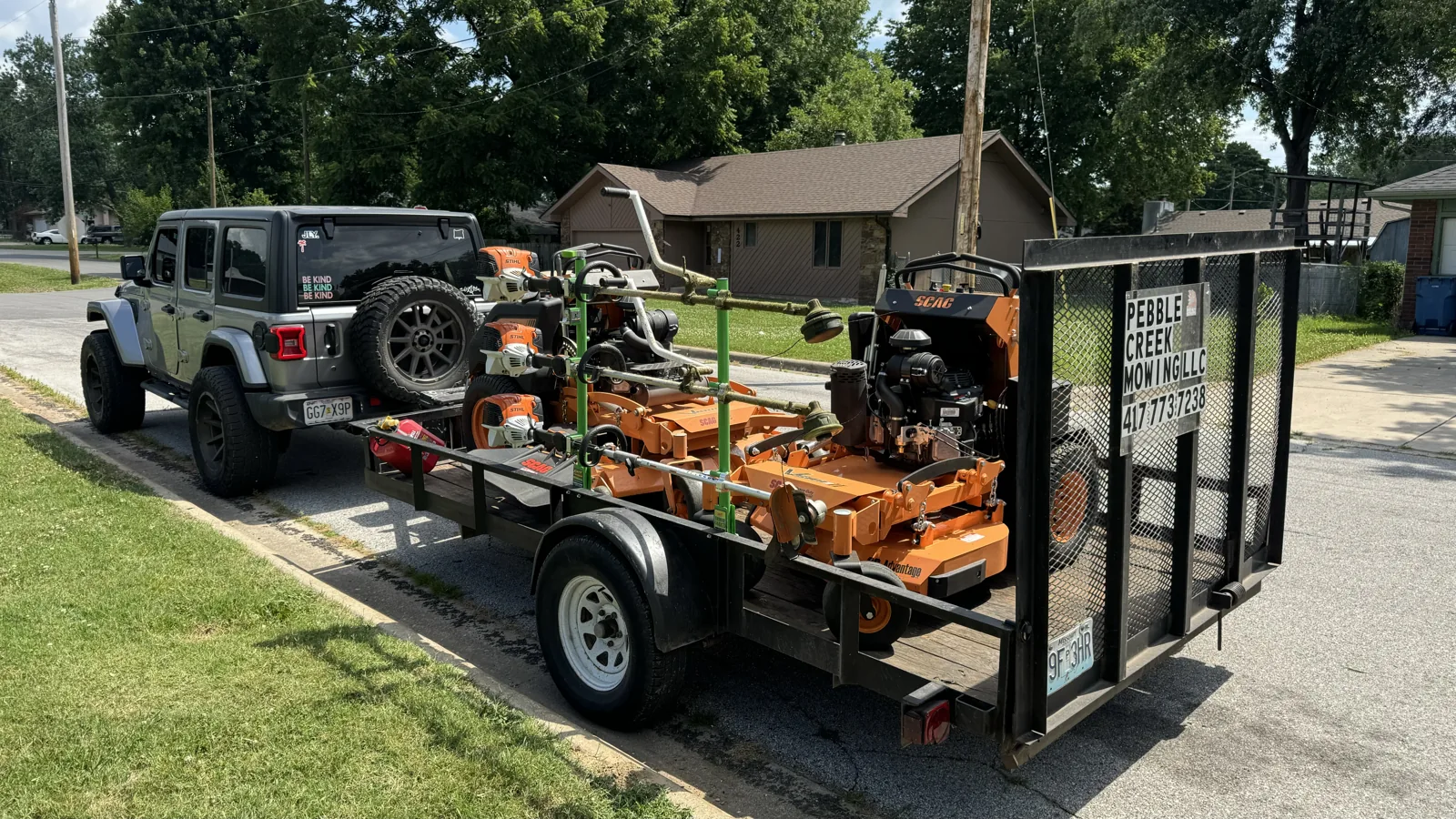
Our original Pebble Creek equipment photo shows a commercial setup with transport space devoted to mowers and trimmers. That is useful context, not a recommendation that a homeowner buy the same equipment. Consider where your mower will live, how you will get it serviced and whether you actually need equipment designed around route work.
Leave with two qualified candidates and a service plan
Ask the seller to identify who handles warranty work, where routine service is available and how parts are ordered for the exact model. Confirm the warranty terms for your intended use rather than assuming every product under one brand has the same coverage. Check blade access and the manufacturer’s maintenance procedure; arrange professional service if that work is outside your comfort level.
Have the seller explain the controls and permitted adjustments with the machine safely stopped. Any operating demonstration should follow the manual in a suitable location. Bring the footwear you normally mow in, check whether the controls are comfortable and ask about visibility and safe mounting where relevant. Comfort is worth assessing before an expensive delivery.
Budget for suitable eye and hearing protection as directed by the mower’s instructions. CPSC recommends safety glasses and keeping bystanders clear. NIOSH emphasizes hearing-protection fit: earmuff seals can be affected by eyewear, and ordinary noise-canceling earbuds are not automatically hearing protectors. Choose equipment you can wear correctly, not simply the largest rating on a listing.
Finish with two models that pass your worksheet and write down why each remains. Then compare the smaller differences: control feel, collection needs, support and total cost. Once the mower is chosen, sensible mowing frequency and sharp blades still matter. The related guides below cover those habits; buying a different machine is not a substitute for them.
Related Lawn Guide chapters
Useful gear for this topic
Compare protection before the first mow
These are optional category comparisons, not tested product endorsements. Compare clear and tinted eye protection for your visibility needs, and earmuff designs for comfort and fit with your eyewear. Follow the mower manual’s required protection; an existing suitable set may be all you need.
As an Amazon Associate, Pebble Creek earns from qualifying purchases. Your price is not increased. How we choose recommendations.
ANSI-rated safety glasses
Best for: Finding comfortable eye coverage compatible with prescription eyewear and the mower’s protection requirements.
Verify the exact manufacturer’s impact-rating documentation, coverage and fit rather than relying on an Amazon search title. Ordinary sunglasses are not a substitute for required protective eyewear. No firsthand testing of these listings is claimed.See current Amazon options ↗Hearing protection for outdoor power equipment
Best for: Choosing hearing protection that fits securely and can be worn consistently during noisy equipment use.
Check the manufacturer’s noise-reduction rating and fitting instructions. A package rating is not a guarantee of your actual protection; eyewear can break an earmuff seal. Ordinary noise-canceling earbuds are not necessarily hearing protectors. No firsthand testing of these listings is claimed.See current Amazon options ↗Sources and further reading
- Toro: Residential walk-behind mower types ↗
- Toro: Choosing commercial mower types ↗
- Toro: Zero-turn mower safety ↗
- CPSC: Rotary power mower safety tips ↗
- NIOSH: Hearing protection selection and fit ↗
- EGO: Grass conditions and mower runtime ↗
This chapter provides general educational information. Site conditions vary, and product labels and equipment manuals control whenever a product or machine is used.