
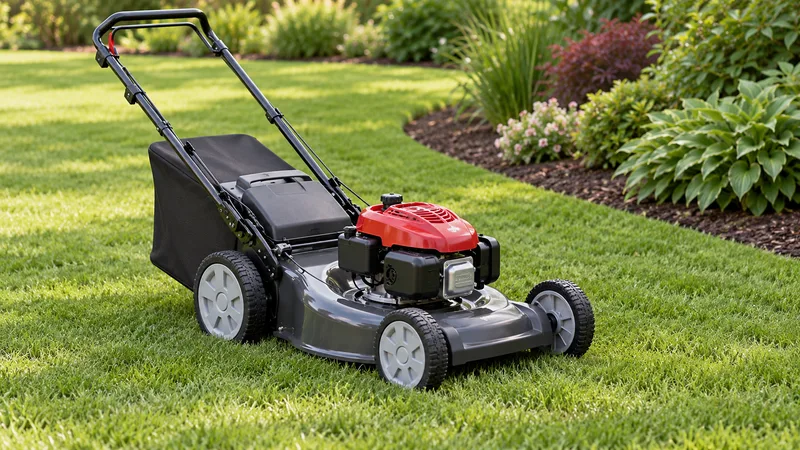
A self-propelled mower helps move its own weight across the lawn. A push mower leaves that work to you. That makes self-propelled models worth considering when long passes wear you out—but it does not automatically make one easier around every tree, bed or fence. Choose for the part of mowing that actually gives you trouble.
Start with the difference: powered wheels, not automatic steering
Here, push mower means a powered rotary walk-behind with no powered wheel drive. The engine or motor turns the blade while you propel the machine. A self-propelled walk-behind adds powered wheels; you still walk behind it, steer and operate its controls. A manual reel mower is a different comparison.
Gas versus battery is a separate decision from push versus self-propelled. Do not assume a battery mower lacks wheel drive, or that every gasoline mower has it. Product categories sometimes call all walk-behinds 'push mowers,' so check the exact drive-system specification rather than the heading above a store shelf.
At Pebble Creek, mowing is part of our regular Southwest Missouri work. For a homeowner comparing these two types, our practical starting question is simple: are you tired from pushing long runs, or frustrated by constant maneuvering? Write that answer down before comparing features. This guide is a decision aid, not a claim that we have tested the individual mowers in shopping results.
Compare the work your yard asks you to do
Think through one complete mowing session, including getting the mower out and putting it away. A yard with a modest amount of grass can still involve many turns. A more open lawn may involve fewer maneuvers but much more time walking behind the machine. Neither total lot size nor a single advertised feature describes that workload.
Use this checklist to identify your priority, then compare two actual machines. The trade-offs below are questions to investigate, not guarantees that every push mower is lighter, cheaper or easier than every self-propelled model. Design and fit can outweigh the category name.
| Your main challenge | Push mower consideration | Self-propelled consideration |
|---|---|---|
| Long, open passes | You supply the forward effort for the whole pass. | Wheel drive can reduce pushing; try its slowest comfortable pace. |
| Frequent turns around beds | No drive control to manage, but you still move the machine. | Check smooth engagement and how easily the drive releases before a turn. |
| Backing out of short spaces | Check rolling effort and handle clearance. | Read the exact reverse/disengagement procedure; designs differ. |
| Moving into storage | Compare actual weight and the route to storage. | Powered assistance while mowing does not prove easy handling when switched off. |
| Slopes or poor footing | Check the exact manual and conditions before considering operation. | Powered wheels do not remove slope limits or make slippery ground safe. |
Try the controls—and keep the safety limits separate
Ask a dealer for a supervised demonstration in a suitable area, with the manual available. Can you engage the drive gently, walk at a comfortable speed, release it predictably and change direction without fighting it? A variable-speed control is only useful if its adjustment and grip work well for the person who will mow.
Reverse behavior deserves its own question. Toro's referenced Recycler manual describes different procedures for versions with and without PoweReverse. That is a useful reminder to check your exact model, not a universal instruction for all self-propelled mowers. Do not force a machine that is resisting movement; follow its manual or ask the dealer.
Self-propulsion is not permission to mow a questionable slope. Follow the exact mower's slope restrictions and operating directions; do not borrow an angle limit from another model. Stop if footing or control is doubtful. Wet grass and hidden ruts make control harder. Keep bystanders away, retain safety guards and never lift or tip a running mower.
Before comparing drive labels such as front-, rear- or all-wheel drive, ask how that particular mower turns and behaves with the collection setup you plan to use. A drive label alone is not a safety assessment of your property.
Three sample yards—and what we would compare first
These are hypothetical layouts, not customer case studies or measured performance tests. Use the closest example to decide what to demonstrate, then change the choice if the machine does not suit you.
Small, level lawn broken up by several curved beds: compare a manageable push model with a self-propelled model that releases its drive smoothly. The key test is repeated direction changes, not maximum travel speed. If the push model rolls comfortably and the mowing session is short, powered wheels may solve a problem you do not have.
Open lawn with long straight passes: start by trying self-propelled options at your natural walking pace. The benefit you are looking for is less sustained pushing, not a promise to finish in half the time. If you bag, include the steps of stopping and handling the collector in your comparison instead of judging only an empty machine.
Mixed lawn with a narrow side strip and a sloping back section: separate the two problems. Check clearance and maneuvering for the side strip; have the slope assessed against the exact manual before choosing equipment for the back. There is no obligation to use one mower on every part of a property. An unsuitable section may need a different maintenance approach or professional help.
Check the last five minutes: cleanup, storage and upkeep
Picture where you will leave the mower after a tiring session. Is the storage entrance level, is there room to turn, and can you roll the machine into position without a lift? Compare the listed weight in the configuration you will actually own, including the battery where applicable. If the route requires stairs or awkward lifting, resolve that problem before buying.
Folding handles and upright storage are model-specific features, not automatic benefits of either mower type. Use only the manufacturer's permitted storage position and preparation. Allow equipment to cool as directed, and keep fuel and battery care within the relevant instructions. A cover does not turn an unsuitable storage spot into a safe one.
Ask what the powered-wheel system adds to maintenance: which adjustments belong to the owner, which parts wear, and whether local service is available. Compare written maintenance schedules rather than assuming that a drive system is either trouble-free or a constant repair problem. Blade care and the mower's other required checks still matter with either type.
An existing mower that is unusually hard to move may need attention rather than replacement. Describe the symptom to a qualified service provider and check the manual before attempting adjustments. Do not defeat an operator control or guard to make a mower feel easier.
Make the choice with a short, repeatable test
Take a simple note to the store: the part of mowing you dislike, the tightest turn, the storage obstacle and any terrain concern. Try both candidates against the same list. Record what felt comfortable and what needed explanation; a feature you cannot confidently control is not a useful upgrade.
Choose push when the actual machine is manageable throughout your route and powered wheels offer little benefit. Choose self-propelled when forward effort is the problem and its drive feels natural through starts, stops and turns. If neither feels manageable, changing the maintenance arrangement can be a better decision than buying the more elaborate mower.
Neither choice guarantees a better cut by itself. Keep the blade in appropriate condition, use a suitable cutting height and mow often enough for the grass's growth. Slow down when the mower's instructions or cutting conditions call for it. Our mowing-frequency and blade-care guides cover those separate decisions.
If you would rather have the mowing handled, send Pebble Creek the property address and describe the areas that are difficult to maintain. We can discuss service availability and the property itself; we will not assume a homeowner mower or a particular drive system is suitable without that context.
Related Lawn Guide chapters
Useful gear for this topic
Compare controls, not just the self-propelled label
This optional category search helps compare drive designs; it is not an endorsement of the results or a claim that Pebble Creek tested them. Read the exact manual and try the controls with a dealer before deciding. Keeping a suitable mower you already own is also an option.
As an Amazon Associate, Pebble Creek earns from qualifying purchases. Your price is not increased. How we choose recommendations.
Self-propelled walk-behind mower controls
Best for: Comparing adjustable walking pace, drive engagement and release, handle fit, actual weight and the exact model's operating instructions before arranging a hands-on demonstration.
Verify the exact mower, drive system, cutting-height range, terrain restrictions and storage instructions. For battery models, check compatible batteries and whether a battery and charger are included. Listings may include unsuitable or non-self-propelled machines. No firsthand testing or universal yard suitability is claimed.See current Amazon options ↗Sources and further reading
- Toro: walk-behind mower options and push versus self-propelled distinction ↗
- Toro Recycler operator's manual: model-specific drive, reverse, storage and safety procedures ↗
- Husqvarna: push mower buying guide and collection choices ↗
- U.S. Consumer Product Safety Commission: rotary mower safety checklist ↗
This chapter provides general educational information. Site conditions vary, and product labels and equipment manuals control whenever a product or machine is used.