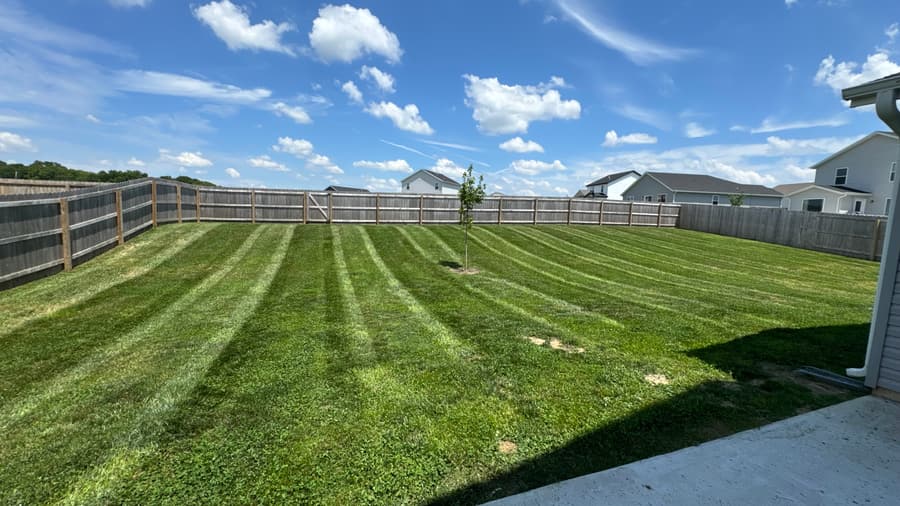
A striped lawn should look deliberate without asking the grass to pay for the effect. The pattern comes from bending grass blades in opposite directions so they reflect light differently—not from cutting alternating rows at different heights. That means the best stripes begin with healthy turf, a level mower, and controlled turns.
What actually creates a lawn stripe
The light and dark bands are an optical effect. Grass bent away from the viewer exposes more of the reflective leaf surface and looks lighter; grass bent toward the viewer looks darker. The direction of the sun and the place from which the lawn is viewed also change how strong the contrast appears.
Cool-season grasses such as tall fescue usually show a pattern more clearly than stiff or very short turf because there is more leaf blade to bend. A roller or mower-mounted striping kit can strengthen that bend, but it cannot repair a weak lawn, an uneven deck, dull blades, or an inconsistent mowing height.
Protect turf health before chasing contrast
Do not lower the mower simply to make a pattern sharper. For many Southwest Missouri tall fescue lawns, keeping a healthy seasonal height matters far more than producing a dramatic stripe. The one-third rule still applies, and a sharp blade should make a clean cut instead of leaving frayed tips across every band.
Wait when soil is saturated. Tires and rollers can press ruts into soft ground, and repeated passes can compact a route that already receives heavy traffic. On dry-enough turf, use a steady speed and enough overlap to avoid narrow uncut lines without repeatedly driving over the same area.
- Set the deck for the grass species and current conditions—not for the photograph.
- Check deck level and tire pressure before blaming the lawn for an uneven pattern.
- Mow when the surface can safely support the equipment without rutting.
- Keep clippings, equipment, and the discharge path away from people, vehicles, windows, and roads.
Build a straight, simple pattern
Start with one or two perimeter passes to create room for controlled turns. Choose a long straight reference such as a sidewalk, driveway edge, fence line, or distant fixed point. Follow that reference for the first pass, then turn and return beside it in the opposite direction. Looking well ahead instead of immediately over the front of the mower makes it easier to hold a straight line.
Overlap each pass enough to cover the tire track and the outer edge of the previous cut. At the row end, make a wide, gentle turn within the perimeter area. Avoid a stopped pivot on one drive tire; that motion can twist the turf crown and leave a brown divot, especially on thin, wet, or newly established grass.
Change the pattern from visit to visit
A good stripe is temporary. Mowing the identical line every visit can train grass to lean in one direction and can concentrate wheel traffic into the same tracks. MU Extension recommends changing mowing direction regularly, and we follow that principle even when one particular pattern photographs best.
Rotate between north-south, east-west, and appropriate diagonal patterns as the property allows. The property—not the pattern—sets the limits. Slopes, drainage swales, trees, narrow gates, ditches, roadside edges, and drop-offs may require a safer direction or a smaller mower even when that makes the stripes less dramatic.
Use a striping kit only when it fits the mower
A striping roller can make the light-and-dark effect stronger by contacting the turf after the deck and tires have passed. It should be an accessory selected for the exact mower model, deck width, mounting points, operating clearance, and manufacturer instructions. A universal-looking attachment is not automatically safe or compatible.
Check that the roller moves freely, follows the ground as designed, and does not interfere with transport, slopes, backing, guards, or other controls. Added pressure is not always better. If the soil is soft, the turf is stressed, or the equipment manual does not allow the setup, leave the roller off and rely on a clean mowing pattern instead.
The Pebble Creek striping standard
The healthiest-looking stripe is built from consistent height, sharp blades, a level deck, steady overlap, and clean turns. The pattern should complement the home and the way people normally see the property, then finish with tidy edges and hard surfaces cleared of clippings.
We would rather leave a safe, even, healthy lawn than force an intense pattern onto wet, stressed, uneven, or unsafe ground. Striping is a finishing detail. Responsible turf care remains the job.
Related Lawn Guide chapters
Useful gear for this topic
Create stronger stripes without sacrificing cut quality
A striping roller can increase contrast, but an even deck, consistent height, and properly inflated tires create the clean foundation first.
As an Amazon Associate, Pebble Creek earns from qualifying purchases. Your price is not increased. How we choose recommendations.
Lawn striping kit for your exact mower
Best for: Bending the grass consistently behind the deck to create more visible light-and-dark stripes.
Confirm mower model, deck width, mounting points, clearance, and manufacturer compatibility before ordering.See current Amazon options ↗Mower deck leveling gauge
Best for: Comparing blade-tip height from side to side and front to back before blaming the turf for an uneven cut.
Use the mower manufacturer's leveling procedure and secure the equipment before reaching beneath the deck.See current Amazon options ↗Low-pressure mower tire gauge
Best for: Keeping mower tires evenly inflated so the deck does not sit lower on one side.
See current Amazon options ↗Sources and further reading
- MU Extension: Managing Lawns and Turfgrass ↗
- MU Extension: Start Your Engines—Mowing Season Begins ↗
- Scag Power Equipment: Lawn Striping and Lawn Patterns ↗
This chapter provides general educational information. Site conditions vary, and product labels and equipment manuals control whenever a product or machine is used.