
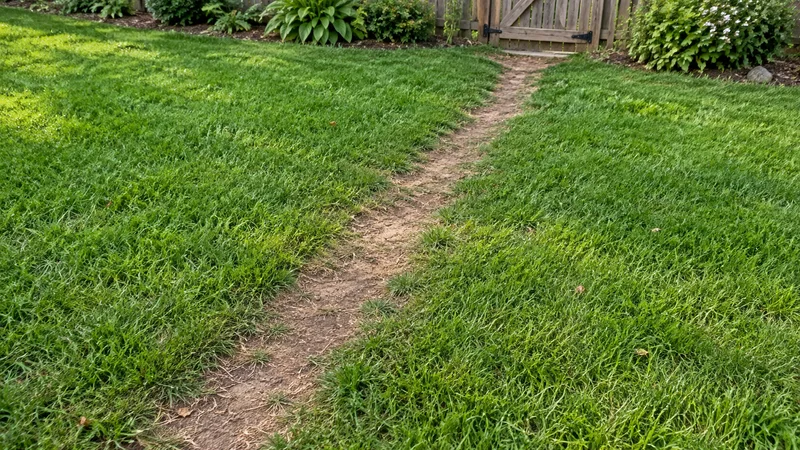
A hard patch in the yard is not enough to diagnose compacted soil. Dry ground, shallow soil over rock and a wet low spot can all make lawn problems look similar. Before booking aeration or buying a treatment, identify the pattern, compare it with nearby healthy turf and record what remains uncertain. This guide helps Southwest Missouri homeowners choose the next useful check—not turn every bare spot into the same repair.
1. Start with the pattern, not a verdict
Compaction squeezes soil particles together and reduces pore space available for air and water. Repeated foot traffic, vehicles and construction can contribute, especially when soil is wet. Thin grass along a gate shortcut, repeated wheel tracks or a former staging area therefore deserves a closer look. Those clues suggest where to investigate; they do not establish the cause by themselves.
Make a quick map of the problem before changing anything. Include the gate, driveway, downspout, slope and routes used by people or pets. Mark the worst patch and an adjacent area that still grows acceptable grass. Photograph both from the same direction. A close-up of bare ground without its surroundings leaves out information that may explain why that particular spot struggles.
Write the question you want answered: is daily traffic wearing out the surface, is the soil restricting growth, or is water collecting there? More than one can be true. Keeping these questions separate prevents a purchase from becoming the diagnosis. Do not describe the whole yard as compacted just because one gate entrance looks worn.
2. Separate compaction from its look-alikes
Use this comparison to organize observations, not to select a treatment from a single symptom. A record of weather and site history is more useful than a one-time hard-versus-soft judgment. If an explanation does not fit, keep it on the uncertain list rather than forcing the evidence.
MU Extension notes that soils can differ over short distances and that building work can disturb the original topsoil. Even neighboring lawns are not necessarily equivalent. A healthy comparison spot on your own property is helpful, but differences in shade, slope or fill still need to be recorded.
| Possible issue | Clues worth recording | What to check next |
|---|---|---|
| Compaction | Repeated traffic or construction matches the struggling area. | Compare similar locations under similar moisture conditions; consider a site assessment. |
| Dry, hard soil | The ground is dry; resistance changes after normal moisture returns. | Repeat observations under comparable moisture rather than assigning a permanent diagnosis. |
| Prolonged wetness or drainage | Water collects, runoff enters or the area stays wet. | Trace water sources and site grading; do not assume aeration will solve the drainage problem. |
| Shallow soil, rock or buried fill | Poor growth follows a distinct small area; a tool meets a localized obstruction. | Stop probing. Have the soil depth and obstruction evaluated safely. |
| Thatch | A distinct interwoven layer sits between green growth and mineral soil. | Identify that layer in a safely obtained profile; loose clippings alone are not thatch. |
3. Compare carefully—and know when to stop
Start with checks that do not penetrate the ground: photographs, the traffic map, rainfall notes and water movement. Before any digging or probing, follow Missouri 811's current process, including its three-full-working-day notice and confirmation of locate status. Utility marking does not identify every private line; irrigation and other privately owned services need separate attention. Avoid uncertain locations and tree roots rather than testing them with a tool.
If the location is cleared and a suitable tool can be used safely under its instructions, compare several points in the problem area with several nearby reference points. Use the same tool and gentle method. Make comparisons when the soil is moist, not saturated, and note whether the locations actually have similar moisture. Do not hammer a screwdriver or force a soil probe into resistant ground.
A casual push test is not a calibrated compaction measurement. There is no universal screwdriver depth that proves your lawn needs aeration. Resistance could reflect dry soil, a stone or a root; soil texture also matters. Stop at an obstruction. If the results disagree, record them as inconclusive and ask for an assessment instead of pushing harder.
A safely obtained soil profile can also help separate a surface-layer problem from the soil beneath it. Thatch is an interwoven layer of stems, crowns and roots, not merely yesterday's grass clippings. If you cannot confidently identify what you are seeing, photograph the profile with scale and ask an Extension specialist or lawn professional to interpret it.
4. Keep one short inspection record
A phone note is enough. Give each location a simple name so a later visit does not accidentally compare a different patch. Record what you saw separately from what you think caused it. The purpose is to make the next decision clearer, not to produce a technical report or collect a pile of measurements you cannot interpret.
For example, a hypothetical note might read: Gate path sparse; nearby grass healthy; daily foot traffic; no standing water observed today; soil comparison not performed because irrigation-line location is unknown. Next step: confirm the private line location and discuss the access route. That is useful evidence even though it contains no compaction reading. It is an example, not a documented Pebble Creek job.
- Date and locations: name the problem patch and reference patch; save a wide and close photograph of each.
- Recent conditions: record rain, irrigation and whether each location appears dry, moist or wet.
- Site history: note repeated traffic, vehicle parking, recent construction, soil placement and changes in drainage.
- Checks and limits: write down the method, differing observations and anything that stopped the check.
- Next action: identify one question to resolve and who will address it before purchasing treatment.
5. Match the response to the finding
If traffic is the repeatable problem, plan how to reduce it or provide an appropriate walking route. An aeration visit cannot prevent the same shortcut from being used afterward. If water is arriving from a downspout or neighboring slope, investigate that water pathway; persistent wetness may need a drainage assessment rather than repeated lawn treatments.
When compaction is supported by the site assessment, core aeration may be part of the plan. It removes plugs rather than merely poking solid spikes into the ground. Grass type, soil readiness and growing season affect the decision. Our Republic aeration guide, linked below, covers service timing and what to ask before scheduling; this article is the earlier diagnostic step.
If shallow soil, rock or construction disturbance is the limiting factor, a different repair scope may be necessary. Do not assume spreading a thin layer of topsoil will correct the underlying condition. Ask what the proposed work addresses, how underground services will be protected and how lawn recovery will be managed.
A routine laboratory fertility test answers a different question: it can inform nutrient and pH decisions, but it is not a compaction test. Use your laboratory's current sampling instructions if that question needs answering. Fertilizer, lime or a soil-probe purchase should not substitute for identifying a physical site problem. You may need no new product at all.
6. What to send with a lawn assessment request
Send the address, approximate affected area, your location notes and the two sets of photographs. Say whether the concern is an everyday walking route, a wet area or ground disturbed by previous work. Include known irrigation or private-line information, but do not guess that an unmarked location is safe. If you have an existing soil-test report, attach it and identify where its sample came from.
Ask for the proposed next step in plain language: what evidence supports the suspected cause, what remains unknown, and what would change the recommendation? If aeration is proposed, ask why it fits this lawn now. If a larger repair is proposed, ask how the scope differs from ordinary lawn maintenance. That keeps the estimate tied to a problem rather than an unexplained list of treatments.
Use Pebble Creek's lawn-care and service-area links below to request help for your Southwest Missouri property. For a patch beneath a tree, also read the related Springfield shade guide; for uncertain wet-versus-dry conditions, use the soil-moisture guide. A useful inspection can end with a targeted referral or a decision to watch the area—not automatically another service.
Related Lawn Guide chapters
Useful gear for this topic
Compare a soil probe only if sampling is your next step
A clean sampling tool already accepted by your laboratory may be enough. If a probe would help, compare open-sided and T-handle models by usable sampling depth, core removal and cleaning access. This is an optional category comparison, not a tool purchase required to diagnose compaction.
As an Amazon Associate, Pebble Creek earns from qualifying purchases. Your price is not increased. How we choose recommendations.
Soil-sample probe
Best for: Collecting consistent cores for a laboratory nutrient and pH test when those are separate questions in your lawn assessment.
A sampling probe is not a compaction meter and does not measure pH itself. Follow laboratory and tool instructions, verify underground utilities and private irrigation locations before use, and never force the tool against roots, rock or hard ground. No firsthand testing of these listings is claimed.See current Amazon options ↗Sources and further reading
- Maryland Extension: Lawn Problems Not Caused by Pests or Diseases ↗
- MU Extension: Improving Lawn and Landscape Soils ↗
- MU Extension: Natural Lawn Care ↗
- Minnesota Extension: How to Control Thatch in Your Lawn ↗
- MU Extension: Soil Testing for Lawns ↗
- Missouri 811: Before You Dig ↗
- Missouri 811: Public vs. Private Utility Lines ↗
This chapter provides general educational information. Site conditions vary, and product labels and equipment manuals control whenever a product or machine is used.