
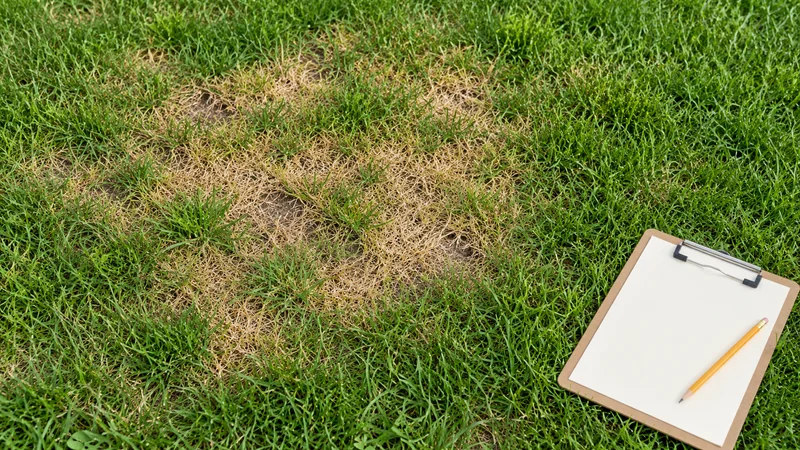
If the same brown patch keeps returning, the next useful step is not automatically another fungicide. First establish whether you are seeing new injury, old damage that has not recovered, or a different problem in the same place. This Southwest Missouri guide helps you build one useful record, review what has already been tried and decide when to get a diagnosis before spending more.
1. Separate new damage from an old scar
Start with the last date you remember the area looking healthy—not merely the date it was sprayed. Photograph the whole affected area from a repeatable position, then take a closer view of the transition into healthy grass. Note whether its edge is expanding, whether another patch has appeared and whether green growth is returning. A dated photograph is more useful than remembering that the lawn looked 'about the same.'
MU Extension describes disease as an interaction among a susceptible plant, a pathogen and favorable conditions. But drought, physical injury and other stresses can resemble disease. Calling every recurring patch fungus can send you back to the wrong treatment. Improvement after an application also does not, by itself, prove what caused the problem.
Keep two questions separate: is there an active problem to address, and does the remaining thin area need repair? Do not repeatedly treat a visible scar just because it has not turned green. If you never obtained a diagnosis, write 'cause unconfirmed' in the record instead of carrying an assumption into the next visit.
2. Keep one log for the patch—not separate notes for every product
Give the area a simple name such as 'back lawn beside the patio.' Keep a dated note and photographs in one place that the homeowner and service provider can both reference. Record observations before conclusions: 'wet at 8 a.m. before the sprinkler ran' is more useful than 'too much water.' Include what is unknown rather than filling gaps from memory.
Use the checklist below across visits. You do not need to purchase five tools or collect a scientific data set. The aim is to spot changes and give the next person enough context to investigate without repeating work. Keep records for healthy nearby turf as a comparison, while recognizing that shade, soil depth and irrigation coverage may differ.
| Record | Useful detail | Question for the next visit |
|---|---|---|
| Damage and diagnosis | Date, patch location, overall and close photographs; who identified the cause and how. | Is injury spreading, recovering or merely still visible? |
| Water and weather | Actual irrigation days and run times, recent rain, wet or dry observations in affected and nearby turf. | Does the pattern coincide with a repeated watering or drainage condition? |
| Fertilizer and treatments | Exact product, date, rate, area and applicator; keep the label or service record. | Was the previous treatment appropriate for the confirmed problem? |
| Mowing | Mowing dates, cutting height, blade condition and any scalping or tire damage. | Does fresh injury follow a particular operation? |
| Site conditions | Shade changes, foot traffic, low spots, downspout discharge and work near the patch. | What condition persists here that does not occur in the healthier area? |
3. Look for the condition that keeps returning
Review actual irrigation, not just the controller's displayed program. A second program, manual watering or runoff from another zone belongs in the history too. Maryland Extension notes that prolonged leaf wetness and frequent or late watering can favor some lawn diseases. Drainage trouble, compaction and drought can also stress turf; brown grass is not proof that the answer is always less water.
For tall-fescue brown patch specifically, MU Extension identifies hot, humid conditions and excessive nitrogen around summer heat as concerns. Its guidance favors early-morning irrigation that avoids unnecessarily prolonged leaf wetness. That is a reason to review the summer record—not evidence that an October patch has the same cause, or a direction to stop all fertilizer indefinitely.
Match mowing and fertility to the grass and the diagnosed issue. Different diseases do not all respond to the same fertilizer change. Check cutting quality, appropriate height and equipment condition rather than adding a product to compensate for repeated physical injury. Some foliar diseases cause temporary discoloration and may not need a fungicide at all.
Write down which adjustment is being made, who is responsible and what observation will be checked afterward. Do not leave one person changing irrigation while another changes it back. When practical, keep the change clear enough to assess, but do not postpone needed professional help just to run a backyard experiment.
4. Audit the previous treatment before repeating it
Recover the exact container label or applicator record. Record the product and active ingredients, application date, treated area, rate and any required watering or follow-up instructions. 'Fungus spray' is not a usable treatment history. If a company applied it, ask what problem it was treating and what result or follow-up it expected.
MU explains that FRAC codes group fungicides by their mode of action. Changing brand names may not change that mode of action; repeated use of similar modes can favor resistance. However, a returning patch is not proof of resistance. An incorrect diagnosis, unsuitable conditions or incomplete records can also leave the original question unresolved.
Follow the complete current label for the exact product and site. This guide supplies no universal repeat interval, rate, mixture or fungicide shopping list. Do not increase a dose or combine products to compensate for an uncertain result. Ask a qualified adviser to review the diagnosis and treatment sequence, including label limits, before another application.
5. Know when a diagnostic sample is the better next step
If damage is spreading quickly, keeps returning despite a documented plan or has never been identified confidently, seek diagnostic help rather than buying another bag on a guess. For Nixa and Ozark residents, MU Extension in Christian County lists plant identification and diagnostic assistance. Elsewhere, ask your local Extension office for the appropriate route.
Send the log and clear photographs first, and ask the receiving laboratory what sample it needs before digging or shipping anything. Utah State's diagnostic guidance explains why material at the boundary between affected and healthy turf can be useful. Follow the receiving lab's current size, soil-depth, packaging and delivery instructions—not a sample recipe borrowed from another state's laboratory.
Tell the diagnostician about every recent treatment, including dates. Keep soil fertility testing separate from plant disease diagnosis: a nutrient and pH report can help answer a fertility question, but it does not identify the organism responsible for a lawn patch. Ask which question each proposed test will answer and what decision its result would change.
6. End each visit with a decision you can follow
Here is a hypothetical example, not a Pebble Creek job report: a homeowner notices the same low area turning brown after an irrigation-program change. The log shows the timing, but timing alone does not establish the cause. The next step is to verify actual watering and site conditions, share the history and obtain diagnosis if needed—not declare that the sprinkler caused fungus.
After a review, record one of three outcomes: continue observation with a defined follow-up, correct a documented maintenance or site issue, or obtain a diagnosis/treatment recommendation. Name the person responsible and the next check date. If the plan is not helping or damage spreads, reassess sooner instead of automatically renewing it.
For a Pebble Creek lawn-care inquiry, include the address, grass type if known, dated photographs, treatment history and the specific maintenance concern. That gives a mowing or property-care conversation a useful starting point without pretending it replaces a laboratory diagnosis. Use our brown-patch and initial-triage guides for those separate questions; this record is what connects the visits so next year's decision does not start from scratch.
Related Lawn Guide chapters
Useful gear for this topic
An optional comparison for your moisture log
You may already have enough information from careful observation and your irrigation record. If comparing a moisture meter, look at simple analog versus longer-probe models, readable scales and outdoor-soil instructions. This is an optional category comparison, not a disease-treatment recommendation.
As an Amazon Associate, Pebble Creek earns from qualifying purchases. Your price is not increased. How we choose recommendations.
Simple soil-moisture meter
Best for: Recording comparable wet-versus-dry observations at the same lawn locations as part of a recurring-problem log.
Follow the exact manufacturer's soil-contact, depth and cleaning instructions. Readings vary with soil and probe contact; a dial is not necessarily a calibrated moisture percentage. Never force a probe into hard ground or near buried utilities or irrigation. A meter does not identify fungus or replace a diagnostic sample. No firsthand testing of these listings is claimed.See current Amazon options ↗Sources and further reading
- MU Extension: Identification and Management of Turfgrass Diseases ↗
- MU Extension: Brown Patch disease profile ↗
- University of Maryland Extension: Diseases of Home Lawns ↗
- Utah State University: Preparing Turfgrass Samples ↗
- MU Extension in Christian County: diagnostic services ↗
This chapter provides general educational information. Site conditions vary, and product labels and equipment manuals control whenever a product or machine is used.