
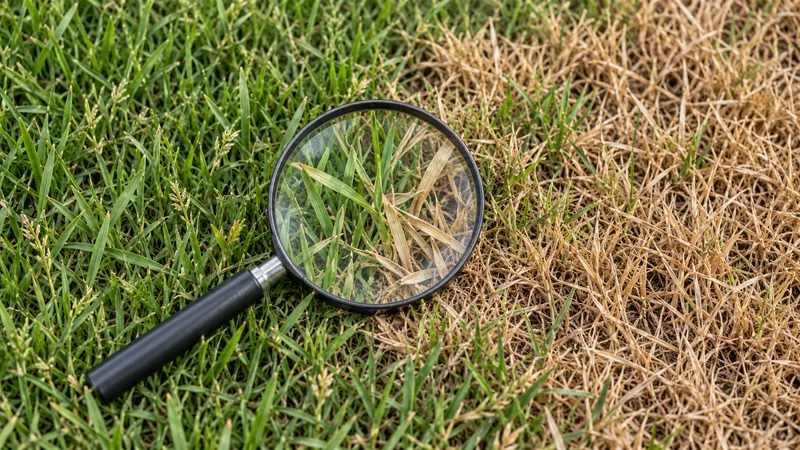
Before you turn up the sprinkler or buy a fungicide, check whether the brown grass is actually short of water. Drought stress, disease, mowing damage and product injury can look similar from the driveway—and more than one can happen together. For Southwest Missouri homeowners, the useful first step is a short investigation, not a treatment chosen from the color. This guide helps you collect the clues that change the next decision.
1. Start with what changed—not the shape alone
Write down when you first noticed the damage and what happened immediately beforehand: a hot dry stretch, repeated rain, a sprinkler change, a mowing visit or a product application. Record the grass type if you know it. If you do not, photograph both the affected grass and a healthy area for identification rather than assuming every lawn is tall fescue.
University of Maryland Extension identifies several non-disease causes of lawn browning, including mowing injury, chemical injury and environmental stress. A stripe following a spreader pass, a shortened hump after mowing or a recurring pet spot deserves a different investigation from an expanding patch with damaged leaves. None of those patterns, by itself, proves the cause.
Do not start by asking whether the grass is definitely dead. Brown leaves can occur on living dormant plants, while damaged plants may fail to recover. Grass species and the length and severity of stress matter. A single photograph, a quick tug on the leaves or one watering is not a reliable verdict on the entire patch.
2. Compare the damaged area with a healthier spot
Choose two nearby places with similar grass: one at the changing edge of the brown area and one that still looks healthier. Compare them on the same visit. Note sun, slope and sprinkler coverage differences before treating one observation as representative of the whole yard.
The table is a triage worksheet, not a disease identification key. Use it to choose the next check. If the evidence points in two directions, record both instead of forcing the lawn into a drought-or-fungus choice.
| Observation | What it may suggest | Check before acting |
|---|---|---|
| Rolled leaves, lingering footprints and dry soil near roots | Water stress deserves attention. | Compare several spots and irrigation coverage; a dry surface alone is not enough. |
| Brown grass but wet or soft soil | More irrigation may not be the answer. | Review recent rain, drainage and watering; seek help if wilt continues despite moisture. |
| Leaf lesions or a patch that continues expanding | Disease needs consideration, not an automatic diagnosis. | Photograph the active edge and individual leaves; ask Extension about a sample before choosing fungicide. |
| Stripes, a shaved rise or torn leaf tips after mowing | Cutting or application injury may fit the timeline. | Check actual cut height, leaf ends and recent product records; compare the mowing guide. |
| Conflicting clues or no clear recent change | Several stresses—or a different cause—may be involved. | Keep the observation record and request diagnostic help instead of stacking treatments. |
3. Check moisture without turning it into a watering experiment
MU Extension lists rolled leaves, persistent footprints and a dull blue-purple cast among water-stress clues. Check the soil near the roots as well as the leaves, in more than one location. Avoid sharp probing where irrigation lines, wiring or other buried features may be present; do not force a tool into hard ground.
A sprinkler that ran yesterday does not prove that the affected spot received water. A rain total also does not show how much reached that particular root zone. Compare the troubled area with the healthier spot and look for missed coverage or runoff. Our soil-moisture and watering guides below explain those checks in more detail.
If the soil is already wet and the grass looks wilted, do not repeatedly add water to chase green color. If it is dry and the other clues support water stress, use a grass-appropriate watering plan that accounts for rainfall and current restrictions. Newly seeded or sodded areas need a separate establishment plan, not a shortcut from an established-lawn guide.
An inexpensive moisture meter can help compare locations, but its scale is not automatically an accurate percentage of soil water. Readings depend on the device and how it contacts the soil. It cannot identify a fungus or tell you whether roots are alive. A careful observation record is useful even if you buy nothing.
4. Look closely at leaves before reaching for a treatment
Inspect several leaves at the transition between green and damaged grass, not only completely dry material in the center. A phone close-up can preserve details that disappear in a wide lawn photo. Look for where discoloration occurs: just the cut tips, separate marks on the blades, or the whole leaf. If using a magnifying glass, put it away afterward rather than leaving it in direct sun.
MU Extension describes leaf lesions and sometimes early-morning fungal growth with brown patch during favorable warm, humid conditions. It also warns that unnecessary watering can worsen that problem. Those observations justify a closer assessment; a brown circle without leaf evidence does not establish brown patch. Our separate Nixa tall-fescue guide covers that specific disease and its lookalikes.
Do not apply a fungicide simply to see whether it helps. The correct choice depends on the diagnosis, grass, timing and current product label. Likewise, a browning lawn is not evidence that it needs fertilizer. University of Minnesota Extension advises limiting traffic and postponing fertilizer on drought-stressed turf. Its regional drought timelines are not promises for a Missouri yard.
While you investigate, avoid repeated mower passes over stressed grass and avoid combining several new treatments. Changing watering, fertilizer and fungicide together makes it harder to understand what happened and may add injury. Necessary care should follow the evidence; uncertainty is a reason to seek help, not to keep experimenting.
5. Make a record that a lawn professional can actually use
Use your phone notes rather than relying on memory. Take a wide photo from a repeatable location, a closer view of the boundary and clear pictures of individual leaves. Add the date and a nearby landmark so the next set of photos shows whether the same area changed. Keep the originals rather than only heavily filtered or marked-up copies.
A useful handoff separates observations from guesses: 'The soil was wet beside the roots at the brown edge this morning' is more informative than 'I think it needs double the water.' Include previous treatment labels or service records when available. Do not invent a rate or product name if someone else applied it.
For Pebble Creek's Southwest Missouri service work, this record helps connect a homeowner's concern with the mowing and maintenance history. It does not replace an on-site assessment or laboratory diagnosis. Ask which next step is supported: a coverage correction, a mowing adjustment, diagnostic sampling or observation before repair.
- First noticed: date, affected location and whether it is spreading.
- Conditions: recent rain, sprinkler dates and soil observations from both comparison spots.
- Recent work: mowing date and height changes; fertilizer, weed-control or other applications.
- Photos: whole area, changing edge and several individual leaves.
- Next check: who will review it, what evidence they need and when to compare again.
6. Get a sample checked when the answer is still unclear
Request help promptly when damage is spreading, the symptoms conflict with the moisture check, or repeated care changes have not explained it. MU's Turfgrass Disease Identification Form provides a structured history and sampling instructions. Follow the current clinic directions before cutting or shipping a sample; an all-dead handful of loose clippings is usually less useful than material from the active boundary.
The MU form calls for a sample spanning affected and healthier turf with roots and soil intact. It also explains how to protect the sample without adding excess moisture and why early-week shipping helps avoid deterioration. Contact the clinic first about current submission arrangements, fees and packaging; send the photographs and treatment history with the request.
Homeowners near Springfield can also contact the MU Extension Greene County plant-identification service at the Springfield Botanical Center; its published phone is 417-874-2963. Call before bringing a sample. A local diagnostic route is more useful than guessing a disease from an online picture.
Once the likely cause is established, choose a matching recovery plan. Correct the stress or management problem before reseeding a repeatedly failing spot. The goal is not to label every brown blade today: it is to avoid the wrong treatment, protect remaining grass and make the next visit a better-informed decision.
Related Lawn Guide chapters
Useful gear for this topic
Compare an optional soil-moisture meter—not a disease detector
Use your existing observations first. If a meter would help compare locations, weigh a simple analog probe against a longer probe designed for the soil depth you need to check. This is a category comparison, not a tested endorsement or a substitute for diagnosis.
As an Amazon Associate, Pebble Creek earns from qualifying purchases. Your price is not increased. How we choose recommendations.
Simple soil-moisture meter
Best for: Comparing readable scales, suitable probe length and outdoor-soil instructions for repeated wet-versus-dry checks at comparable locations.
Check the exact manufacturer's soil-contact, insertion-depth, cleaning and calibration instructions. Do not assume a dial is a precise percentage or that a multi-function meter replaces a laboratory soil test. Do not force probes into hard ground or near buried lines; no meter identifies lawn disease or proves root survival. No firsthand use of these listings is claimed.See current Amazon options ↗Sources and further reading
- MU Extension: Water-stress signs and soil-moisture checks ↗
- University of Maryland Extension: Lawn problems not caused by pests or diseases ↗
- MU Extension: Check for brown patch before adding water ↗
- University of Minnesota Extension: Traffic and fertilizer precautions during drought ↗
- MU Extension: Turfgrass disease history and sample instructions ↗
- MU Extension in Greene County: Plant-identification services ↗
This chapter provides general educational information. Site conditions vary, and product labels and equipment manuals control whenever a product or machine is used.