
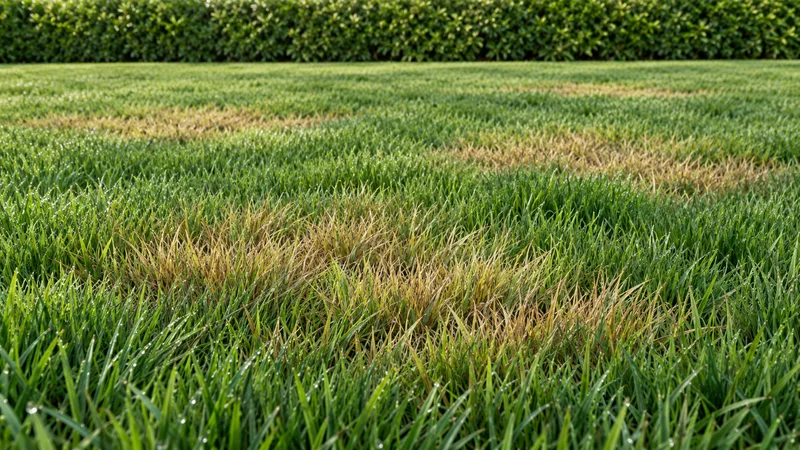
If your Nixa tall-fescue lawn develops brown patches after warm, humid weather, brown patch disease is one possibility—not a diagnosis. Before adding water, fertilizer or fungicide, look at individual leaves near the edge of the affected area and write down what happened before the color changed. This guide helps you gather useful evidence, avoid common knee-jerk treatments and decide when to ask for diagnostic help.
1. Check the grass and the weather—not just the color
Brown patch is a fungal disease that affects tall fescue in Missouri, especially during warm, humid summer conditions. MU Extension highlights nighttime lows near 68°F and daytime highs near or above 86°F as favorable weather. Those numbers describe risk conditions, not a temperature test that proves a lawn is infected.
On lawn-height fescue, look for tan or straw-colored patches and irregular pale lesions with darker brown borders on individual leaves at the advancing edge. The distinct dark 'smoke ring' often shown in golf-turf photographs is not a required homeowner identification feature. Use the linked MU disease photographs as examples, not as a substitute for examining your grass.
First confirm that the affected grass is tall fescue. Large patch in warm-season grasses such as zoysia is a different management problem, often associated with spring or fall. Mississippi State Extension explains this seasonal distinction. Do not copy a zoysia treatment calendar onto fescue—or assume a new October brown spot must be active summer brown patch.
2. Make a five-minute observation record
Choose one affected area and one nearby healthier comparison area. Photograph the whole setting, the boundary between green and discolored turf, and several leaves in focus. Include something for scale beside the leaves without flattening them. A wide view shows drainage and shade that a tight close-up misses.
Write down the first day you noticed the change and whether the patch is expanding. If the situation is stable, repeat the same photographs from the same position the next day. Rapidly spreading damage deserves prompt professional or Extension advice rather than waiting for a perfect photo diary.
This is a record to help a diagnostician, not a home disease test. A phone photo cannot show every root, crown or microscopic feature needed to distinguish problems. Avoid making several treatment changes at once before you have documented the starting condition.
- Grass: known species, recent seed or sod, and whether the problem affects just one part of a mixed lawn.
- Weather and water: recent hot nights, rainfall, sprinkler start times, run lengths and whether leaves stay wet well into the morning.
- Maintenance: last mowing date and height; names, dates and rates of fertilizer or other products already used.
- Pattern: expanding patches, straight equipment-width bands, a low wet corner or a strip along pavement.
- Leaves and soil: close-up leaf appearance plus whether the root zone feels dry, moist or saturated compared with healthier turf.
3. Lookalikes: what would change the next step?
Brown patch can coexist with drought stress or another problem. Use patterns to choose the next check, not to rule disease in or out by appearance alone. A sprinkler running every night does not prove the roots receive enough water, and dry ground does not prove there is no disease.
The following is a troubleshooting worksheet, not a list of diagnoses. Bring conflicting clues to the person evaluating the lawn instead of picking whichever label looks most familiar.
| Observation | What to investigate | Avoid this assumption |
|---|---|---|
| Discolored patches after humid nights; lesions on leaves | Brown patch is plausible: photograph affected leaves at the edge and seek confirmation. | Every brown circle needs fungicide. |
| Dry soil and wilting in a sprinkler’s missed area | Check water coverage and root-zone conditions as well as the leaves. | More overnight watering is automatically the answer. |
| Browning appeared right after mowing, especially on high spots | Compare remaining height, exposed stems and cut tips with unaffected grass. | Newly visible brown grass proves a new infection. |
| Straight bands or damage following an application | Review the exact product, rate, equipment path and timing. | Another fertilizer application will repair it. |
| A zoysia area browns during spring or fall | Confirm species and ask about large patch or other causes. | Tall-fescue summer advice fits every lawn. |
4. Reduce avoidable stress while you investigate
NC State Extension emphasizes prolonged leaf wetness: humid weather, dew, poor air movement and late-day watering can keep leaves wet long enough to favor brown patch. Check the timer before extending it. For established grass that actually needs irrigation, early morning is generally preferable to adding another evening wet period. Use our related watering guides for amounts and intervals rather than imposing a fixed daily schedule.
Do not force a stressed lawn greener with an extra nitrogen dose. Excessive nitrogen can increase disease severity. Keep the product history with your notes and choose any future feeding from the grass condition, season and existing plan—not from brown color alone.
Maintain a suitable fescue mowing height with a sharp blade and avoid scalping. Wait if the surface is too soft for equipment, and do not cut wet turf just to remove dew. Check whether shade, blocked drainage or repeated irrigation overlap keeps the same corner damp. These are conditions to address, not proof that a particular tree must be removed or every lawn needs aeration.
A rain gauge can help record rain before you change irrigation, but it cannot measure leaf-wetness duration, root-zone moisture or fungus. Use equipment you already have when it serves the purpose; a new gadget does not replace the observation record.
5. Get diagnostic help near Nixa
Nixa homeowners can start with MU Extension in Christian County. Its services page specifically lists plant disease, insect and weed diagnosis for turf. The county office lists 417-581-3558. Call before collecting or delivering a sample and explain that you need help with a discolored tall-fescue lawn, not simply a fertility test.
Ask what photographs and physical material they want, whether a diagnostic-clinic submission is appropriate, and the current fee and delivery instructions. A bag of soil collected for nutrient testing is not the same submission as diseased turf. Follow the office’s instructions rather than sending only completely dead clippings or guessing a mailing address.
Have the observation record and product labels ready. Useful questions are: 'Which signs support brown patch?', 'Could another problem be present?', and 'What evidence would change the recommendation?' Nixa’s city boundary does not create different disease biology; the local resource gives you a practical route to help.
6. Treatment and recovery are separate decisions
Fungicide is not an automatic next step for every brown lawn. NC State notes that fungicides can control brown patch, but applications made after damage appears may not deliver visible recovery during hot weather when cool-season grass grows slowly. Suppressing a disease and restoring green leaf growth are not the same result.
If a qualified recommendation includes a fungicide, check the exact label for residential-lawn use, grass species, target disease, rate, application conditions and restrictions. Do not copy a golf-course product table or treat every lawn on the same calendar. This guide does not prescribe a chemical, dose or preventive program.
MU notes that affected grass may recover as conditions improve when other stresses are absent; severe injury can still leave turf needing repair. Keep the follow-up focused on new growth and whether damage continues, not an overnight color change. Confirm what remains alive before buying seed or promising a full recovery.
For a Pebble Creek Nixa lawn-care request, send the wide view, close-ups and maintenance history with your estimate request. Explain whether you need a mowing adjustment, an inspection or a repair plan. Routine mowing is not a laboratory diagnosis or an assumed fungicide service; agree on the actual work after the cause and next step are clearer.
Related Lawn Guide chapters
Useful gear for this topic
Compare an optional rain gauge for the inspection record
Use your existing rainfall record first. If you need a gauge, compare a readable stake model with a bracket-mounted option that suits your yard. This is a category comparison, not a tested endorsement or a disease treatment.
As an Amazon Associate, Pebble Creek earns from qualifying purchases. Your price is not increased. How we choose recommendations.
Simple outdoor rain gauge
Best for: Recording actual rainfall alongside sprinkler times and lawn photographs before changing irrigation.
Check scale units, capacity, mounting and freeze-care instructions for the exact gauge. Place it clear of roofs and tree cover. It cannot measure leaf-wetness duration, soil moisture or diagnose brown patch. No firsthand use of these listings is claimed.See current Amazon options ↗Sources and further reading
- MU Extension: Brown patch symptoms and management in Missouri ↗
- NC State Extension: Brown patch development, cultural care and treatment limits ↗
- MU Extension: Check for brown patch before adding water ↗
- MU Extension in Christian County: Turf diagnosis and other services ↗
- MU Extension in Christian County: Contact the local office ↗
- Mississippi State Extension: How warm-season large patch differs ↗
This chapter provides general educational information. Site conditions vary, and product labels and equipment manuals control whenever a product or machine is used.