
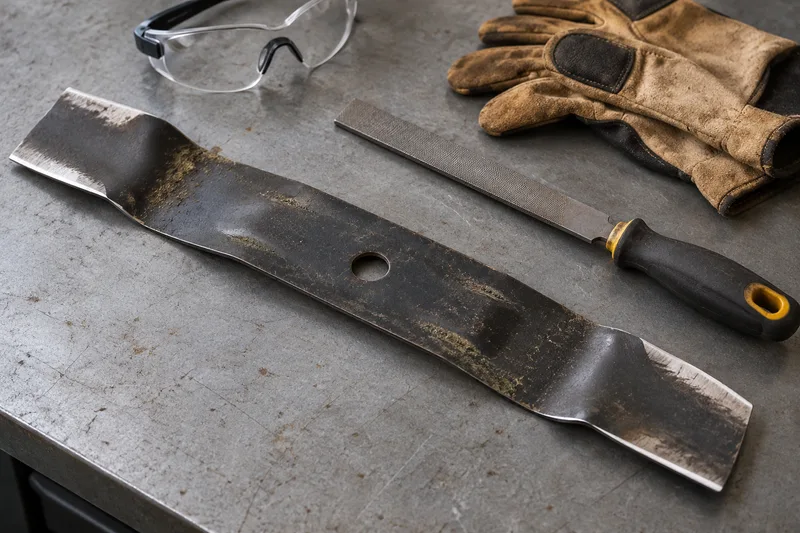
For a Springfield homeowner, the useful answer is to inspect on the mower manufacturer's schedule and sharpen when the edge needs it—not automatically after a fixed number of weekends. An annual service can be a starting point for ordinary residential use, but damage, operating hours and cut quality can call for attention sooner. Choose DIY only if you can complete the entire job safely, including removal, balancing and correct reinstallation; otherwise ask a qualified shop.
1. Separate the inspection schedule from the sharpening decision
Toro's general residential guidance recommends sharpening or replacement yearly under normal use, with checks for nicks, damage and dullness after each tank of fuel. Its model-specific instructions can be more frequent: the TimeCutter HD MyRide 48-inch manual linked below calls for blade inspection before each use or daily. Neither statement means every mower should be sharpened after every tank, nor does the tank-based check translate directly to a battery mower.
Start a note with your exact model, serial number, manual's inspection interval, last sharpening date and approximate use since then. If you cannot remember the last service, record the history as unknown rather than guessing. Check before the next planned mowing day so a shop visit does not become an emergency.
Here is a planning example, not a manufacturer interval: one homeowner mowing 45 minutes a week for 24 weeks accumulates 18 hours; another mowing two hours a week accumulates 48. Both can say they sharpened last spring, but the workload is different. Follow your manual first and use the record to notice changes.
Pebble Creek's Southwest Missouri mowing work depends on a consistent finish. The homeowner lesson is to make blade condition part of mowing preparation, not wait until the whole yard looks rough. Our separate sharp-blade guide explains the lawn benefits; this one helps you decide when and where to arrange maintenance.
2. Use the symptom to choose the next step
Do not diagnose every poor cut as a dull blade. Toro's cut-quality guidance also points to mowing dry grass and avoiding removal of too much growth at once. Note whether the problem appears across the yard or only in wet, tall or uneven spots. A short description of what changed helps a shop more than simply asking for a sharper edge.
An impact or abnormal vibration changes the task. Stop mowing and follow the shutdown and inspection instructions before further use. EGO specifically calls for stopping, removing the detachable battery and waiting for motion to stop before inspection after an impact or unusual vibration. Do not keep mowing just to see whether the vibration disappears.
Use this table to organize the decision, not to certify a blade as safe from a photograph. If damage or the cause of vibration is uncertain, have the mower inspected. A blade that balances can still have a structural defect.
| What you notice | What to record | Next step |
|---|---|---|
| Normal cut; scheduled check due | Date, hours and manual interval | Inspect as directed; sharpening is not automatic. |
| Ragged cut without an impact | Grass conditions and last blade service | Check blade condition and other cut-quality factors. |
| Hit a solid object | What was struck and any new noise | Stop; follow the manual's damage inspection and replacement rules. |
| New vibration | When it began; recent blade work | Stop and seek diagnosis before more mowing. |
| Crack, bend or severe wear | Model and blade identification | Replace as directed; do not straighten or weld. |
3. Decide whether you can complete the whole DIY job
The hardest part may be accessing and reinstalling the blade rather than sharpening it. Before starting, locate the manual's safe access method, blade orientation, hardware order and tightening specification. A file or sharpening jig does not solve a seized fastener, an unknown blade assembly or the lack of a suitable way to support the machine.
For gas equipment, follow the manual's shutdown, key removal and spark-plug disconnection instructions. For removable-battery equipment, remove the battery and any safety key as directed. Let all movement stop. Use the specified hand and eye protection. Never work under an unsupported raised mower, and do not assume every walk-behind can be tipped the same way.
The linked Toro manual permits filing while preserving the original cutting angle, then checking balance and reinstalling with the specified hardware and torque. It also warns that moving one blade can move another on a multi-blade mower. These are reasons to use the instructions for your exact machine; this article intentionally supplies no universal grinding angle or torque number.
DIY is a reasonable option only when every answer below is yes. One unanswered item is a reason to pause and get help, not buy another attachment and hope it fits.
- Toro TimeCutter HD MyRide 48-inch manual: an example, not universal instructions ↗
- Before-first-cut mower preparation ↗
- I have the correct manual and can identify the blade assembly.
- I can isolate power and access the blade using the prescribed support or tipping method.
- I have the required protective equipment and the proper removal, sharpening, balance-checking and installation tools.
- I can identify damage that rules out sharpening and follow the manufacturer's limits.
- I can reinstall the blade correctly, including the specified tightening method, and stop if the result is abnormal.
4. Ask a shop about the complete service, not just an edge
Oregon distinguishes a working mower edge from a razor edge and explains that balancing helps prevent harmful vibration and wear. Ask whether the shop checks condition and balance as part of sharpening. Do not assume a low advertised sharpening charge includes taking the blade off your mower, reinstalling it or diagnosing vibration.
Make two columns on your note: loose-blade service and whole-mower service. For each, record what is included, the quoted total, expected return date and what happens if the blade should be replaced. The better choice may be the shop that can handle removal and diagnosis, even if a loose-blade service sounds simpler.
If you cannot safely remove the blade, say so when booking. Ask what the shop accepts before transporting equipment. Take a photo of the model/serial label, the manual reference and your symptom notes. Let the shop give its transport instructions; do not improvise fuel handling or send a loose sharp blade unprotected.
- Do you service this exact mower or accept this blade type?
- Does the quote include damage inspection, sharpening and balancing?
- Is blade removal and reinstallation included, or must I bring detached blades?
- If replacement is needed, will you confirm the exact part and price before proceeding?
- What is the current turnaround, and is an appointment required?
5. Verified Springfield and Nixa starting points
Westlake Ace Hardware at 2350 S. Campbell in Springfield lists mower-blade sharpening on its official store page. Its listed telephone number is 417-887-8926. This is a verified local place to ask about sharpening, not a claim that every blade type is accepted or that same-day service is available. Call before visiting to confirm loose-blade versus whole-mower service, balancing, current price and turnaround.
For readers who use the Nixa area, Pebble Creek also recommends contacting Nixa Hardware for SCAG support. Its official power-equipment page lists SCAG among the riding mower brands it services. The store is at 510 W. Mt. Vernon Street, Nixa, with telephone 417-725-3512. Confirm your model and the specific blade work first; general mower service does not establish a sharpening appointment or quote.
These are contact options, not a sponsored shop ranking or a claim that we tested every service. Keep the provider's answer with your maintenance record. If a shop does not handle your blade system, ask your mower manufacturer for an appropriate service location rather than substituting an unverified part or procedure.
6. Close the loop after service
Keep the invoice or DIY record with the mower model, date, approximate hours, work completed and any replacement part number. Write down the next inspection required by the manual. If a shop serviced only loose blades, the reinstalling person still needs the correct assembly and tightening instructions.
After the mower is fully reassembled, use the manufacturer's normal operating checks in a clear area. Stop if there is abnormal noise, vibration or poor operation. A freshly sharpened blade is not a reason to overlook a new problem. If the cut is still unsatisfactory, describe the conditions and changes to the shop rather than repeatedly removing more metal.
Choose a balancer only if you will perform manufacturer-permitted blade work yourself. Compare how it supports your blade's center opening, whether its setup is stable and what instructions are included. A balancing tool is not a straightness test, crack detector or guarantee of safe installation. There is no need to buy one just to take a mower to a shop.
If you would rather arrange lawn service than maintain mowing equipment, check Pebble Creek's actual coverage. Our mowing routes include South Springfield west of Highway 65; this educational guide does not imply citywide mower repair or mowing coverage. We provide lawn care, not the sharpening services listed above.
Related Lawn Guide chapters
Useful gear for this topic
Compare a blade balancer if you plan to sharpen at home
Use a suitable tool you already own, or compare this optional category for manufacturer-permitted blade maintenance. A shop visit does not require buying a balancer. Pebble Creek has not tested these search-result products.
As an Amazon Associate, Pebble Creek earns from qualifying purchases. Your price is not increased. How we choose recommendations.
Mower blade balancer
Best for: Comparing center-hole support, stable setup and clear instructions for checking balance after permitted sharpening.
Verify the blade opening fits the support and follow both tool and mower instructions. Balance does not establish straightness or structural safety. Never straighten or weld damaged blades. Use the exact mower manual for power isolation, removal and installation torque, or have a qualified shop handle the job.See current Amazon options ↗Sources and further reading
- Toro: residential blade inspection and sharpening guidance ↗
- Toro: TimeCutter HD MyRide 48-inch model 75210 manual (model-specific) ↗
- EGO: cordless mower maintenance and safe inspection ↗
- Oregon: mower-blade sharpening and balancing FAQ ↗
- Westlake Ace Hardware: Springfield S. Campbell location ↗
- Nixa Hardware: power-equipment service ↗
This chapter provides general educational information. Site conditions vary, and product labels and equipment manuals control whenever a product or machine is used.