
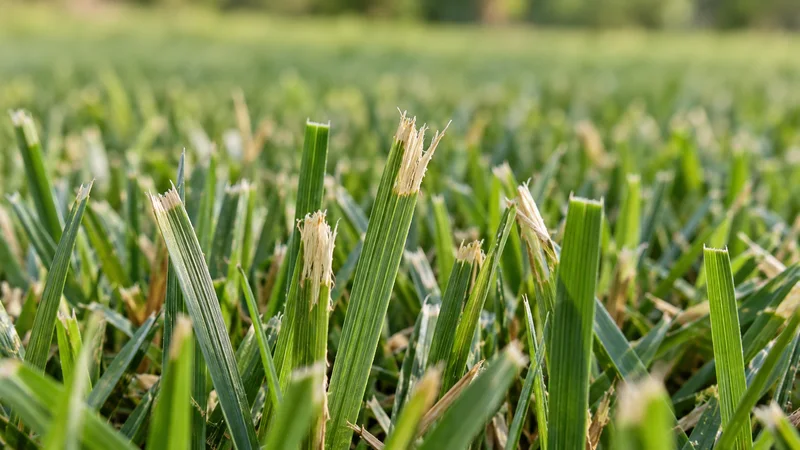
If your Republic lawn looked green before mowing and brown afterward, start with the remaining grass—not a bag of fertilizer. A low cut can expose pale lower growth; a dull or damaged blade can leave torn tips that turn tan; and mowing can make existing drought stress or dead material easier to see. The timing is a clue, not proof of the cause. Here is a practical way to decide whether the next step is a mowing change, mower service or a closer lawn inspection.
1. Separate a brown surface from brown leaf tips
Take a close photograph of several standing leaves and a wider photograph showing the whole affected strip. Compare them with nearby grass that still looks good. Look at what is attached to the plant: loose clippings lying across green leaves are different from leaves that are themselves discolored.
University of Maryland Extension describes frayed, light-brown tips after dull-blade damage and scalping where a low cut crosses uneven ground. With torn tips, much of each leaf can remain green below the damaged end. With an overly low cut, less green leaf remains and lower stems or older material become prominent. These clues can occur together.
Record whether you noticed the change immediately after cutting or during the following days. An immediate color change deserves a height and surface check; tan ends that develop afterward deserve a cut-quality check. Neither observation excludes disease, chemical injury or prior stress. Do not use a photograph alone to blame the mower—or to promise that the lawn is healthy.
2. Match the pattern to a useful next check
Walk the affected area without running the mower over it again. A repeating stripe, a shaved hump and a uniformly dull-looking lawn call for different checks. This worksheet narrows the investigation; it does not identify a disease or certify that equipment is safe.
| What you see | Check next | Do not do this |
|---|---|---|
| Short pale spots on rises or pavement transitions | Measure remaining grass beside a healthier spot; note the change in ground shape. | Lower the whole deck to make the surrounding lawn match. |
| Green leaves with fuzzy, shredded tan ends | Compare fresh cut tips; have blade condition and correct installation checked. | Assume a new blade, or a recent sharpening, guarantees a clean cut. |
| A repeated low strip within otherwise even passes | Check the mower’s approved setup, tires and cutting components through its manual or service shop. | Keep testing across the entire yard or improvise a deck adjustment. |
| Loose brown clippings above green grass | Gently separate the clippings to see the living turf; assess whether heavy mats need removal. | Treat ordinary surface clippings as proof the lawn died. |
| Browning beyond the mowing pattern, wilt or continuing spread | Review moisture, recent weather and product applications; seek diagnostic help if unclear. | Automatically add extra fertilizer, water or fungicide. |
3. Use a next-mow checklist—not another lower pass
Before the next visit, write down the previous mowing date, approximate pre-cut height, measured finished height and any recent setting change. A mower lever number is a setting, not a measurement of the grass left on a bumpy yard. Use a ruler you already own; you do not need a new tool for this record.
Purdue Extension recommends removing no more than one-third of leaf height in one mowing and returning overgrown grass toward its normal height gradually. For a simple example, cutting six-inch grass to four inches removes one-third; cutting it to three removes half. That is a calculation, not a recommendation that every Republic lawn should be four inches tall. Grass species, conditions and safe machine capability still control.
Use the scalping guide linked below for ground transitions and mower setup. This article stops at deciding what to inspect; do not substitute a general checklist for the exact tire pressures, blade orientation, deck measurements or bolt torque in your mower’s manual.
- Choose a representative, safely accessible spot and photograph the existing grass before changing anything.
- Confirm grass type and a suitable finished height; measure the actual leaves after cutting, not only the dial.
- Resolve torn-tip or mechanical concerns before mowing again. New vibration, an impact or suspected blade damage calls for stopping and service, not a test cut.
- When conditions and equipment are suitable, inspect the first short pass before continuing across the property.
- Record the setting, measured result and cut-tip appearance so the following visit has a useful comparison.
4. Check stress before changing the watering or feeding
MU Extension warns that drought- or heat-stressed turf can be injured by mowing and that homeowners sometimes overwater an unattractive scalped or dull-blade cut. Check soil moisture and the grass, not just brown color. Persistent footprints, rolled leaves and a dull blue-green cast are useful water-stress clues, but wet soil with wilt is not a reason to keep adding water.
Dry leaves and firm ground help produce a cleaner, more even mowing result. If wet grass is clumping or the ground is soft enough to rut, wait for an appropriate window instead of repeatedly crossing the damage. Normal, evenly spread clippings are useful; thick mats are a different situation. Our clipping guide explains the distinction.
Do not try to force the old cut ends green with an unplanned fertilizer dose. First establish whether the issue is cutting, moisture or something else, then follow the lawn’s seasonal nutrient plan and any applicable label. A brown appearance by itself is not a nutrient test.
Recovery should be judged by new growth and whether the affected area stops expanding—not by a guaranteed number of days. Growth varies with weather and grass condition. A better next cut can prevent additional injury without instantly erasing existing damage.
5. Know when to call a mower shop or ask for lawn diagnosis
Choose equipment help when the problem follows a repeated cutting pattern, the machine was recently struck or serviced, or vibration and rough cutting appear together. Shut down, wait for all moving parts to stop and follow the manufacturer’s power-isolation instructions before any inspection. Do not reach under a mower that can start. If blade removal or safely supporting the machine is unfamiliar, use a qualified shop.
The linked Toro manual is an example of model-specific blade inspection, balance and installation requirements—not instructions for every mower. A balancer is a maintenance check after permitted sharpening; it does not make a cracked or bent blade usable. No generic torque number or sharpening angle fits all equipment.
For Republic homeowners whose symptoms do not fit a cutting problem, MU Extension’s Greene County services page offers a nearby diagnostic route: plant and insect identification through the Master Gardener Hotline room at the Springfield Botanical Center, 2400 S. Scenic Ave. The listed phone is 417-874-2963. Call first about current availability and what lawn photographs or samples to bring.
Tell the person helping you what changed before the browning, including mowing, weather and product applications. If damage continues beyond the cut pattern, do not wait for another mowing experiment. Republic shares regional grass-care principles; the local resource is useful because it provides an actual next step, not a different rule for grass inside city limits.
6. Send a useful mowing concern to your lawn-care provider
Pebble Creek’s Southwest Missouri mowing work includes both residential yards and larger frontage areas. The original commercial-lawn photo in our scalping guide shows why an open area is not necessarily flat. That is relevant context for a Republic service request, but it is not evidence that your yard has the same cause.
Send a wide photo, close-ups of the cut tips, the mowing date and the location of the trouble spot. Add whether the grass was unusually tall, whether a setting changed and whether the same patch was visible beforehand. Ask what will be checked before the next visit: height, cutting quality, ground transition or lawn health.
For recurring service in Republic, agree on the next safe mowing window and any inspection or repair scope separately. The immediate goal is to avoid repeating damage and make the next decision from evidence. Buying seed, treating for fungus or replacing equipment can wait until there is a reason for that particular action.
Related Lawn Guide chapters
Useful gear for this topic
Compare a blade balancer only if blade maintenance is the next step
A mower shop can handle blade service without a tool purchase. If you already maintain your own blades under the mower manual, compare a simple cone balancer with a supported fixture that suits the blade and workspace. This is a category comparison, not a tested endorsement or a cure for every brown lawn.
As an Amazon Associate, Pebble Creek earns from qualifying purchases. Your price is not increased. How we choose recommendations.
Mower blade balancer
Best for: Comparing a stable, repeatable balance check after sharpening permitted by the exact mower manufacturer.
Verify blade center-hole fit, support method and the balancer instructions. Balance does not prove sharpness, straightness or structural safety. Replace damaged blades as directed; follow the mower manual for shutdown, power isolation, removal and installation torque, or use a qualified shop. No firsthand testing of these listings is claimed.See current Amazon options ↗Sources and further reading
- University of Maryland Extension: Dull blades, scalping and non-disease lawn damage ↗
- Purdue Extension: Mowing height, frequency and cut quality ↗
- MU Extension: Mowing, clippings and stress precautions ↗
- MU Extension: Water-stress observations and avoiding overwatering ↗
- Toro: Example operator manual—use your exact mower’s instructions ↗
- MU Extension in Greene County: Plant identification and diagnostic services ↗
This chapter provides general educational information. Site conditions vary, and product labels and equipment manuals control whenever a product or machine is used.