
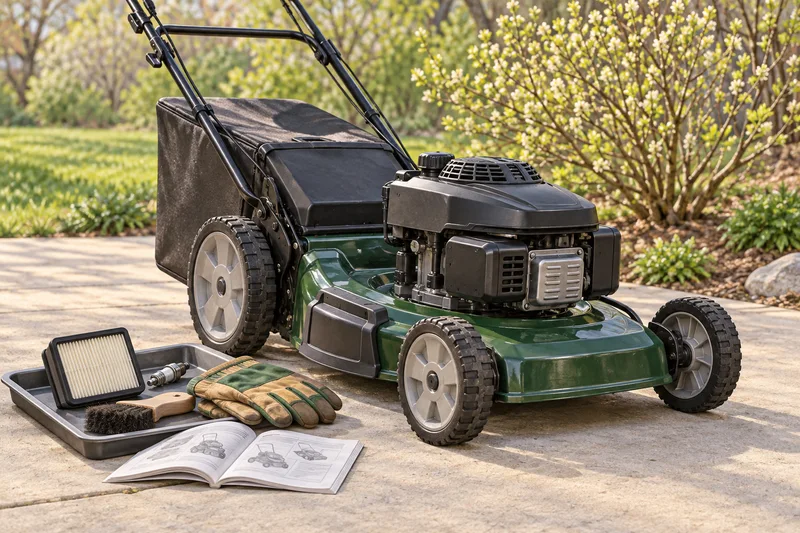
Before the first spring cut in Nixa, work through the mower in this order: identify its manuals, make it safe to inspect, check the machine, complete the gas or battery checks that apply, then test its controls and cut. A mower that starts is not automatically ready to use. This checklist helps you separate routine preparation from problems that should keep the mower parked until they are repaired.
1. Find the right manuals before buying a tune-up kit
Photograph the mower's model and serial label. On a gas machine, also record the engine identification; the engine and mower are not necessarily made by the same company. Find the matching operator and engine manuals, including the correct serial range. For cordless equipment, keep the battery and charger instructions with them. Toro's support guidance uses model and serial numbers to identify manuals and parts.
Make a short job list from those documents, not from a generic spring shopping list. Separate checks required before each use from services due by operating hours or calendar time. If you serviced the mower before winter, use that record rather than automatically replacing the same parts again. If its history is unknown, mark it unknown and ask a qualified shop to establish a baseline.
At Pebble Creek, dependable equipment matters because Southwest Missouri mowing work still needs to get done when the grass is ready. For a homeowner, the useful takeaway is to inspect before the day you need to mow. This guide is about readiness, not choosing a new mower or teaching a full blade-sharpening procedure.
2. Shut it down and inspect the whole machine
Park on a firm, level surface, shut off the engine or motor, wait for every moving part to stop and let hot components cool. Follow the manual's service-isolation procedure: remove the key if fitted, disconnect the gas engine's spark-plug lead where directed, or remove the cordless mower's detachable battery packs and safety key. Electric-start gas machines may need additional battery isolation. Do not assume switching it off prevents an accidental start.
Check guards, discharge components, handles, wheels, accessible fasteners and visible wiring before addressing cosmetic dirt. Use the table as a record, not permission to dismantle something you cannot safely service. A missing guard or failed safety control is a repair, not an optional improvement. Never bypass a safety device to get one more mowing done.
| Check | What to look for | Hold the mower out of use when… |
|---|---|---|
| Guards and discharge setup | Correct bag, cover, chute or mulch insert installed as the manual requires | Protection is missing, broken or cannot stay secured |
| Handles, wheels and controls | Secure attachments; normal control movement; tires checked as specified | Something is loose, damaged, binding or does not release correctly |
| Gas system, if fitted | Leaks, damaged lines and secure fuel cap | Fuel is leaking or fuel-system damage is visible |
| Battery and charger, if fitted | Intact cases, connections and cords; no damage or abnormal condition | A pack is damaged or a charger/cord is defective |
| Deck and cutting assembly | Safe-access inspection for damage, buildup and loose parts | A blade is cracked or bent, or mounting damage is suspected |
3. Gas mower: check what is due, not just what is in the kit
Check engine oil exactly as your engine manual describes, including the level-checking method. Use its specified oil and capacity; do not pour in an entire bottle simply because it came in a kit. Perform an oil or filter change when your model's schedule requires it. A general internet interval is not a substitute for that engine's instructions.
Inspect the air filter and follow the procedure for its actual type. Paper, foam and combined filters are not interchangeable maintenance tasks. Do not assume every filter should be washed, oiled or blasted with compressed air. Check the spark-plug service requirement, correct part, gap and installation instructions before removal or replacement. Briggs & Stratton's spring guide identifies these common service items; it does not make every kit compatible with every engine.
Review what happened to the fuel during storage. Use fresh, manufacturer-approved fuel; if old or contaminated fuel is suspected, follow the manual or ask the shop about safe removal and disposal. Do not keep adding products and trying to start it as a substitute for diagnosis. Refuel only outdoors with the engine stopped and cool, away from ignition sources, and address spills before starting.
Check each proposed kit component against the manufacturer's parts information. Kawasaki's kit table, for example, lists different engine families and kit numbers. The mower's paint color, deck width or brand alone is not enough. Buying the correct individual parts can be more sensible than a bundle containing items your service does not require.
4. Battery mower: different service, not no service
A cordless mower does not need a gasoline-engine oil change, spark plug or engine air-filter kit. It still needs sound cutting parts, guards and controls. With the packs removed, clear accessible debris using the cleaning method in its manual. Do not copy a gas mower's wash-down routine onto electrical equipment; EGO specifically cautions against hose washing its cordless mowers.
Inspect the battery, charger and cord before charging. Use the manufacturer's approved compatible equipment and temperature limits. Do not charge or use a damaged battery, open its case, improvise a repair or defeat a protective feature. Have battery damage evaluated through the manufacturer or an authorized service provider. If a charge or fault indicator is unfamiliar, consult its meaning rather than repeatedly restarting the machine.
Write the battery and charger model on your service record too. That makes a call about a fault more useful than simply saying the mower is electric. If the mower has several packs, identify which one showed the problem without deliberately operating damaged equipment to reproduce it.
5. Inspect the cutting system, then make a controlled test
Access the underside only by the method specified for that mower, with the power isolated. Do not guess which way to tip a gas mower or reach beneath an unsupported raised machine. If you lack the lifting equipment, tools or training the procedure requires, have a qualified shop do that inspection. Gloves do not remove the cutting hazard.
A damaged blade needs the correct replacement, not an attempt to bend or weld it back into shape. Use the manual's blade hardware and torque requirements. Leave detailed sharpening, balancing and deck-cleaning procedures to their dedicated instructions. First establish that the assembly is intact and safe.
Once servicing is complete, reinstall protective components and reconnect power only as the manual directs. Carry out its control, brake and safety-interlock checks in a clear, safe area. Never run a gasoline engine in a garage, even with the door open. Keep children, pets and bystanders away; stop for unusual vibration, noise or a control that fails its test.
Choose a small, dry, debris-free lawn section for the first cut, with the appropriate height setting. Check the result before committing to the whole yard. An uneven or torn cut calls for investigation, not repeated passes at a lower setting. Our mowing-height and blade-quality guides explain the lawn side of that decision.
6. Leave yourself a usable maintenance record
A note saying 'tuned up in spring' will not tell you what is due next. Use one row per task and record what was actually checked or replaced. Keep receipts and part numbers with the machine's identification photos. Do not mark a failed inspection complete just because you have ordered the part.
Here is a hypothetical hours example, not a service interval recommendation: if your manual specifies a particular service every 50 hours, it was last done at 80 hours and the meter now reads 126, the next hours-based service is at 130—4 operating hours away. An earlier calendar deadline or special-condition requirement still takes precedence. Without a meter, keep a running usage estimate and follow the manual's calendar requirements.
| Task | Completed record | Next action |
|---|---|---|
| Model and manual check | Mower/engine/battery IDs and manual revision | Keep with receipts |
| Oil, filter or plug service, if applicable | Date, meter hours, exact part and work done | Manual's next due date/hours |
| Guard and blade inspection | Pass or specific defect—not just 'checked' | Repair and recheck before use if failed |
| Controls and first-cut check | Test outcome and any abnormal symptom | Service diagnosis if unresolved |
| Shop work | Work order, findings and replaced parts | Record the shop's documented follow-up |
7. For a Nixa service call, bring the problem and the identification
We recommend Nixa Hardware & Seed Company as a local starting point for mower-service questions, including SCAG owners. Its official power-equipment page lists SCAG among the brands it services and describes a full-service small-engine repair shop. The listed location is 510 W Mt Vernon Street, Nixa, and the phone is 417-725-3512. The page lists no mechanics on Saturday, so confirm service intake and current shop availability before loading the mower.
Give the shop your model and serial numbers, engine details if applicable, service history and a concise symptom description: when it last ran normally, what changed and whether it struck an object. Ask about diagnostic charges, authorization before extra work, turnaround and transport arrangements. Do not assume a listed brand means every model, battery system or warranty repair is accepted. This recommendation is not a promise of price, availability or a dealer partnership.
If you would rather arrange mowing than maintain your own equipment, ask Pebble Creek about service for your Nixa property. A service inquiry is separate from mower repair; we are not offering a small-engine repair service. Confirm coverage and scheduling for the address rather than assuming immediate availability.
Related Lawn Guide chapters
Useful gear for this topic
Compare service parts only after checking your engine manual
For a gas mower with service due, compare the required parts individually with a correctly matched kit. This optional category is not a universal spring shopping list and is unnecessary for battery mowers. Pebble Creek has not tested the items in these search results.
As an Amazon Associate, Pebble Creek earns from qualifying purchases. Your price is not increased. How we choose recommendations.
Mower engine service kit matched by engine model
Best for: Comparing kit contents with the engine manufacturer's required oil, filters and spark plugs after identifying the exact engine.
Do not choose by mower brand or deck width alone. Verify engine model/specification, serial range, manufacturer part numbers, oil grade and quantity in the current manuals. Confirm each included part and seller; a generic search does not establish compatibility. Battery mowers do not need gasoline-engine tune-up kits. Follow safe service procedures or use a qualified shop. No firsthand testing or guaranteed fit is claimed.See current Amazon options ↗Sources and further reading
- Toro: product safety and correct-manual lookup ↗
- Toro: TimeCutter HD MyRide 75210 manual (model-specific example, not a universal service schedule) ↗
- Toro: residential mower maintenance and preparation ↗
- Briggs & Stratton: spring engine maintenance items ↗
- EGO: cordless mower maintenance and safety ↗
- Kawasaki Engines: tune-up kit compatibility ↗
- Nixa Hardware & Seed Company: service information ↗
This chapter provides general educational information. Site conditions vary, and product labels and equipment manuals control whenever a product or machine is used.