
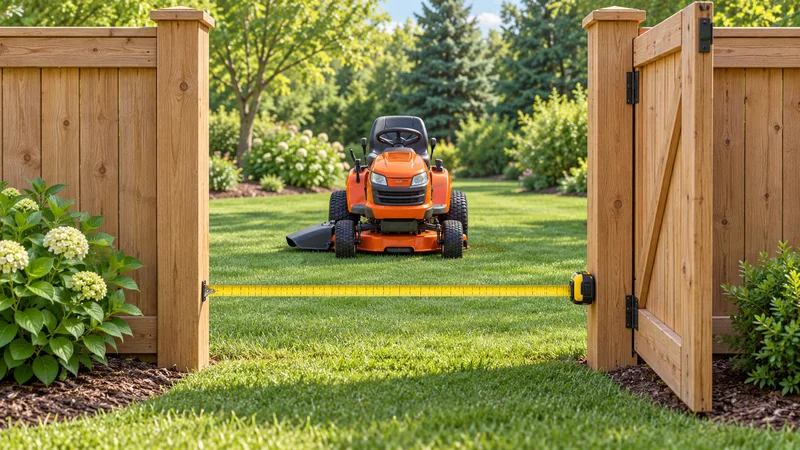
Choose a deck only after checking the mower's actual outside width against your narrowest access point. A 42-inch cut does not mean a 42-inch-wide machine. Then check the turns, storage and areas you can realistically mow with it. The best size is the one that finishes your property efficiently without making every gate a squeeze—not automatically the biggest deck your budget allows.
Cutting width and machine width are different measurements
Cutting width describes the strip the blades cut. For access, you need the widest part of the complete machine in the configuration the manufacturer permits for that situation. Ask for operating width, transport width, total length and the dimensions with any collection equipment installed. A listing that gives only deck size has not answered the gate question.
SCAG's Liberty Z specifications distinguish chute-down width from transport width. The linked Toro TimeCutter 42-inch manual instead lists widths with the deflector down and up. These examples, checked October 25, 2026, show why an exact model and configuration matter. They are not interchangeable measurements or promises that a raised deflector may be used while mowing.
Use the table to shortlist—not to buy sight unseen. Confirm the model year, serial range and accessories, then measure the assembled mower at the dealer. A different machine with the same advertised cut can have a different outside width.
| Machine / nominal cut | Chute or deflector down | Manufacturer's narrower dimension |
|---|---|---|
| SCAG Liberty Z / 36 | 48.5 | 37 transport |
| SCAG Liberty Z / 42 | 54.5 | 43 transport |
| SCAG Liberty Z / 48 | 60.5 | 49 transport |
| Toro TimeCutter / 42, linked manual | 53 | 48.5 deflector up |
Walk the whole route with this measuring worksheet
Pebble Creek's Southwest Missouri mowing work includes fenced lawns, not just open fields. That is why the route from storage to the grass belongs in the buying decision. Start where the mower will live and walk to every separate lawn area. A generous front gate does not help if the passage beside the house is narrower.
Open each gate fully and secure it against movement before measuring. Measure the clear gap, not the gate's advertised size or the distance between the centers of its posts. Include hinges, latches and anything projecting into the opening. Check at the heights where different parts of the mower will pass; a leaning post can make the upper opening narrower.
Record actual numbers and take photos from both directions. Do not round a 47½-inch opening up to 48. Note a gate that drags, a latch you have to hold out of the way or a path that is only usable when dry. Those are unresolved access problems, not extra clearance.
| Checkpoint | Record | Check beyond the number |
|---|---|---|
| Storage door | Clear width, height and inside parking space | Shelves, handles, steps and the door's open position |
| Every gate | Narrowest usable gap at relevant heights | Latch, hinges, leaning posts and gate swing |
| Side passage | Narrowest width along the entire route | Downspouts, meters, beds and fixed obstacles |
| Approach and exit | Straight space before and after each opening | A turn immediately beyond the gate |
| Mowing area | Open strips and narrow spaces between obstacles | Where the full operating configuration must fit |
Calculate leftover space—but do not invent a universal safety margin
Subtract the machine's verified width from the clear opening. For a hypothetical 49-inch opening and a 43-inch machine configuration, 49 − 43 = 6 inches total, or 3 inches on each side only when perfectly centered. That calculation describes space; it does not certify the route or a transport procedure.
The same opening and a 49-inch machine leave zero clearance. Reject that pairing. Even a small positive result can disappear when the ground is uneven, a post leans or your approach is angled. Do not treat a fraction of an inch on paper as a practical daily fit.
There is no universal extra-inch rule in this worksheet. Take your measurements and photos to the dealer and agree on a comfortable, manufacturer-compliant access plan. Where fit is marginal, choose a narrower machine, use another suitable mower for that area or have the access problem properly assessed before purchasing.
Measure a mower only when safely parked: follow its manual to disengage blades, set the brake, stop the engine, remove the key and wait for movement to stop and hot parts to cool. Never reach under the deck to find a measurement. Keep helpers away from a moving mower.
A mower that passes straight through may still fail the turn
Imagine a gate followed immediately by a right-angle turn beside a raised bed. The opening width alone tells you almost nothing about that second maneuver. The machine's length, projecting deck and accessories also occupy space while turning. A zero-turn label does not make the mower's physical footprint disappear.
Sketch the route from above. Mark both gate posts, the wall or bed beyond them, and the available straight approach and exit. A cardboard outline of the published footprint can help reveal an obvious conflict on your sketch or a clear level surface, but it cannot reproduce the mower's steering behavior. Do not use it as proof of safe access.
Ask the dealer for a controlled demonstration appropriate to your route, with a trained operator and no bystanders in the maneuvering area. Explain any slope, drop-off, soft ground or drainage ditch before discussing fit. Toro's manual requires a terrain assessment; enough width is not evidence that a riding mower is suitable for the terrain.
Do not remove a discharge guard or tie it up while mowing to make a larger deck fit. The Exmark Quest manual warns against mowing without the required deflector, mulch kit or complete collection system. Any transport adjustment or approved attachment must follow the exact machine's instructions, with its protective configuration restored for mowing.
Will a wider deck actually save work on your lawn?
After access passes, compare the open mowing area rather than the lot's total acreage. Draw the lawn without the house, driveway, beds and other non-grass areas. Identify the largest uninterrupted rectangle and separately mark places that still need a smaller mower or trimmer. A wider machine is less compelling if it cannot reach much of the grass.
Here is a simple hypothetical comparison, not a timed mower test. Across a 120-foot-wide open rectangle, assume a 3-inch overlap on every pass. A 48-inch deck covers an effective 45 inches, or 3.75 feet: approximately 32 passes. A 60-inch deck covers 57 inches, or 4.75 feet: approximately 26 passes after rounding up. Actual edge passes and overlap will vary.
Six fewer passes do not tell you the minutes saved. You still need the length of each pass, a suitable operating speed, turning time and time spent going around obstacles. Keep the overlap assumption consistent and do not assume a faster speed gives an acceptable cut.
For a broad front lawn and a small fenced rear lawn, compare two complete plans: one smaller mower for both, or a larger machine plus a separate suitable tool for the rear. Include extra storage, maintenance and switching time. This is a useful reason to keep a working small mower, not a reason every homeowner needs two.
Take a short, specific request to the dealer
Instead of asking only for a 48- or 52-inch deck, say: “Here are my smallest opening, the turn behind it and the storage space. Please show me a machine that can use this route safely in its intended configuration.” Bring the worksheet and photos so the conversation stays about your property.
Write the exact model and all included attachments beside the dealer's measurements. Ask what changes between transport and mowing, and where the manual describes it. If the proposed solution depends on removing a guard, rubbing a post or ignoring an awkward turn, the access question has not been solved.
Once the route works, use our broader mower-selection and brand-comparison guides for power, comfort and service support. If you would rather arrange mowing than buy equipment, our lawn-care and service-area pages explain the options. Keep the final decision simple: workable access first, manageable mowing pattern second, then equipment features.
- Pebble Creek lawn-care services ↗
- Check our service areas ↗
- Choose a mower for your whole property ↗
- Compare mower brands and local dealer support ↗
- Bring: opening measurements, route sketch, photos and storage dimensions.
- Confirm: actual outside width, overall length, installed accessories and permitted transport configuration.
- Resolve before purchase: close fits, turns, terrain concerns and areas needing another tool.
Related Lawn Guide chapters
Useful gear for this topic
Compare a measuring tape only if you need one
An existing readable tape may handle every gate measurement. This optional category comparison is useful for longer route and lawn measurements; it is not a tested product endorsement or a mower-fit guarantee.
As an Amazon Associate, Pebble Creek earns from qualifying purchases. Your price is not increased. How we choose recommendations.
Long open-reel measuring tapes
Best for: Recording longer side passages and open mowing areas, with readable feet-and-inch graduations. A suitable tape you already own is enough for a short gate opening.
Check units, smallest marked increment, the manufacturer's zero-point instructions and tape condition. Keep the tape straight without stretching it; recheck close openings with a suitable shorter tape. A measurement tool does not establish a safe mower clearance. Measure around stationary equipment only. Search results may include metric-only or unrelated tools; no firsthand testing is claimed.See current Amazon options ↗Sources and further reading
- SCAG: Liberty Z dimensions ↗
- Toro: TimeCutter 42-inch operator manual ↗
- Exmark: Quest operator manual and discharge protection ↗
This chapter provides general educational information. Site conditions vary, and product labels and equipment manuals control whenever a product or machine is used.