
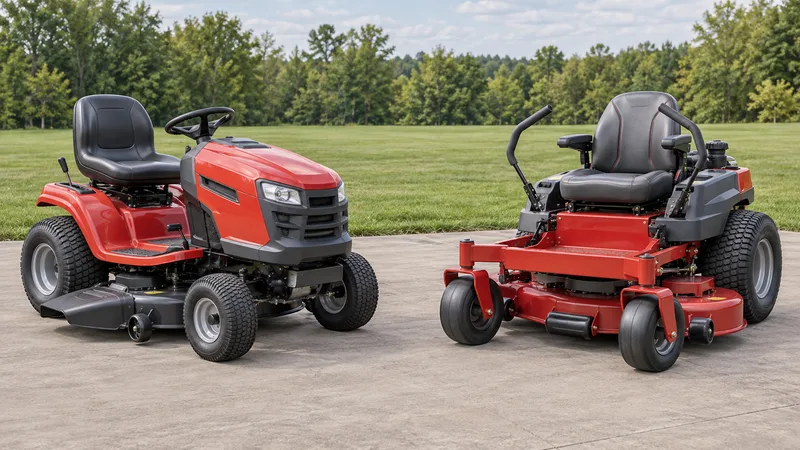
A zero-turn is worth comparing when mowing around obstacles and turning at the end of rows are your main frustrations. A lawn tractor is worth comparing when you prefer its controls or need a particular compatible attachment. Neither category wins automatically on hills, price or cut quality. Start with the work your property requires, then eliminate machines that cannot safely do it.
What changes when you move from a tractor to a zero-turn?
A conventional lawn tractor uses a steering wheel and follows a turning arc. A typical lap-bar zero-turn changes the relative speed of its drive wheels to steer, allowing much tighter turns. Husqvarna's control guide explains that difference, including how quickly a large difference between the controls can turn the machine. A familiar seat does not mean familiar handling.
Not every zero-turn uses lap bars: Cub Cadet, for example, also documents steering-wheel zero-turns. Compare the actual steering system, braking procedure and operator instructions rather than identifying a machine by the shape of its controls alone. Here we are comparing homeowner lawn tractors with seated zero-turns, not farm tractors or stand-on commercial machines.
At Pebble Creek, mowing and landscape-bed care are part of our Southwest Missouri work. For this buying decision, our starting point is the route around the property—not a promise that one machine will mow every yard faster. Map the grass, beds, entrances and areas needing separate attention before you shop. This guide does not claim firsthand testing of the models in shopping results.
Use this property decision matrix
Write one sentence about the job that matters most: finishing a large mowing area, navigating repeated turns, using a specific implement, or fitting equipment into limited storage. Then use the table to decide which machines deserve a demonstration. A strong preference is not enough to overcome a failed safety or clearance check.
The useful comparison is between two complete setups, including the collector, chute, hitch or other equipment you will actually use. Do not compare a bare tractor with a fully equipped zero-turn and assume the difference comes entirely from the mower category.
| Property or task | Lawn tractor: check this | Zero-turn: check this |
|---|---|---|
| Many trees and curved beds | Turning arc and room to finish a pass without repeated repositioning. | Maneuvering space, visibility and comfortable low-speed control around each obstacle. |
| Mostly open mowing | Useful cutting width and comfortable operating pace. | Whether quicker row-end turns actually matter on your layout; no fixed time-saving promise. |
| Cart, collection or other attachment | Exact approved implement, hitch and operating limits—not just the word tractor. | Exact approved accessory and towing limits; do not assume every zero-turn can tow or none can. |
| Slopes, ditches or wet ground | Exact manual, surface conditions and areas to exclude. | The same site-specific checks; a tight turning radius does not establish stability. |
| Gate and storage access | Total configured width, length, turning space and room for attachments. | Chute, collection system and any rollover-bar clearance, plus space to enter and exit safely. |
Treat slopes and edges as safety exclusions—not tie-breakers
Do not use the shortcut 'tractor for hills, zero-turn for flat ground' as a safety rule. CPSC identifies overturning as a hazard for riding mowers and garden tractors. Either candidate can be unsuitable. Have the actual terrain assessed against the exact operator's manual, including its operating direction, slope limits and attachment restrictions.
Toro's zero-turn guidance warns about wet grass, sudden movements, water, retaining walls and drop-offs. Those are reasons to leave an area out of the riding-mower route, not challenges to overcome with extra speed or horsepower. A published maximum angle is not a guarantee that every surface below it is safe.
Photograph questionable areas from a safe position and take them to a qualified dealer or service provider. Include drainage ditches, ruts, soft edges and the route between lawn sections. If control or stability is doubtful, stop and arrange a different maintenance method. Keep children and bystanders away and never remove guards to reach closer to an obstacle.
Match attachments to real jobs before paying for versatility
Make a short list of non-mowing jobs you actually perform, and how often. 'Move leaves with a cart each fall' is more useful than 'might need attachments someday.' Ask for the implement's part number, the machine models it is approved for, any required hitch or weights, and the applicable load and terrain restrictions in writing.
A lawn tractor may offer the combination you need, but its name does not make it a substitute for a garden or compact utility tractor. Likewise, some zero-turns support approved hauling, bagging or mulching accessories. Cub Cadet's ZTS accessory guide explicitly makes compatibility model-specific; it is not permission to fit those items to another machine.
For a collection system, ask to see the full installed footprint and the emptying procedure. For a cart, check the mower and cart instructions together, including total loaded weight and slope restrictions. A hitch hole is not a towing-capacity rating. If a proposed task is outside the manufacturer's approved use, remove that combination from your shortlist.
Include installation, removal and storage in the decision. An attachment used twice a year can still occupy space all year. Compare owning it with a separate tool, rental or occasional service, using actual local quotes if you need a cost comparison. We are not assigning invented purchase prices or annual savings here.
Check storage, comfort and the complete mowing session
Measure the narrowest entrance and the available parking space, then compare the complete machine dimensions supplied by the manufacturer. Deck cutting width is not necessarily overall width. Account for the discharge equipment, collector and overhead clearance, and leave usable room to get on, get off and access routine service points. Do not defeat a guard to squeeze through.
Ask for a supervised demonstration on a suitable area with the manual available. Can you reach and use the controls comfortably, stop predictably and maneuver at a controlled pace? Include the person who will normally mow. Neither a steering wheel nor lap bars are automatically comfortable for everyone, and a stationary seat test cannot answer every operating question.
Compare the whole session: preparing the area, mowing, trimming the excluded spots, emptying a collector, cleaning as instructed and putting everything away. The fastest advertised travel speed is not your mowing speed or a guarantee of the best finish. Our general mower-buying worksheet covers broader budget and access questions; use this comparison to narrow the riding-mower type.
A correctly fitted storage cover can be an optional finishing purchase, not a substitute for suitable storage. Compare shape, complete-machine measurements, ventilation and the manufacturer's care instructions. The referenced Classic Accessories tractor-cover instructions require cooling before covering and prohibit use during operation or transport on an open truck or trailer. Read the exact cover's instructions; do not assume a storage cover is a transport cover.
Three example choices—and the final dealer questions
These are hypothetical examples, not Pebble Creek customer case studies or timed equipment tests. An open, level lawn with several island beds and no attachment jobs: start by demonstrating a zero-turn alongside a tractor, concentrating on controlled turns and the remaining trimming work. Keep the tractor in consideration if it meets the owner's needs more comfortably.
A mostly open property where an approved cart or collection system is central to upkeep: compare complete compatible packages before choosing. The implement may decide the shortlist. Do not buy a mower first and discover later that the accessory you expected is unavailable or inappropriate for its rated use.
A property with a narrow entrance and a steep or unstable edge: solve those constraints before choosing either type. A ride-on may serve only the accessible section, or neither candidate may be suitable. Leaving a dangerous section to another maintenance approach is a valid decision, not a failure to buy enough mower.
Before buying, leave with four answers: which areas the machine can appropriately maintain; which exact accessories are approved; where it will fit when fully configured; and who supplies routine service and parts. Choose the option that passes those checks and addresses your main task. If you would rather compare mowing service, send Pebble Creek your address and the difficult areas; availability depends on our actual service area.
Related Lawn Guide chapters
Useful gear for this topic
Compare storage covers after choosing the mower
An existing suitable storage arrangement may need no extra purchase. These optional category searches compare zero-turn and tractor cover shapes, not mower performance. Verify the exact dimensions and instructions; the results are not tested endorsements or guaranteed matches.
As an Amazon Associate, Pebble Creek earns from qualifying purchases. Your price is not increased. How we choose recommendations.
Zero-turn mower storage covers
Best for: Comparing covers shaped for a seated zero-turn, with documented dimensions, ventilation and a securing system appropriate to stationary storage.
Match the complete machine, including controls, any rollover bar and collection equipment, to the exact cover fit chart. Cool the mower before covering and follow both manuals. Do not use a storage cover during operation or assume it is approved for open-trailer transport. No firsthand use or universal fit is claimed.See current Amazon options ↗Lawn-tractor storage covers
Best for: Comparing tractor-shaped covers by overall length, width, height, ventilation and whether the installed collection system is included in the fit specification.
Deck size alone does not prove fit. Check the exact mower and cover instructions, including new-machine restrictions, cooling, drying and accessory clearance. A storage cover is not automatically suitable for transport or a replacement for safe storage. No firsthand testing of these listings is claimed.See current Amazon options ↗Sources and further reading
- Husqvarna: lap-bar steering control explanation ↗
- Cub Cadet: zero-turn maneuverability and steering-wheel alternatives ↗
- Cub Cadet: model-specific Ultima ZTS attachments ↗
- Toro: zero-turn safety, slopes and edge hazards ↗
- CPSC: mower safety and riding-mower overturn hazards ↗
- Classic Accessories: tractor-cover fitting, cooling and transport cautions (PDF) ↗
This chapter provides general educational information. Site conditions vary, and product labels and equipment manuals control whenever a product or machine is used.