
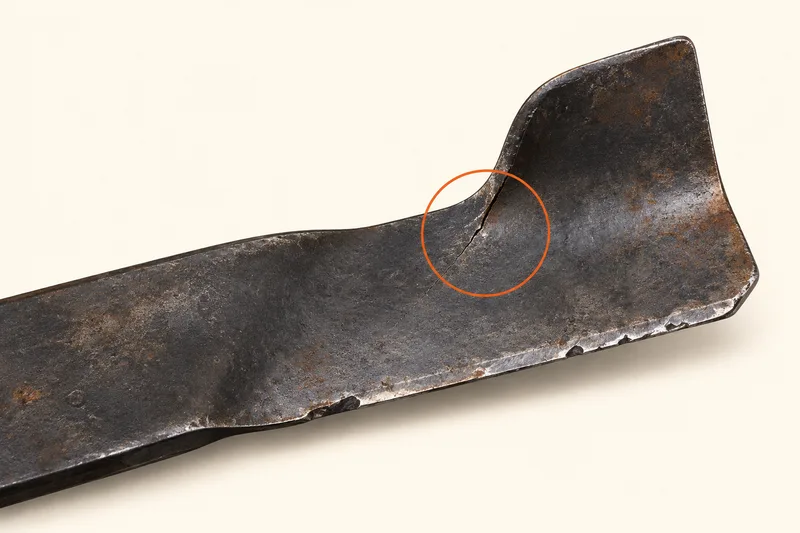
A dull edge does not automatically mean a new blade, and a sharp edge does not make a damaged blade usable. Start with the blade's condition, then identify the correct replacement if needed. For Southwest Missouri homeowners, that order can prevent two wasted trips: paying to sharpen a blade that should be discarded, or buying a replacement that looks right but does not belong on the mower.
First, make inspection possible without starting the mower
Find the operator's manual for your exact machine before reaching near a blade. Stop the mower, wait for all movement to end and follow its power-isolation procedure. EGO's cordless guidance calls for removing the detachable battery before checking the machine; a gasoline mower has different instructions. Turning a switch off alone is not a complete service procedure.
Use the manual's approved access and support method. Do not crawl under an unsupported raised mower, improvise a lifting arrangement or tip a gasoline mower in an arbitrary direction. Wear the specified protection and keep fingers away from cutting edges and pinch points. If you cannot access the blade safely, the next step is a shop inspection, not a closer look while it runs.
Have the technician distinguish the edge from the blade body, curved sail and mounting area. A new vibration after an impact is a reason to stop and investigate; it is not proof that sharpening is the answer. Explain what happened, even if the mower still starts.
Dull, cracked or bent: choose the right next step
Toro's TimeCutter HD MyRide manual separates dull or nicked cutting edges from cracks, wear and slots in the curved blade area. Its damaged-blade instructions call for replacement. Treat that distinction as the starting question, while using your own model's inspection criteria.
The table is a triage aid, not a remote safety certification. If you cannot tell whether a mark is a surface scratch or a crack, leave the mower out of service until a qualified technician resolves it. Never straighten a bent blade or weld a cracked one.
| What you find | Next decision | Do not assume |
|---|---|---|
| Dull edge or small nicks; no other defect identified | Have it assessed for sharpening within the manufacturer's limits. | Every nick can be ground away without removing too much metal. |
| Crack, broken section or slot forming near the sail | Replace the damaged blade under the model's instructions. | Sharpening or balancing repairs structural damage. |
| Bent blade or distorted mounting area | Stop using it and have the blade and mounting components assessed. | A fresh edge will correct the bend. |
| Heavy thinning or repeated sharpening | Compare remaining material with the exact manual's discard limits. | A blade is usable merely because it can still cut. |
| Impact followed by vibration or an uneven cut | Stop and arrange inspection before further mowing. | Replacing the blade alone rules out other damage. |
There is no universal number of sharpenings
Two blades sharpened the same number of times may have very different amounts of metal left. A light touch-up and an attempt to remove a deep gouge are not equivalent. Count alone is a poor reason to approve a worn blade for another season.
For a concrete manufacturer example, the SCAG SFC-21 manual linked below says to replace a blade if any part is worn to half its original thickness, and not to sharpen beyond one-third of its width. Those are SFC-21 instructions, not permission to apply those thresholds to every SCAG, Toro or battery mower. Find the limits that belong to your model.
If the original shape or required measurement is unclear, ask the dealer to assess it against the correct specification. Do not grind until a damaged blade looks symmetrical and call the job finished. Balancing is part of permitted sharpening; it does not establish that a blade is straight or free of cracks. Replacement is the sensible endpoint when the manual's limits are reached.
Build a replacement-parts record before shopping
Start with the mower identification plate and the correct parts diagram. SCAG's support guidance uses the complete model and serial numbers to locate manuals and recommends dealer help identifying parts. Photograph those numbers while they are readable. If the deck has its own identification or has been changed, record that too.
Use the checklist below as a buying worksheet. Write an answer beside each item, or mark it unresolved. The old blade's stamp is useful evidence, but a previous owner may have installed the wrong part. Cross-check it with the machine's parts information instead of treating it as the only authority.
A useful question for a parts counter is: 'Here are my model, serial number and deck information. Which blade part number and any replacement hardware does the manufacturer specify for this setup?' Keep the written answer with the receipt so next year's purchase starts with a verified record.
- Machine identity: manufacturer, complete model, serial number and any separate deck identification.
- Current configuration: deck width and whether it uses side discharge, an approved mulching kit or a bagging setup.
- Part identity: original blade part number, any documented superseding number, and the exact proposed replacement number.
- Mounting and geometry: approved center-hole interface, any outer holes, length, thickness, offset, lift and rotation.
- Package contents: individual blade versus the correct set, plus required bolts, washers or other specified hardware.
- Installation information: the applicable manual, orientation, fastening procedure and torque; book shop installation if needed.
Why length and a product photo cannot prove fit
Oregon's blade-geometry reference shows several separate dimensions: center and outer holes, width, thickness, offset and air lift. The cutting direction matters too. A matching overall length is only one check. For measurements, follow the maker's method: Oregon's 95-370 specification explains diagonal corner-to-corner length and measurements near the center for width and thickness.
Here is a hypothetical shopping mistake: two listings show blades of the same length, but one has a five-point mounting opening and the other a different interface. The matching length does not settle the purchase. Some manufacturers document alternative hole shapes for specific adapters, so appearance alone cannot establish compatibility in either direction. Use the documented application or get dealer confirmation.
Do not drill, file or otherwise alter a blade to make it fit. Do not substitute extra washers or choose a higher-lift blade merely because an advertisement promises more airflow. The replacement must be approved for the actual machine and configuration. A ruler can help identify a part; it cannot certify compatibility.
If shopping online, compare the mower manufacturer's specified part with a replacement manufacturer's explicitly documented cross-reference. Check the exact seller listing and package quantity after that. If the listing's title, specifications and part number disagree, resolve the discrepancy before ordering.
Get the part checked locally, then return to mowing
For SCAG parts questions in Nixa, we recommend starting with Nixa Hardware. Its power-equipment page lists SCAG and a small-engine service department. Take your identification photos and parts worksheet; call 417-725-3512 to confirm help for your exact model and current availability. Its posted Saturday shop hours say no mechanics, so do not assume an inspection can be done during a Saturday parts visit.
Ask the installer to record the replacement number and the inspection outcome, especially after an impact. Keep the removed, rejected blade separate from usable spares so it cannot accidentally go back onto the mower. Have the shop advise on safe disposal. If abnormal vibration persists after service, stop and return for diagnosis rather than trying to mow through it.
The optional comparison below is a starting search for replacement blades, not a preselected fit for your mower. Enter the verified part number before choosing a listing. You may prefer to buy directly from the dealer who confirmed the application; this guide does not claim Pebble Creek tested the search results.
Our Southwest Missouri lawn-care focus is helping you keep the property on a workable mowing schedule. Pebble Creek provides mowing in Nixa, Republic, Clever, Billings and South Springfield west of Highway 65; Ozark is available for projects rather than recurring mowing. Equipment diagnosis belongs with the appropriate repair provider. For lawn service while you sort out equipment, check our coverage and request an estimate.
Related Lawn Guide chapters
Useful gear for this topic
Compare replacement blades after confirming the part number
This optional category search helps compare the specified OEM part with documented aftermarket replacements. Enter your verified part number to narrow the results. Buying from the dealer who confirmed fit is also an option; Pebble Creek has not tested these search-result products.
As an Amazon Associate, Pebble Creek earns from qualifying purchases. Your price is not increased. How we choose recommendations.
Replacement blade matched by OEM part number
Best for: Comparing the exact specified blade, documented cross-references, single-blade versus set contents, and required hardware after the mower and deck have been identified.
Search results are not fitment approval. Confirm the complete model and serial range, OEM part number, mounting interface, length, thickness, offset, lift, rotation and deck configuration with the manufacturer or dealer. Follow its replacement and installation instructions. Never modify a blade to fit; no universal compatibility or firsthand testing is claimed.See current Amazon options ↗Sources and further reading
- Toro: TimeCutter HD MyRide 48-inch, model 75210, serial 401000000 and up—blade inspection ↗
- SCAG: SFC-21 operator manual, section 7.6—blade wear limits ↗
- SCAG: FAQ—model, serial number and parts support ↗
- Oregon: blade features, geometry and mounting interfaces ↗
- Oregon: 95-370 product specification—measurement definitions only ↗
- EGO: cordless lawn-mower maintenance and isolation ↗
- Nixa Hardware: power equipment and service department ↗
This chapter provides general educational information. Site conditions vary, and product labels and equipment manuals control whenever a product or machine is used.