
The first mowing is due when your grass has resumed growth and needs a cut under suitable conditions. The last mowing is the final needed cut before growth stops—not automatically the last visit in a service agreement. For Southwest Missouri homeowners, the useful question is not simply which month to circle. It is what the lawn is doing today and how that compares with the previous visit.
Use the calendar to plan inspections, not force a cut
MU Extension's cool-season maintenance calendar says to continue normal-height mowing until growth ends. It also recommends removing no more than one-third of the green leaf area in one cut. Together, those two rules give a better seasonal bookend than a universal opening or closing date. A lawn that still needs cutting should not be abandoned just because the month changed; grass that has stopped growing does not need an extra pass for the calendar's sake.
Make your calendar entry a reminder to look, measure, and decide. Record the date checked separately from the date actually mowed. That small distinction prevents an inspection, rain delay, or leaf-only visit from being mistaken for a completed mowing. If someone else maintains the property, agree on how those different visits will be described before the season gets busy.
Know which grass you are starting and stopping
Tall fescue and zoysia do not follow the same growth pattern. University of Maryland Extension describes spring and autumn as the main growing periods for cool-season turf, with warm-season turf growing in summer. Temperature, sunlight, soil moisture, and fertility all influence the pace. Its general growth principles are useful here; Maryland's calendar dates should not be copied onto a Missouri property.
MU's turf guidance also distinguishes warm-season zoysia from cool-season fescue. Do not apply advice about a low spring cleanup cut on zoysia to a tall-fescue lawn. If the property has different grasses in different areas, identify those areas before selecting the first-cut height. An existing green lawn is not proof that every section should receive the same treatment.
A practical first-mowing checklist
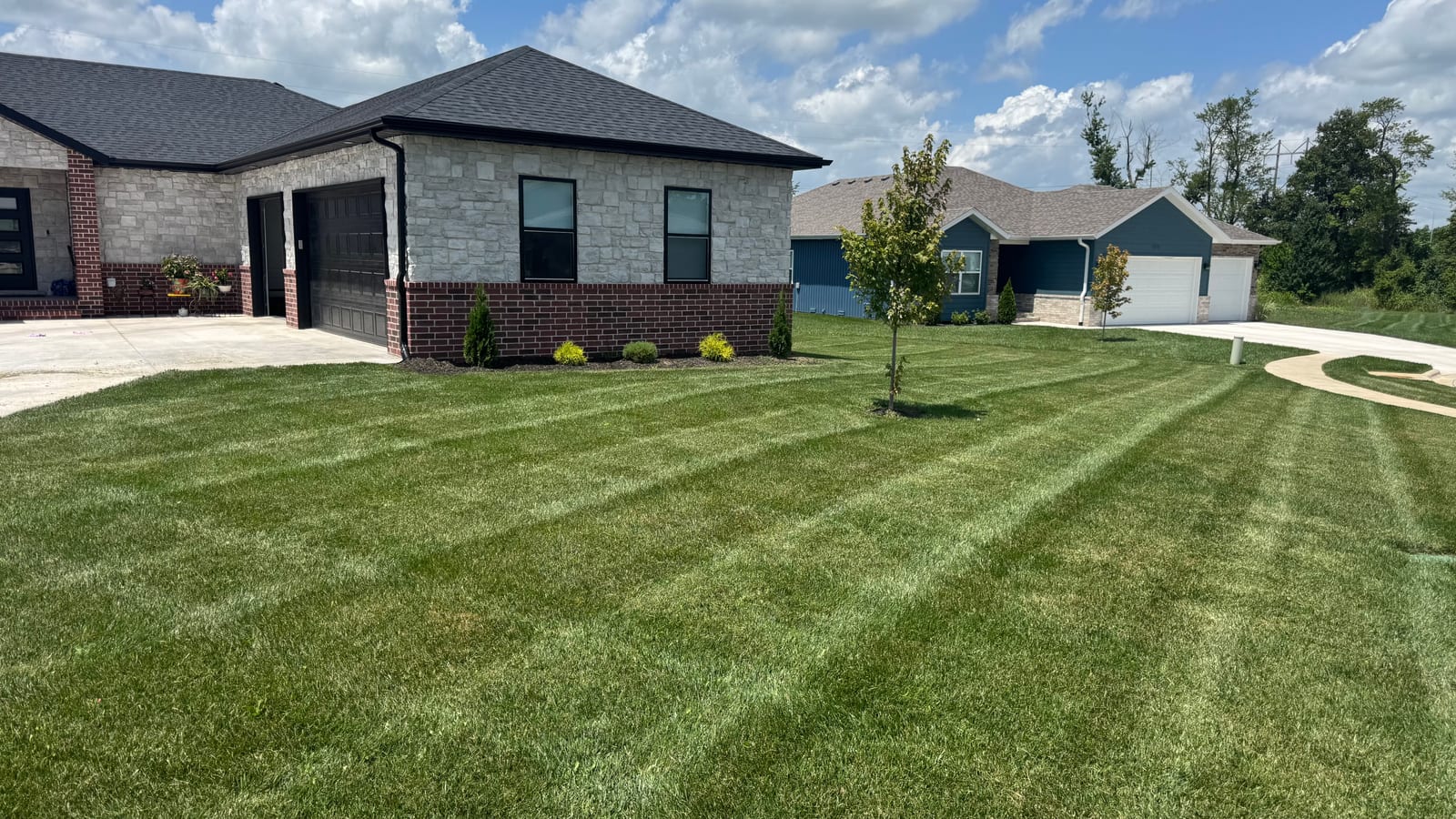
Start with a walk around the property. Locate branches, toys, loose edging, and other obstacles before bringing out the mower. Ask whether any work was done over winter that changed an access point or left a hazard. Our residential work photo shows an open lawn beside a driveway and planted beds; even that straightforward layout has boundaries to check before a new season begins.
Measure several representative patches rather than the tallest isolated weed. Compare grass height with the intended finished height, using the one-third rule from article 1.2. If the lawn has already become overgrown, use the gradual catch-up approach in article 1.8. Do not call an aggressive recovery cut a normal first mow just because it is your first visit of the year.
Ground conditions still matter. Maryland Extension advises against mowing wet lawns or lawns whose growth has paused from drought or heat stress. If the turf is not ready, write down why and arrange another check. An outdoor thermometer can help you record a weather trend, but one reading cannot establish grass growth, soil firmness, or mower traction.
- Identify the grass and choose its appropriate seasonal mowing height.
- Check access, obstacles, and any newly disturbed areas with the property owner.
- Record the measured height, whether a cut is needed, and the reason for any delay.
- Check the mower's condition using its own preseason instructions before operating it.
End with a normal maintenance cut, not a scalp
For Missouri cool-season turf, MU's recommendation is regular mowing heights until growth stops. Cutting extremely low to finish the year is not a substitute for deciding whether another visit is needed. Keep the grass-specific height and one-third limit in view, including when the interval between autumn cuts becomes longer.
Treat the final date as something you confirm afterward. For example, note that you mowed on one inspection, then record no additional cutting needed on later checks. If the lawn subsequently needs another appropriate cut, the later completed visit becomes the final mowing. This is a planning example, not a report about a particular Pebble Creek customer or a promise about the length of every mowing season.
Separate leaves and seasonal cleanup from grass growth
MU Extension warns against allowing leaves to pack down and smother turf. That need can remain even after mowing is finished. A leaf visit and a grass-cutting visit may happen together, but they answer different questions. Discuss what cleanup is included rather than assuming the last mowing automatically finishes every outdoor task.
For a clear request, describe the areas involved: front lawn, fenced backyard, side access, or landscape beds. Include recent photos of the leaf coverage and any access restrictions. Ask the provider to distinguish mowing, leaf handling, and bed cleanup in the scope. That makes an end-of-season estimate easier to understand and helps avoid paying for a service you thought was already included.
Store the mower after the work is actually finished
The Exmark Commercial 21 manual, hosted by Toro, calls for seasonal maintenance before storage and a cover to keep the mower clean and protected; its safety instructions require cooling before storage. Follow the instructions for your exact mower, engine, and battery rather than borrowing another machine's fuel or charging procedure. A cover is only part of storage preparation; it does not replace maintenance, a suitable location, or the manufacturer's safety directions.
Before buying a cover, write down the model and measure the machine in its approved storage position. Compare cover dimensions, handle clearance, fastening, and ventilation information. A cover advertised for a walk-behind mower is not necessarily appropriate for a riding mower. Keep the manual and your last service record together so restarting next year begins with known information instead of guesswork.
Make next season easier to schedule
Keep a short record with the actual first and last mowing dates, the finished height, postponed visits, and separate cleanup dates. Add one wide photo from the same viewpoint at each seasonal boundary. Over time that gives you a useful property history without pretending that last year's dates guarantee this year's weather or growth.
When requesting Pebble Creek lawn care, share your address, current photos, grass type if known, and whether you want recurring mowing or a single visit. Mention any existing agreement's start or end date so we can distinguish the service schedule from the lawn's needs. The lawn-care, service-area, and estimate links below are the next step for a property-specific plan in Southwest Missouri.
Related Lawn Guide chapters
Useful gear for this topic
Useful tools for the start and end of mowing season
Compare an outdoor thermometer for recording weather trends and a properly fitted cover for storage. Neither sets your mowing dates. These are category comparisons, not products we claim to have personally tested.
As an Amazon Associate, Pebble Creek earns from qualifying purchases. Your price is not increased. How we choose recommendations.
Outdoor minimum/maximum thermometer
Best for: Recording outdoor temperature trends alongside your own grass-height and ground-condition checks.
Check the manual for outdoor sensor placement, measurement range, and weather exposure limits. Temperature alone does not decide whether a lawn needs mowing.See current Amazon options ↗Mower storage cover matched to your equipment
Best for: Covering a cleaned, cooled mower after the final mowing and the manufacturer's storage preparation.
Match dimensions and handle clearance to your model. Follow the mower manual for cleaning, cooling, fuel or battery care, and storage; a cover is not a substitute for a suitable storage location.See current Amazon options ↗Sources and further reading
- MU Extension: Cool-Season Grasses Lawn Maintenance Calendar ↗
- University of Maryland Extension: Maintaining an Established Lawn ↗
- MU Extension: Managing Lawns and Turfgrass ↗
- Exmark Commercial 21: Mower Storage and Maintenance (use your exact model's manual) ↗
This chapter provides general educational information. Site conditions vary, and product labels and equipment manuals control whenever a product or machine is used.