
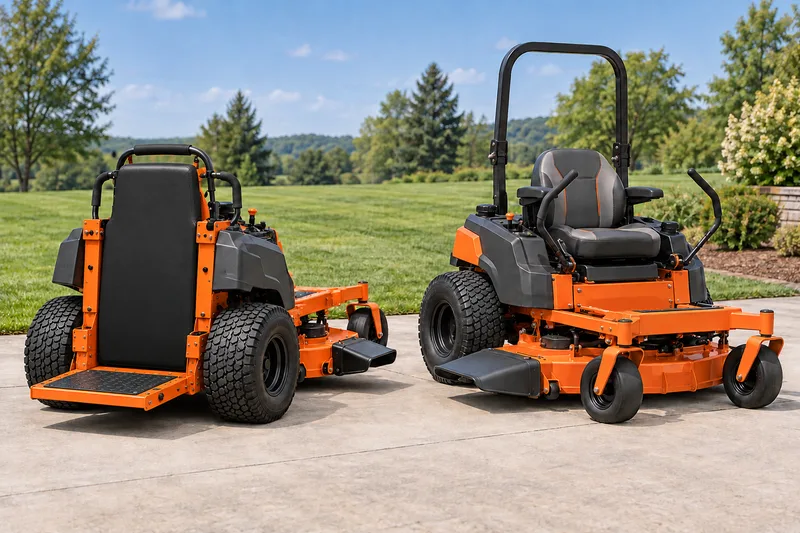
A stand-on mower is worth trying when you make frequent stops and need a compact machine. A seated zero-turn is worth trying when you spend longer stretches mowing and prefer a seat. Neither choice automatically wins on comfort, access or safety. Start with your actual route and storage space, then compare both with a supervised dealer demonstration. The deciding question is not which looks more professional—it is which you can operate comfortably and correctly on your property.
Match the operator position to the work you actually do
Write down a normal mowing day before shopping: how long you mow at a stretch, how often you stop for gates or cleanup, and where the mower must travel between lawn areas. A homeowner mowing one open lawn has a different routine from someone loading a trailer between several properties. Do not buy around a hypothetical route you might someday have.
Pebble Creek's Southwest Missouri mowing work includes fenced residential lawns as well as larger open areas. That mix is why we suggest separating the machine's cutting job from its access and handling jobs. A mower may cut the open section comfortably but still be awkward to store, maneuver through a gate approach or get on and off repeatedly.
Use the table as a shortlist, not a verdict. A stand-on design puts the operator behind the machine on a platform; a seated design provides a seat and a different reach to the controls. Within each style, the platform, padding, suspension, controls and adjustment range vary. Your experience on one mower does not establish how every mower in that category feels.
| Your routine | What to compare | What would rule it out |
|---|---|---|
| Many short stops | Safe shutdown and mounting routine; footing and reach | You cannot enter or leave the operating position securely |
| Long uninterrupted mowing | Seat or platform fit after more than a brief try | Pain, numbness or difficulty maintaining comfortable control |
| Tight storage or transport | Full assembled length, width, height and loaded weight | It only fits with unsafe changes or no usable clearance |
| Several operators | Adjustment range and training for each person | The machine suits one person but another cannot control it correctly |
Do a comfort test, not a parking-lot popularity contest
Ask the dealer to explain the controls and safety systems before a demonstration. Start with the engine off: can you reach the controls without stretching, place your feet securely, see the deck edges and look behind you without fighting your position? Wear the footwear and required protective equipment you would normally use. Record what needs adjustment before moving.
Then, where the dealer permits and conditions are safe, compare low-speed starts, controlled turns, stopping and visibility around representative obstacles. Avoid judging either machine only on smooth pavement. Ask whether a supervised grass demonstration is available; do not invent a rough-ground test, approach a ditch or try a slope to prove what a mower can handle.
Make a simple note after each demonstration: comfortable, needs adjustment, or unsuitable for reach, footing, visibility and vibration. Include getting on and off only after following that mower's stopping procedure. If two people will operate it, each needs to try it. A salesperson's preference is not a substitute for the actual operator's fit.
Standing is not automatically easier on your back, and sitting is not automatically fatigue-free. There is no universal comfort winner here. Stop if you develop pain, numbness or unsafe fatigue rather than pushing through to finish a test. If an existing physical limitation affects operating a mower, get appropriate advice before choosing equipment; a mower comparison cannot determine medical suitability.
Compare complete dimensions—compact does not always mean narrower
Here is a useful reality check from two SCAG specification pages checked October 26, 2026. Both examples have a nominal 52-inch cut, but their overall dimensions are different. The V-Ride II is shorter in these published figures, while the Patriot is slightly narrower. These are examples of specific product families, not a comparison of all stand-on and seated machines.
The listed length difference is 73 − 69.5 = 3.5 inches. That may matter in a particular storage arrangement, but it is not a promise of extra trailer capacity. Accessories, securement space, usable trailer dimensions and weight limits can change the answer. Measure the actual assembled mower and confirm how the manufacturer defines each dimension.
Do not assume a foldable platform or a lowered roll bar has been included in a headline measurement. Ask for the exact operating and storage configurations and the rules for using them. Transport width is not permission to mow with a discharge guard lifted. For the full gate-measuring worksheet, use our deck-width guide; this comparison is about the additional footprint and operator-position decision.
| Dimension | V-Ride II stand-on | Patriot seated |
|---|---|---|
| Length | 69.5 | 73 |
| Width, discharge chute down | 65.25 | 64.5 |
| Width, chute in transport position | 53.75 | 53 |
| Height | 47.25 | 61 with ROPS up; 46.5 folded |
Check storage and the whole job—not just maximum speed
Mark the proposed parking footprint on the garage or shed floor, then add the room you actually need to enter, leave and maintain the mower. Check door hardware, shelving and overhead obstructions. A rectangle that technically fits can still block the route to your other equipment. If transport is part of the plan, have the dealer review loading, ramp compatibility and securement with you.
For a fair work comparison, separate mowing time from loading, gate handling, trimming and cleanup. Use your own timed observations with suitable equipment, not a manufacturer's maximum travel speed multiplied by deck width. The faster-looking mower may not reduce the parts of your routine that consume the most time.
For example, if your recorded visit takes 60 minutes and only 35 minutes are mowing, there are 25 minutes outside the cutting task. Changing operator style cannot automatically erase those 25 minutes. This is a planning example, not a Pebble Creek performance test or a prediction of savings. Ask what specific part of your routine the proposed machine improves before paying for it.
Also ask how maintenance access works on the exact model. Can you check the items the operator manual assigns to you without awkward reaching or removing equipment unnecessarily? Compare the service schedule, local parts support and warranty terms separately from the standing-versus-sitting preference. Neither style is exempt from upkeep.
Operator style does not override safety limits
Read the manual for the exact model and serial range before operation. A stand-on platform is not a reason to treat a mower as suitable for every slope, and being able to step off is not a rollover-safety plan. Do not transfer one model's slope limit to another. If the site falls outside the machine's instructions, choose a different method.
SCAG's safety guidance calls for intact guards and functioning interlocks, avoiding wet grass and staying away from drop-offs. For its ROPS-equipped seated mowers, follow the roll-bar and seat-belt instructions together: the raised, locked bar and belt are the operating configuration described in its guidance; a lowered bar provides no rollover protection. Check overhead clearance rather than treating folding the bar as a routine convenience.
Follow the manual's full parking and shutdown procedure before leaving the operator position. Use the required eye and hearing protection and keep other people out of the work area. Do not bypass a platform, seat or other safety switch to make repeated stops easier. Convenience is not worth disabling a protective system.
Choose the mower that passes your checklist
Choose a stand-on only if you prefer its operating position, can use it securely and have verified a real access or storage benefit. Choose a seated mower if its position fits you better and the complete machine works with your property and storage. If neither passes the checklist, keep looking rather than forcing a purchase because the deck size or monthly payment looks right.
We recommend including SCAG in your comparison and talking with Nixa Hardware & Seed Company as a local starting point. Its power-equipment page lists SCAG and a small-engine repair shop. Call to confirm the exact mower, demonstration arrangements and current service availability; this is not a claim that every model is in stock or that we have tested every current machine.
Bring your dimensions, a few property photos and your comfort notes to that conversation. Ask the dealer to show the manual, adjustments and maintenance access on the actual candidate. A useful quote identifies the model and included equipment, not just the brand. Compare total ownership needs after you know it fits.
If the better answer is to have the mowing handled for you, review Pebble Creek's lawn-care service and current service area or request an estimate. Owning a larger machine is only one way to solve a lawn-maintenance problem. The right result is reliable care with equipment and a routine that fit the property.
Related Lawn Guide chapters
Useful gear for this topic
Compare protective equipment for either mower style
Use suitable protection you already own. These optional category searches help compare fit and manufacturer documentation, not mower performance. Pebble Creek has not tested the products in these search results.
As an Amazon Associate, Pebble Creek earns from qualifying purchases. Your price is not increased. How we choose recommendations.
ANSI-rated safety glasses
Best for: Comparing side coverage, clear or tinted lenses and compatibility with prescription glasses and hearing protection.
Check the exact manufacturer's impact-rating documentation, coverage and fitting instructions. Ordinary sunglasses are not a substitute for required protective eyewear. Verify compatibility with other required protection; no firsthand testing or guaranteed fit is claimed.See current Amazon options ↗Hearing protection for outdoor power equipment
Best for: Comparing correctly fitted earmuffs and the manufacturer's noise-reduction and fitting information for equipment use.
Follow the mower manual and the hearing protector manufacturer's fitting instructions. A package rating does not guarantee actual protection; glasses can interfere with an earmuff seal. Ordinary noise-canceling earbuds are not necessarily hearing protectors. No firsthand testing or guaranteed protection level is claimed.See current Amazon options ↗Sources and further reading
- SCAG V-Ride II: dimensions and operator platform ↗
- SCAG Patriot: dimensions and operator seat ↗
- SCAG: operation and safety ↗
- SCAG: model-specific operator manuals ↗
- Nixa Hardware & Seed: power equipment and service ↗
This chapter provides general educational information. Site conditions vary, and product labels and equipment manuals control whenever a product or machine is used.