
A lawn can look green before mowing and suddenly show pale streaks or shaved patches afterward. Before adding water or fertilizer, check what the mower actually removed. Scalping is a cutting-height problem: the blade cuts too close to the surface in all or part of the lawn. The useful question is not simply whether the deck setting was low. It is why the cutting edge reached too low at that particular place.
Separate scalping from a rough-looking cut
Look closely at both the pattern and the remaining grass. A shaved high spot is different from leaves that remain tall but have shredded tips. A brown patch that was already present before mowing also needs a different investigation. Write down when the discoloration appeared rather than treating every brown area as mower damage.
MU Extension explains that an overly short cut removes leaf area needed to support the plant and its roots. Its advice also cautions against trusting the mower's adjustment markings as a measurement. Check the standing grass after mowing in several places, including the pale patch and the healthy-looking turf next to it. Those comparisons are more useful than the lever number alone.
Check whether the height suits the grass and the growth
For tall fescue, MU Extension lists seasonal mowing ranges of 2 to 3.5 inches in spring, 3 to 4 inches in summer, and 2.5 to 3.5 inches in fall. It also notes that conditions and intended use affect the choice. These are not settings to copy onto every Missouri lawn: identify the grass first and account for shade, stress, and the actual surface.
A second issue is how much leaf you remove at once. Follow the one-third guideline, even if the mower is set to a normally suitable height. Bringing six-inch grass directly to three inches removes half its height. After a missed cut, use a staged return to the normal routine rather than lowering the deck to make up for lost time. Several lower passes in one afternoon do not give the plant recovery time between cuts.
Notice where the ground changes shape
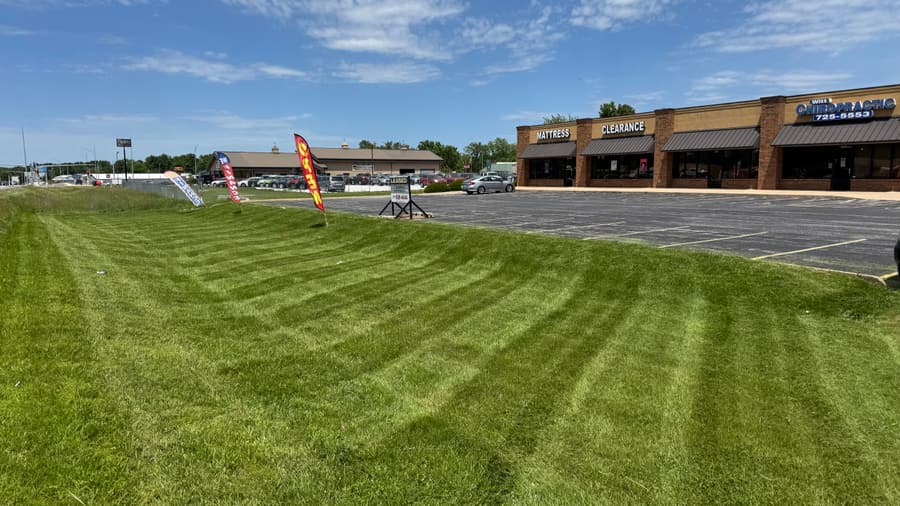
The commercial frontage in our cover photo has a different shape from a flat backyard. That is the kind of distinction worth recording for Southwest Missouri property care: a broad open area can still contain rises, drainage transitions, and pavement edges. Do not assume that an open property can be handled with one unchanging approach from boundary to boundary.
Toro recommends raising the cutting height on uneven turf to avoid scalping. Respect your machine's slope limits. If the same spot is shaved repeatedly, photograph the rise, dip, or edge involved so you can discuss a different maintenance approach instead of repeating the problem.
- Before the next visit, photograph the affected spot from the same direction and include enough surroundings to locate it.
- Note whether the problem repeats in the same place or follows the mower across otherwise different areas.
- Tell the crew about recent ground disturbance or a newly noticed obstacle before work starts.
Check tires before adjusting the deck
Uneven tire pressure can cause uneven cutting. Check pneumatic tires cold, using your mower's specified pressures; front and rear values may differ. Then follow its blade-tip measuring and deck-leveling procedure on level ground.
Before inspection, shut down, remove the key, wait for movement to stop, and follow the manual's power-isolation and support instructions. The linked Toro manual illustrates one model's procedure, not universal settings. Ask a service shop if yours is unclear.
Understand what anti-scalp rollers can and cannot do
Set anti-scalp rollers according to your model's manual and cutting height; they do not override terrain limits. Do not modify guards. After an impact or new vibration, stop and arrange an inspection.
For a service request, write down the mower model, the current height setting, and whether the uneven result started suddenly. A repeatable description gives the technician a starting point. Keep previous maintenance receipts together with those notes so a later visit does not begin with the same unanswered questions.
Do not water a cutting problem into a bigger problem
MU Extension's Home Lawn Watering Guide warns that dull-blade damage and scalped turf are sometimes mistaken for a need for more irrigation. Appearance alone does not tell you whether the soil is dry. Check moisture and recent rainfall before adding water; do not keep saturating ground that is already adequately moist.
Correct the cause before the next mowing and watch for new growth instead of promising that every damaged patch will recover on the same timetable. Take a dated follow-up photo. If the area keeps declining or remains bare, have it assessed before selecting a treatment or repair plan. Fertilizer and irrigation are not substitutes for identifying what went wrong.
Give your lawn-care provider a useful record
For a Pebble Creek mowing assessment, send the address, a wide photo, a close view of the cut grass, and the approximate date the issue appeared. Tell us whether it happens after every visit, follows one direction, or affects only one edge. If you mow yourself, include the mower model and any recent setup changes.
That information makes an onsite conversation more productive than simply asking for a greener lawn. Our mowing photographs show a range of residential and commercial properties; the goal is a plan suited to the actual ground, not an identical cut imposed everywhere. Use our lawn-care and service-area links to check coverage, then request an estimate if you would like help maintaining the property.
Related Lawn Guide chapters
Useful gear for this topic
Compare two tools for checking mower setup
A tire gauge checks inflation; a deck gauge checks cutting-edge height. They answer different questions, so start with the mower manual rather than buying parts at random. These are category comparisons, not claims that Pebble Creek tested the search results.
As an Amazon Associate, Pebble Creek earns from qualifying purchases. Your price is not increased. How we choose recommendations.
Mower deck leveling gauge
Best for: Comparing blade-tip height from side to side and front to back before blaming the turf for an uneven cut.
Choose a gauge with the range and clearance your mower's measuring procedure requires. Shut down and isolate power; follow the manual's blade-access and support instructions.See current Amazon options ↗Low-pressure mower tire gauge
Best for: Keeping mower tires evenly inflated so the deck does not sit lower on one side.
Choose a gauge whose measurement range includes your mower's specified pressure. Front and rear tires may differ; use the equipment manual, never a guessed pressure.See current Amazon options ↗Sources and further reading
- MU Extension: Cool-Season Grasses Lawn Maintenance Calendar ↗
- MU Extension: Mowing Too Short Can Harm Your Lawn ↗
- Toro: Mower Operation, Tire Pressure, and Deck Leveling (consult your exact model's manual) ↗
- MU Extension: Home Lawn Watering Guide ↗
This chapter provides general educational information. Site conditions vary, and product labels and equipment manuals control whenever a product or machine is used.