
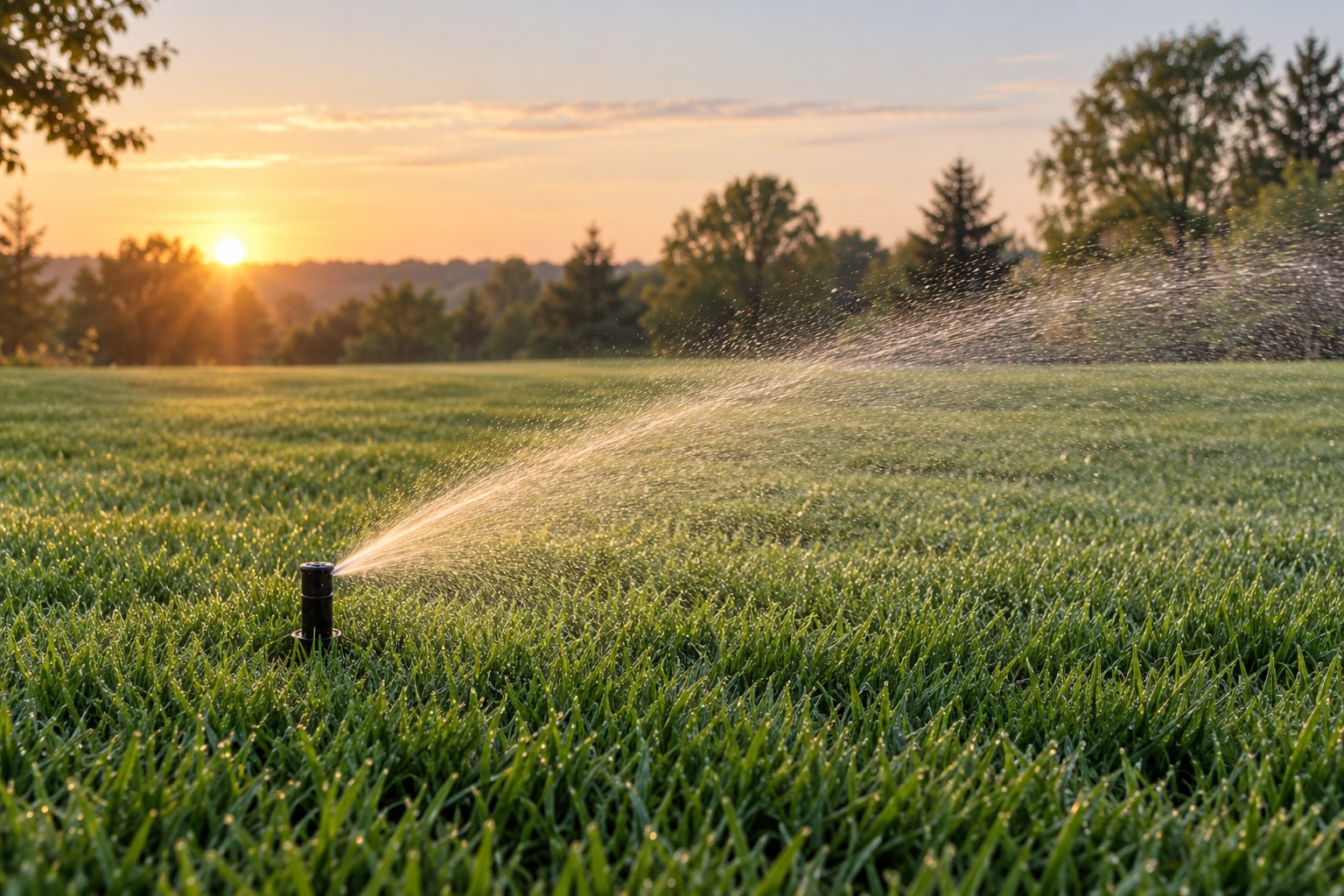
Morning is usually the better choice for an established lawn that actually needs water. MU Extension recommends roughly 6–8 a.m.: winds are often lighter, evaporation is lower, and grass can dry as the day warms. Evening may feel equally cool, but wet leaves can stay wet through the night. The useful rule is morning when needed—not every morning, and not the same rule for a fresh seedbed.
1. Why morning beats a routine evening watering
There are two separate concerns: getting water into the ground efficiently and limiting how long grass leaves remain wet. MU's Home Lawn Watering Guide favors early morning for both. A calm morning gives a sprinkler a better chance of putting water where you aimed it rather than drifting across a driveway.
Evening solves part of the heat problem but can extend leaf wetness into overnight dew. MU's drought-watering guidance explains that morning leaves the rest of the day for foliage to dry, whereas evening moisture can linger all night. That matters during warm, humid Missouri weather, when conditions can favor turf disease. It does not mean one evening watering automatically causes fungus.
The clock is a starting point, not a guarantee. A windy morning, saturated yard or rainy forecast may be a reason to postpone. Nor does a 6 a.m. start prove the lawn needs water. Check conditions first; guide 3.7 covers measuring the amount, while the next guide addresses how often to irrigate.
2. Choose a window, not an all-day watering habit
For established turf, make early morning the default window on days irrigation is justified. Avoid scheduling through the hottest part of the day just because the timer allows it. EPA WaterSense recommends avoiding midday irrigation and checking local utility guidance; hot or windy conditions can waste water and disrupt coverage.
Cooler evening temperatures are not the whole decision. Consider when the leaves will dry, whether rain has already met the need, and whether the utility permits watering then. This comparison is about routine timing for established grass—not a prescription for every seedbed or an announcement of current local restrictions.
| Window | Main tradeoff | Practical choice |
|---|---|---|
| Early morning | Often cooler and calmer; leaves can dry during the day. | Preferred when soil and turf checks show a need. |
| Hot or windy midday | More evaporation or drift; uneven coverage may worsen. | Avoid as the routine timer setting; reassess actual conditions. |
| Late evening or overnight | Cooler air, but a longer wet-leaf period can favor disease. | Do not make it the default simply because it is convenient. |
| Rainy or already-wet conditions | An ideal clock time does not fix excess water. | Skip or delay the run and check again. |
3. Set the timer backward from your finish time
First establish the necessary runtime from your own sprinkler measurements; do not copy the minutes from another lawn. Then fit that runtime into the available morning window. A hypothetical setup needing 40 minutes of sprinkler-on time, with a chosen 7:00 a.m. finish, would start at 6:20 a.m. Those minutes illustrate clock planning only, not a watering dose.
If the same measured total must be split because water runs off, allow time for absorption breaks too. For example, two 20-minute runs separated by a 30-minute break occupy 70 minutes: 5:50–6:10, a break until 6:40, then 6:40–7:00. That example starts earlier than MU's preferred window; choosing a later finish could keep it within 6–8 a.m. The correct break length depends on the site, not this arithmetic.
Check your timer's manual before programming. A start time may launch a whole multi-zone program rather than one zone. Add all zone runtimes and breaks when working out the finish. Verify AM versus PM, the device clock, enabled days, extra programs, and the stop time during an observed test. Avoid accidentally repeating the entire program because each zone was given another start.
A rain-delay control can postpone a saved schedule; it is not necessarily an automatic rain sensor. Orbit's B-hyve XD instructions, for example, describe a user-selected delay period. Features and restart behavior vary by model. Confirm what yours does, and review the next run after rain, a power interruption or a clock change.
4. What if you missed the morning?
Do not start an evening make-up cycle solely because a calendar reminder was missed. If the root zone is still adequately moist and the established lawn is not showing a need, reassess the next morning. If it is dry and showing stress, the issue is the plant's condition, not maintaining a perfect streak of morning starts.
MU identifies lingering footprints, rolled leaves and a bluish-purple cast as possible water-stress signals and advises watering within a day of seeing them. Brown color alone does not diagnose thirst: dormant grass, disease and other problems can look similar. Inspect moisture before adding more water. If daytime watering is necessary, watch the actual coverage and runoff instead of extending a timer blindly to compensate for heat.
A basic hose timer may help if work hours are the only obstacle to morning watering. Choose one that supports the schedule you need and has understandable shutoff and delay controls. Inspect connections, follow pressure and freeze-care limits, and watch the first run. Automation should remove an inconvenient wake-up, not remove your checks.
5. New seed is the important exception
A freshly seeded area cannot rely on the established lawn's deeper root system. MU's establishment guidance calls for a moist seed zone and light, frequent irrigation at first. Depending on drying conditions, that can require attention later in the day as well as in the morning. A morning-only rule that lets germinating seed dry out defeats the establishment plan.
Keep moisture even without puddling or washing seed downhill. University of Maryland Extension identifies ponding and erosion as common causes of seedling failure. Separate the new patch from established turf when possible so maintaining one seedbed does not repeatedly soak the whole lawn. Follow the seed or sod establishment instructions and adjust as roots develop; our overseeding guide covers that transition in more detail.
6. Coordinate watering with the next mowing visit
For your Pebble Creek mowing visit, tell us about active sprinkler programs, recently seeded areas and soft spots before the crew arrives. Shutoff time and mowing-ready time are not necessarily the same: grass and ground may still be wet after a morning cycle. Our wet-grass mowing guide explains why the crew may need to wait even though irrigation has finished.
Keep a short timer note: the area being watered, why irrigation is needed, the allowed day, start and finish times, any soak breaks, and when you will inspect it again. Remove obsolete evening programs rather than layering a new morning program over them. Review the setup when seasons change instead of leaving a summer routine running through a cool October week.
The takeaway is simple: use a calm early-morning window for routine irrigation of established grass, let moisture and plant condition decide whether to run it, and manage new seed separately. A well-chosen time helps; it cannot correct too much water, poor sprinkler coverage or soil that is already saturated.
Related Lawn Guide chapters
Useful gear for this topic
Compare an optional timer for morning watering
You may not need new equipment. If your schedule prevents morning watering, compare timer controls against your existing hose and sprinkler. This is a product-category comparison, not a field-tested endorsement or a reason to irrigate more often.
As an Amazon Associate, Pebble Creek earns from qualifying purchases. Your price is not increased. How we choose recommendations.
Programmable hose watering timer
Best for: Comparing clear start-time and duration settings, manual shutoff, rain delay and the number of outlets needed to run a portable sprinkler in the morning.
Check hose threads, supply-pressure limits, batteries, outdoor rating and freeze-care instructions for the exact model. Confirm whether rain delay is manual or sensor-driven and observe the first run. A timer does not measure lawn moisture or establish the right runtime. No firsthand testing of these listings is claimed.See current Amazon options ↗Sources and further reading
- MU Extension: Home Lawn Watering Guide—morning window and stress checks ↗
- MU Extension: Tips for Watering Your Lawn During a Drought—leaf wetness ↗
- EPA WaterSense: Watering Tips—timing, controls and cycle-and-soak ↗
- MU Extension: Lawn Establishment and Renovation—new seed care ↗
- University of Maryland Extension: Seedling Problems—ponding and erosion ↗
- Orbit: B-hyve XD Rain Delay—model-specific control example ↗
- Hunter: Pro-C Program Start Times—one start runs all assigned stations ↗
This chapter provides general educational information. Site conditions vary, and product labels and equipment manuals control whenever a product or machine is used.