
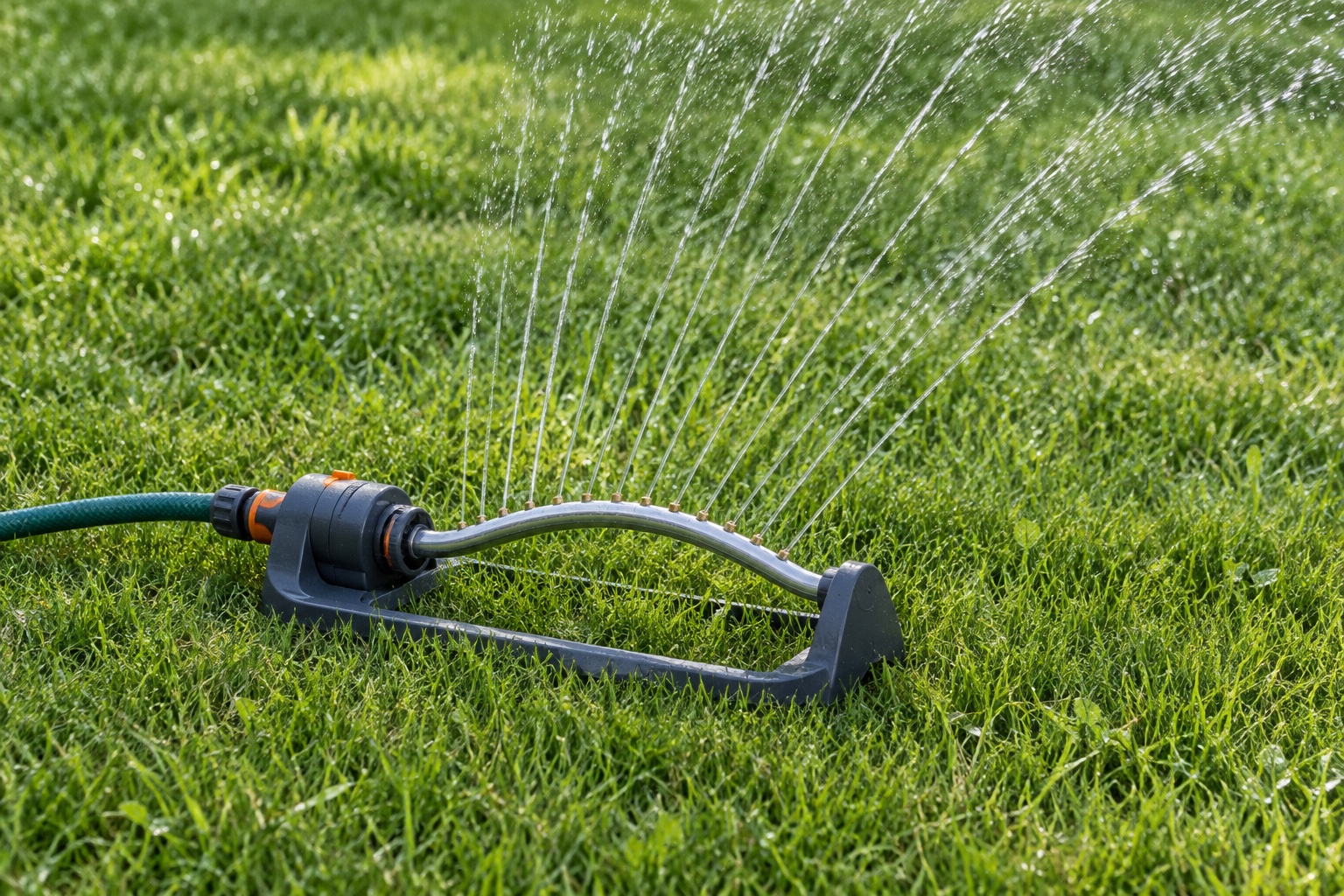
For an established lawn you want to keep green during a Springfield summer, MU Extension gives roughly 1 to 1.5 inches per week from rain and irrigation combined as a planning range—not an automatic sprinkler allowance. Subtract rain that actually reached the soil, then measure how quickly your sprinkler delivers the remaining amount. Cooler weather, wet soil, new seed and summer dormancy change that decision. Here is how to turn a water-depth target into a useful number of minutes.
1. Decide what you are watering for
The summer range above describes keeping established turf green and growing. It is not a year-round minimum or a command to add 1.5 inches every week. In a cool, rainy October week, supplemental irrigation may be unnecessary. Inspect the lawn and root-zone moisture instead of leaving a July setting running into fall.
Keeping tall fescue green and managing a dormant summer lawn are different goals. Dormancy can reduce routine irrigation, but prolonged drought can still kill turf; brown grass is not proof of safe dormancy. MU describes occasional survival watering during extended drought, and guide 2.4 explains that decision. Do not apply this green-lawn worksheet blindly to a dormant lawn.
New seed and newly laid sod also need their own establishment plan. They cannot be managed as a mature root system. Use the overseeding guide and your seed or sod instructions rather than delivering this worksheet's whole total in one session. Confirm the grass type before borrowing someone else's watering program.
2. Subtract measured rain and water already applied
Keep a simple record for the same seven-day period: rain, sprinkler water already applied and the remaining amount. Use a rain gauge in a representative open spot, following its placement instructions. A weather app's area total is useful context, but it is not a measurement of your own lawn.
For a basic estimate, remaining irrigation depth = chosen total target minus useful rainfall minus irrigation already delivered, with a minimum of zero. This is a planning worksheet, not a measurement of plant water use. A downpour that runs off or water caught by tree cover is not all stored in the root zone. Check the soil and distribution before crediting every measured inch—or adding water just to balance the arithmetic.
The hypothetical example below uses a 1-inch total target for one established, actively growing lawn in suitable conditions. It is not a Springfield weather report or a dose recommended for every property.
| Record | Example depth | What it means |
|---|---|---|
| Chosen total target | 1.00 inch | A working assumption for this example, including rain. |
| Rain credited | 0.35 inch | Assumed to have soaked into the target area. |
| Irrigation already applied | 0.15 inch | Count it; do not restart the total at each visit. |
| Remaining irrigation | 0.50 inch | 1.00 − 0.35 − 0.15 = 0.50 inch. |
3. Measure sprinkler output with a catch test
Set several identical, shallow, straight-sided containers upright across the area being watered, including near and far parts of the pattern. Avoid sharp-edged cans, keep the setup stable and remove every container before mowing. Use a ruler to read water depth, not the volume of differently shaped containers.
Run the sprinkler for a measured interval, such as 20 minutes, under the pressure and settings you normally use. Write down each depth. Add the depths and divide by the number of containers to get an average; keep the individual readings too. Test each separate zone or portable-sprinkler position rather than assuming the entire yard receives one rate.
If some cups are almost dry while others are full, correct coverage first. Inspect blocked or tilted heads, leaks, spray direction and pressure according to the equipment manual. EPA's sprinkler checklist covers those checks. Extending the runtime to satisfy one dry corner can overwater the rest. Reposition or repair, then repeat the test.
4. Convert the missing inches into minutes
Suppose four hypothetical catch readings after 20 minutes are 0.18, 0.20, 0.22 and 0.20 inch. Their average is 0.20 inch. The measured application rate is 0.20 ÷ 20 × 60 = 0.60 inch per hour. To supply the example's remaining 0.50 inch, calculate 0.50 ÷ 0.60 × 60 = 50 minutes of total sprinkler-on time.
That is total runtime for the tested area, not 50 minutes for every sprinkler position regardless of overlap. Water received from adjacent positions counts too. Record where the sprinkler stood and reproduce the measured layout. If you change hose length, pressure, spray width or nozzle settings, check the output again.
For a volume check, 1 inch over 1,000 square feet is about 624 gallons. Half an inch over a 3,000-square-foot lawn is therefore about 936 gallons: 0.50 × 3 × 624. This geometry explains why a small depth can use a lot of water; it is not a utility bill estimate. Your actual meter use can be higher when water misses the lawn or leaks.
5. Stop runoff instead of forcing the full amount at once
The soil controls how quickly water can soak in. Watch the first run, particularly on slopes or compacted spots. If water pools or travels toward the sidewalk, stop. Let it soak in and reassess before continuing. Splitting needed runtime into shorter cycles with absorption breaks can help; EPA calls this cycle-and-soak.
In the 50-minute example, five 10-minute cycles would total the same on-time, but that is only arithmetic—not a universal setting. Your ground might start shedding water sooner, or need a longer break. Soil that is already saturated needs a pause in irrigation, not another cycle. Persistent wet patches deserve investigation.
Do not make up for a missed week by dumping several weeks' worth of water on the lawn. Recheck present moisture and demand. A controller or timer can stop an unattended sprinkler, but a saved program still needs seasonal review.
6. Check Springfield's current water guidance
City Utilities of Springfield's Ways to Save Water page provides local conservation guidance, including its linked Even/Odd Watering Program, avoiding pavement spray and checking leaks. It also lists Energy Services at 417-874-8200 for conservation questions. Check that official page and any current water-service notices before programming irrigation.
A conservation program or an allowed watering day is not an instruction to water when the soil is already moist. This article does not declare whether an emergency restriction is active today. If another provider supplies your address, follow that provider's current guidance. Springfield-area addresses do not all establish the same water-service relationship.
The quantity calculation works across nearby Missouri communities; city boundaries do not change the mathematics. What makes it useful locally is combining Missouri turf guidance, your own rainfall measurement and the actual supplier's current instructions.
7. Leave a clear record for the next visit
Save one line per lawn area: date range, turf goal, target depth, rain credited, irrigation already applied, catch-test rate, remaining runtime and any runoff observed. Label estimates as estimates. A family member or contractor can then see what has already happened instead of adding a second full watering.
For Pebble Creek mowing visits in our South Springfield service area, tell us about recent irrigation, new seed and soft spots before the crew arrives. The lawn-care and service-area links explain our actual coverage; this educational guide is not a claim of citywide mowing or irrigation-system installation.
The useful result is a measured amount with a reason behind it—not a rigid timer setting. Rain and sprinkler output tell you the quantity; checking the soil tells you whether applying that quantity still makes sense. Time of day and the spacing between watering days are separate decisions covered by the next guides in this chapter.
Related Lawn Guide chapters
Useful gear for this topic
Compare tools for measuring water and adjusting coverage
A ruler and suitable containers you already own may be enough for a catch test. These optional product-category comparisons are not field-tested endorsements, and buying a sprinkler does not establish your lawn's water requirement.
As an Amazon Associate, Pebble Creek earns from qualifying purchases. Your price is not increased. How we choose recommendations.
Simple outdoor rain gauge
Best for: Comparing readable scales, mounting options and capacity for recording rain at your property before calculating supplemental water.
Follow placement and freeze-care instructions. A gauge measures rain at its location, not soil moisture or effective rainfall everywhere in the yard. Check units and do not mix millimeters with inches; no specific listing is claimed to be tested by Pebble Creek.See current Amazon options ↗Adjustable lawn sprinkler
Best for: Comparing adjustable width and range for the actual lawn shape, water supply and hose setup—not simply the largest advertised coverage area.
Check the manufacturer's pressure and connection requirements. Measure output with catch containers, account for overlapping positions and rainfall, avoid runoff and follow current supplier restrictions. No fixed runtime or exact-product performance is promised.See current Amazon options ↗Sources and further reading
- MU Extension: Home Lawn Watering Guide—amounts and sprinkler measurements ↗
- MU Extension: Managing Lawns and Turfgrass—dormancy and establishment exceptions ↗
- City Utilities of Springfield: Ways to Save Water and local program links ↗
- EPA WaterSense: Watering Tips—adjusting amounts and cycle-and-soak ↗
- EPA WaterSense: Sprinkler Spruce-Up—leaks and uneven coverage ↗
- UMN Extension: Water-saving strategies—auditing systems and adapting to rainfall ↗
This chapter provides general educational information. Site conditions vary, and product labels and equipment manuals control whenever a product or machine is used.