
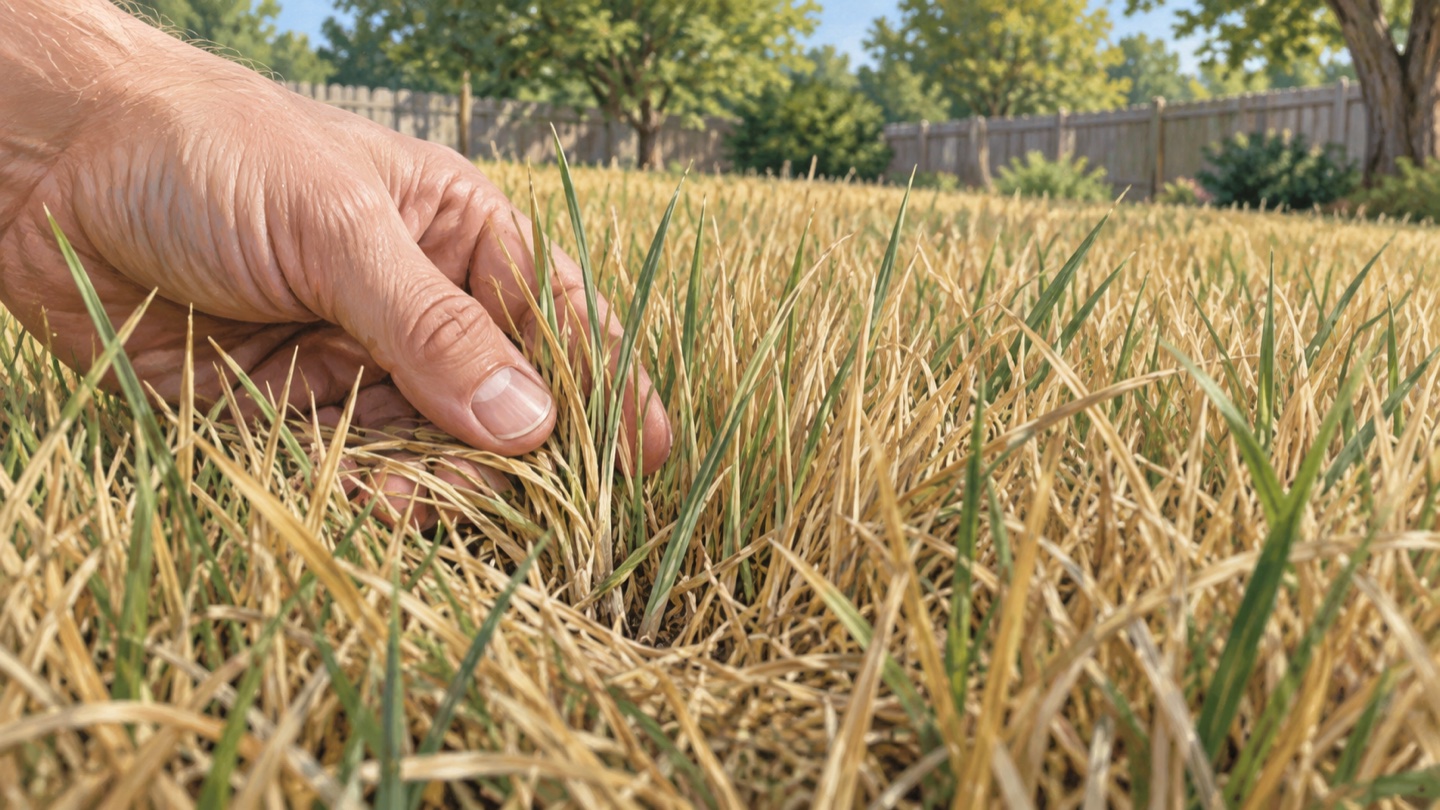
A tan lawn in August does not automatically need more mowing, fertilizer, or replacement. Established tall fescue can slow down and turn brown during hot, dry weather. Accepting that temporary loss of color can be reasonable—but calling it dormant is not permission to forget it. For a Nixa, Ozark, or Springfield property, start with three questions: is the grass established, can you supply water reliably, and are you seeing a broad dry-weather slowdown or a separate problem?
Dormant is a condition, not a guarantee
During dormancy, leaf growth stops or slows dramatically while living tissue at the plant's base can remain capable of recovery. MU Extension warns that this survival response does not guarantee complete recovery. A long drought can still kill grass. Brown color alone cannot tell you which plants will return.
That distinction matters when deciding whether to keep a mowing appointment. Our lawn-care approach separates appearance from the work the grass actually needs. A brown section with no meaningful growth does not need a cosmetic pass just because the rest of the property was cut last week. Describe the condition when arranging service rather than asking for a shorter cut to make the brown disappear.
Choose a realistic summer goal
Kansas State describes two broad approaches: supply enough water to support active growth, or accept dormancy during dry weather. Green color carries a water and maintenance commitment. Dormancy trades that appearance for reduced irrigation, but still requires observation. Neither choice should be made solely by comparing your yard with a neighbor's.
Make the choice explicit with everyone caring for the property. Decide who checks rainfall, who adjusts irrigation, and who contacts the mowing crew if growth stops. A small written plan prevents one person trying to wake up the lawn while another assumes watering has been paused. Respect local water restrictions before either plan.
- Prefer green turf: confirm that water access, coverage, cost, and restrictions support that goal.
- Accept summer browning: plan inspections and discuss survival watering rather than abandoning the lawn.
- New seed or sod: follow its establishment watering plan; do not deliberately stress it into dormancy.
Less watering does not mean no water forever
MU Extension's Home Lawn Watering Guide recommends 1½ inches of irrigation every two weeks for dormant cool-season turf during extended summer drought in its quick-facts guidance. The aim is to keep crowns hydrated, not promise a green lawn. Its detailed guidance includes other ranges: soil, rainfall, rooting, and drought severity matter. Ask your local Extension office for a site-specific plan if conditions are severe or uncertain, and do not add irrigation to already-wet soil.
Keep a dated record of rain and watering. 'The sprinkler ran Tuesday' is less useful than the amount it actually delivered. Compare several straight-sided catch containers across the watered area. A single wet spot beside the sprinkler cannot represent the far edge. Adjust coverage and stop runoff rather than simply extending the timer.
K-State also cautions against repeatedly forcing a lawn between dormancy and active growth, which consumes stored reserves. Avoid a heavy cosmetic green-up before an event followed by another long dry spell. If you change goals, make it a sustainable plan rather than a one-week appearance fix.
Do not diagnose every brown patch as drought
Hot, humid conditions can also favor brown patch disease in tall fescue. K-State notes that its symptoms can resemble drought; leaf lesions around the affected area's edge can be a useful clue. Its guidance favors early-morning watering when needed, avoiding long evening leaf wetness and excessive fertilizer. A fungicide is not a default answer to a brown lawn.
Take one wide photo showing the pattern and a close photo of the grass at the transition from green to brown. Record whether the area is spreading, what irrigation it receives, and when the change began. Bring those details to Extension or a qualified turf professional if the cause is unclear. These observations help a diagnosis; neither this article nor its illustrative cover identifies the cause of your particular patch.
Give stressed turf a break from extra work
Limit unnecessary traffic while the lawn is hot and dry. Do not add mower passes just to refresh stripes, and keep repeated walking or equipment routes off the weakest areas where practical. Dormancy management is not a reason to scalp remaining green grass.
For grass still growing, keep the summer cut toward the appropriate taller end for your fescue and remove no more than one-third at a time. K-State's tall-fescue guidance also emphasizes sharp blades. When growth returns after rain, measure before mowing; the mowing-height and one-third-rule articles linked below cover the cutting decision in more detail.
Watch recovery before choosing a repair
After cooler conditions and adequate moisture return, compare new growth with your earlier photos. Do not label the entire lawn dead because some areas recover sooner than others. Likewise, do not promise yourself every bare patch will fill in without help. Areas that remain thin need a separate assessment of the cause and repair options.
K-State identifies September as a strong planting window for tall fescue and emphasizes fall fertilization. That is a planning opportunity, not an instruction to put seed and fertilizer on every brown area. Check whether repair is needed, whether establishment watering is available, and whether any previous weed-control product restricts seeding. Follow its label. Our upcoming fall-care and overseeding topics will handle those decisions separately.
What to tell Pebble Creek before the next visit
When contacting us about a summer slowdown, include your address, whether the lawn is established or newly planted, your irrigation goal, the date of the last cut, and photos of the affected areas. Mention any watering restrictions and changes since the last visit. That gives a much clearer starting point than 'the lawn looks dead.'
Use our lawn-care and service-area links to discuss mowing needs, or request an estimate if you need help planning ongoing care. Article 2.3 explains how heat changes mowing; this article explains the separate choice about dormancy. The takeaway is to choose a realistic goal, monitor conditions, and avoid treating brown color alone as a work order.
Related Lawn Guide chapters
Useful gear for this topic
Tools worth comparing
These links help you compare the right type of product without replacing the equipment manual, product label, or an exact fitment check.
As an Amazon Associate, Pebble Creek earns from qualifying purchases. Your price is not increased. How we choose recommendations.
Simple soil-moisture meter
Best for: Comparing standard and longer-probe analog moisture meters to check several lawn locations. A careful soil inspection may be enough; this is an optional comparison, not an item we claim to have tested.
Choose a probe intended for outdoor soil and follow its depth and calibration instructions. Readings vary with soil and contact; a meter cannot diagnose dormancy, disease, or root survival. Do not force a probe into hard soil or near buried utilities.See current Amazon options ↗Adjustable oscillating lawn sprinkler
Best for: Comparing adjustable width and range on oscillating sprinklers for rectangular lawn areas. Choose for the actual yard shape and water supply, not the largest advertised area.
Check pressure, hose-connection requirements, and the manufacturer's instructions. Measure distribution with catch containers, account for rain, avoid runoff, and obey local restrictions. A sprinkler does not determine the correct irrigation amount or guarantee recovery.See current Amazon options ↗Sources and further reading
- MU Extension: Home Lawn Watering Guide ↗
- K-State: Lawn Irrigation and Dormancy Management ↗
- K-State Extension: Summer Brown Patch in Tall Fescue ↗
- K-State Extension: Tall Fescue Lawns (PDF) ↗
This chapter provides general educational information. Site conditions vary, and product labels and equipment manuals control whenever a product or machine is used.