
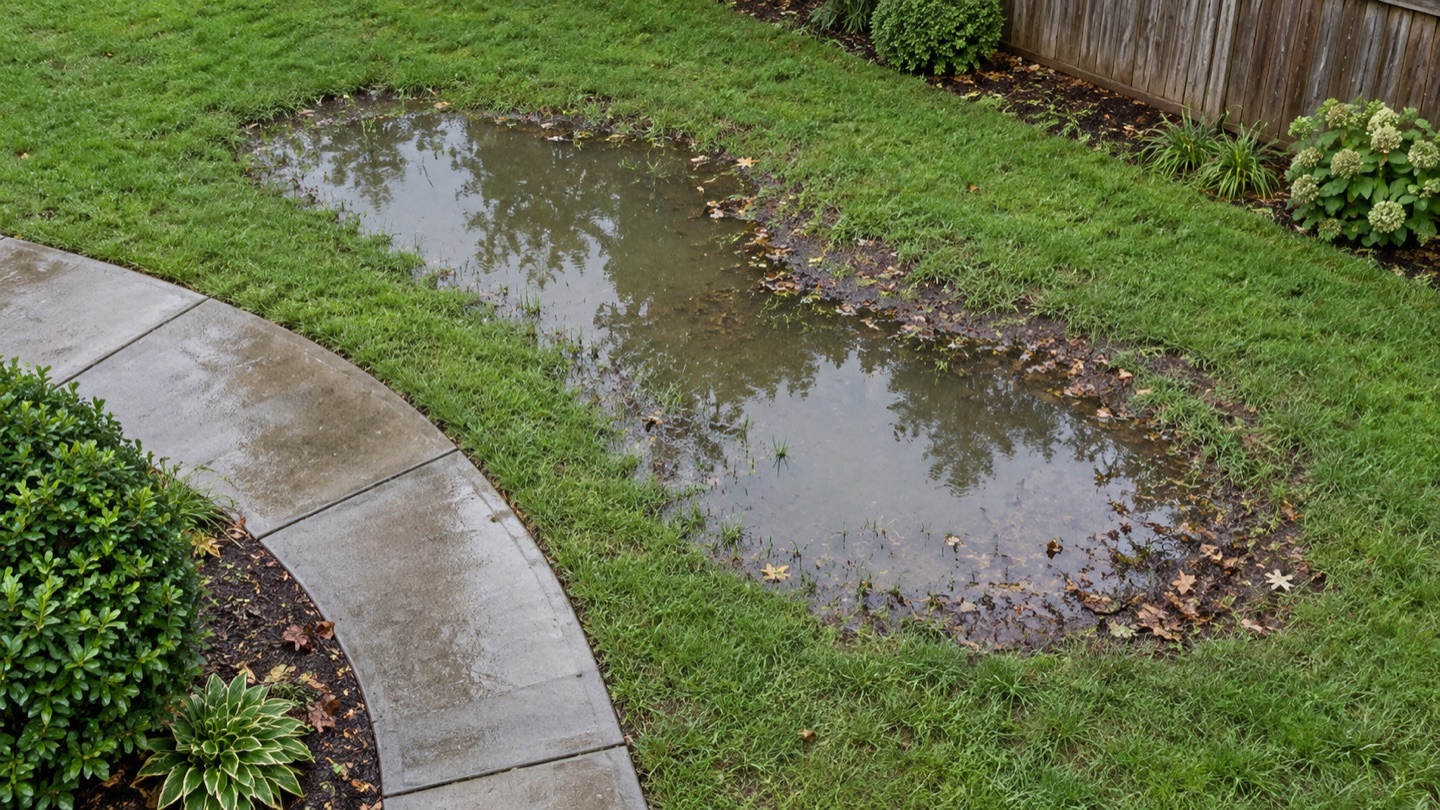
After a soaking Southwest Missouri storm, the question is not just whether the grass is dry. It is whether the ground can carry equipment without damage, whether water has somewhere to go, and whether the lawn needs routine cleanup or actual repair. For a homeowner in Nixa, Ozark, Springfield, or the surrounding area, the right first step is usually to pause and inspect—not to squeeze a mower onto the lawn because the scheduled day arrived. Here is a practical order of operations for established turf, especially tall fescue.
1. Separate a soggy yard from a flood-safety problem
A familiar puddle after rain and water arriving from a creek, road, or overflowing drainage channel deserve different responses. Do not walk into floodwater to inspect the grass. The National Weather Service warns that standing water can conceal contamination, debris, and electrical hazards. Waterproof boots do not remove those risks. Keep people and pets away, follow local safety instructions, and leave hazardous cleanup to qualified help.
Once conditions are safe, take photographs from a firm path before starting work. Record where water collected, where it appeared to enter, and what it left behind. This simple record is more useful for a later conversation than describing the entire yard as flooded. You do not need to stand in the damaged area to document it.
2. Pause sprinklers and give saturated ground room to recover
An established lawn with puddles does not need another automatic watering cycle. Pause or rain-delay irrigation and reassess actual soil conditions before restarting it. A rain gauge helps document the storm at your property, but it cannot tell you how much water ran off, how wet the root zone remains, or whether the mower will leave ruts. Check the yard rather than subtracting rainfall from a rigid weekly allowance.
University of Maryland Extension notes that wet soil is especially vulnerable to compaction. Keep mowers, carts, parked vehicles, and unnecessary foot traffic off soft areas. Dry pavement and dry leaf tips are not proof of firm soil beneath the grass. If ordinary access at the edge reveals sinking footprints, squishing, or water rising around your shoes, stop and give it more time; do not drive a mower through as a test.
There is no reliable universal answer of 'wait 24 hours.' Shade, soil, slope, prior rainfall, and the next forecast all change the drying period. Communicate the specific soft area to your lawn-care provider so a delayed or partial visit is an informed decision.
3. Inspect storm debris before restarting equipment
After water recedes and access is safe, look for sticks, loose stones, displaced edging, litter, and other objects that were not there before. Penn State Extension specifically identifies deposited debris as a hazard to mower operators. Start with a visual check from firm ground, then remove ordinary loose material without dragging heavy loads across wet turf. Do not handle unknown containers, sharp debris, or contaminated deposits as routine yard waste.
Pay particular attention to the gate, narrow side yard, and route from the driveway. A lawn may have a usable open section but no safe equipment access to it. Mark the area on a photo for the crew instead of assuming they can get around it. If debris is plastered into a heavy layer over the grass, ask for an assessment rather than repeatedly power-raking mud.
4. Resume mowing gently, not with a catch-up scalp
When both the turf surface and supporting ground are suitable, resume with a sharp blade and a height appropriate for your grass. MU Extension recommends removing no more than one-third of the green leaf area at a time. Rain-delayed growth does not make a single low cut a good shortcut. Raise the cutting height for the first pass if needed and work back toward the normal height over later cuts as growth and conditions allow.
Keep the plan simple: inspect, choose a workable route, cut without forcing the machine, and stop if traction or ground support becomes questionable. Do not mow a wet slope just because the flatter section looks acceptable. Collect or disperse heavy clumps once conditions permit rather than leaving a dense blanket on the lawn. Our wet-grass and overgrown-lawn guides below explain those mowing decisions in more detail.
5. Watch for recovery before buying a rescue treatment
Flood stress is not determined by the rain total alone. MU Extension's flooded-lawn guidance emphasizes the duration of submersion, soil temperature, and oxygen supply. University of Minnesota Extension also explains that warm ponded water can damage turf much faster than cool spring flooding. A yellow patch is therefore a reason to observe and investigate, not a diagnosis of fertilizer deficiency.
Compare photographs of the same patch as the ground recovers. Look for renewed growth versus continuing decline, and note whether silt has buried the grass. Significant sediment, erosion, or persistent bare areas need a repair plan. Do not automatically add fertilizer, fungicide, lime, or seed to every storm-damaged spot. Match any treatment to an identified problem and product label; for broad tall-fescue repairs, Missouri's fall establishment window is generally preferable to forcing a new lawn through summer heat.
6. Treat repeated ponding as a site problem
If the same depression fills after storm after storm, mowing differently will not change where water collects. Minnesota Extension distinguishes ponding associated with poor drainage or depressions from broader flood damage. Note nearby downspout outlets, the shape of the ground, and any visible blockage from a safe location. Those observations help a professional determine what needs a closer look; they do not establish the solution by themselves.
A drain, regrading, or a different planting approach may be appropriate in some locations, but none is a universal fix. Get the drainage route and outlet evaluated before digging or redirecting water. Do not send water toward a neighboring property or a foundation. Core aeration can be part of recovery or compaction management when conditions are suitable; it is not permission to run machinery over saturated ground or a substitute for correcting the cause of repeated ponding.
7. Give your lawn-care crew a clear post-rain update
For Pebble Creek service, a useful message is specific: 'The front is firm, but the side gate and back corner are still holding water.' Include the date, a photo from a safe spot, and any changed access or debris. That gives us something actionable to review instead of asking you to guess whether the whole property is ready.
Use this short checklist before requesting a catch-up visit. You may not need any new product at all; the biggest improvement can be waiting for the right conditions and making the next visit clear.
- Water: irrigation paused while the established lawn is saturated; rainfall and recurring puddles noted.
- Access: a firm equipment route, with soft sections and hazards identified.
- Cleanup: ordinary loose debris addressed only when safe; contaminated material escalated.
- Mowing: suitable conditions, appropriate height, and no single low cut to erase missed growth.
- Repair: persistent ponding, sediment, or declining turf documented for an assessment.
Related Lawn Guide chapters
Useful gear for this topic
Compare two optional wet-weather supplies
A gauge helps record rain; boots are for ordinary damp-ground work after hazards are ruled out. Neither tells you a lawn is safe to mow. These are category comparisons, not products we claim to have tested. Reuse suitable supplies you already own.
As an Amazon Associate, Pebble Creek earns from qualifying purchases. Your price is not increased. How we choose recommendations.
Simple outdoor rain gauge
Best for: Comparing a stake-mounted gauge with a bracket-mounted gauge by readable markings, capacity, stability, and ease of emptying after a storm.
Follow mounting and freeze-care instructions; keep the gauge clear of roofs and tree cover. A rainfall reading cannot diagnose drainage, root-zone saturation, or whether the soil will support a mower.See current Amazon options ↗Waterproof, slip-resistant work boots
Best for: Comparing pull-on rubber work boots with waterproof lace-up work boots by fit, support, tread, and manufacturer-rated conditions for ordinary damp-ground cleanup.
Read the exact waterproofing, traction, and care specifications. Slip resistance is not a guarantee. Boots do not make floodwater, contaminated debris, electrical hazards, wet slopes, or saturated ground safe; postpone work or seek qualified help.See current Amazon options ↗Sources and further reading
- MU Extension: Caring for Flooded Lawns ↗
- University of Minnesota Extension: Repairing Flooded Lawns ↗
- University of Maryland Extension: Maintaining an Established Lawn ↗
- Penn State Extension: Gardens After Flooding ↗
- MU Extension: Cool-Season Grasses Lawn Maintenance Calendar ↗
- National Weather Service: After a Flood ↗
This chapter provides general educational information. Site conditions vary, and product labels and equipment manuals control whenever a product or machine is used.