
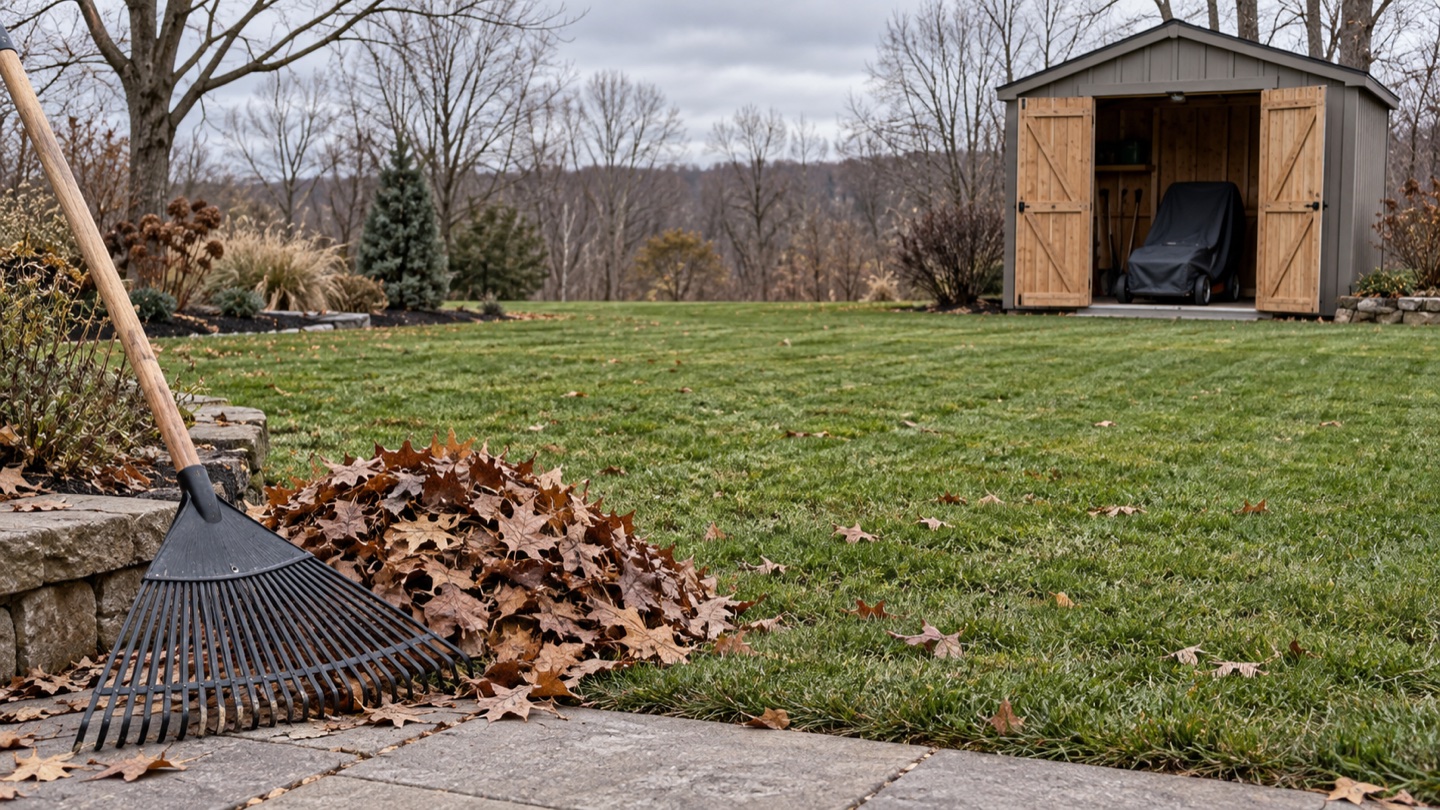
Getting a lawn ready for winter is not one unusually short mowing or one bag labeled winterizer. For Southwest Missouri tall fescue, it is a handoff: finish the work the grass still needs, prevent leaves from burying it, check moisture, and put equipment away according to its manual. Start planning in fall, then let growth and ground conditions decide when each task is finished. A warm spell can extend the mowing season even after you thought the last visit was done.
1. Keep mowing while the grass needs it
Do not end mowing just because a particular month arrives. MU Extension recommends maintaining the regular mowing height until growth stops. If the lawn keeps gaining height, it may need another cut. If it has barely grown, an extra pass simply to match a schedule is not the goal.
Keep the one-third rule in mind: avoid taking off more than about a third of the grass blade in one mowing. An overgrown lawn needs a gradual return to its maintained height, not a drastic final scalp. Check the grass after the cut rather than assuming the mower's numbered lever is an accurate measurement.
For a service visit, separate the final cut from leaf collection when discussing the scope. A property may stop needing mowing before its trees finish dropping leaves. Confirm whether a later cleanup is needed instead of assuming the last mowing closes out every fall task.
2. Leave fine fragments, not a blanket of leaves
A scattering of dry leaves can often be chopped into small pieces with a suitable mower. Work regularly while the material is manageable; a second pass may help reduce the pieces. The useful result is visible grass with fine fragments filtering down, not a thick layer spread evenly over the lawn.
University of Minnesota Extension recommends switching to collection when less than about half the lawn surface is visible through the leaf litter. Treat that as a practical warning to remove excess, not a reason to wait until wet leaves form a mat. Heavy accumulations deserve cleanup even if the grass underneath no longer needs cutting.
Before requesting leaf service, note where leaves collect and where collected material should go. Include corners, fence lines, and the bottom of slopes in your photos. Do not assume that a lawn cleanup automatically includes gutters, roof work, or hauling every type of yard debris; agree on those items separately.
3. Check moisture before the ground freezes
Cool weather does not prove that the soil has enough water. A dry fall can leave turf moisture-stressed going into winter. Check the ground and recent rainfall rather than watering automatically because it is a particular day. MU's winter guidance calls for moist soil, not waterlogged soil.
University of Minnesota's winter-watering guidance also emphasizes avoiding drought stress before the ground freezes. Use that principle here, not Minnesota's calendar dates. Where irrigation is still needed and conditions allow it, avoid runoff and pooling. Recently seeded areas need their own establishment plan rather than being treated exactly like mature turf.
Arrange irrigation winterization before damaging freezes according to the system's requirements. Tell the person servicing it about new seed that still needs water so those two jobs can be coordinated. A lawn-care visit is not a substitute for proper irrigation-system winterization, and a general article cannot set a safe shutoff date for every property.
4. Review treatments instead of adding a mystery winterizer
Fall feeding can be part of a cool-season lawn program, but a seasonal name on a bag does not tell you what your property needs. Review the fertilizer already applied, the lawn area, the product analysis, and any soil-test recommendations before adding another treatment. Ask what nutrients a proposed application supplies and why.
MU's calendar includes late-fall fertilization as growth slows and recommends lime only when a soil test indicates a need. That is not a recommendation to add lime and fertilizer to every lawn together. Follow the exact product label and a property-specific plan; do not stack overlapping applications from a homeowner and a service provider.
Keep a simple record of product names and application dates. If you cannot tell what was applied earlier, finding that information is a better next step than guessing. This winter checklist is an overview; treatment amounts and timing belong in the detailed plan for that lawn.
5. Record what still needs attention
Walk the property before putting the season out of mind. Photograph thin areas, recurring puddles, worn shortcuts, and places where leaves repeatedly pile up. Note whether a problem appeared before or after a recent change, such as new construction or redirected drainage. Those observations make a spring conversation more useful than a vague memory that the lawn looked bad.
Keep completed work separate from future work. A fall cleanup can be finished while a drainage question still needs an estimate. Likewise, fresh seed should have an aftercare note that does not disappear when mowing slows down. Avoid turning a winter checklist into an assumption that every observed problem needs immediate treatment.
For a Pebble Creek request, send the service address, a wide photo, close-ups of the specific areas, and a short list of priorities. Say whether you want leaf cleanup, continued mowing as needed, or an assessment for later work. That helps us discuss a clear scope for your Southwest Missouri property.
6. Store the mower by its manual, not a universal shortcut
Once mowing is actually finished, locate the operator's manual for the mower and its engine or battery system. Briggs & Stratton's storage guidance emphasizes preparing equipment before an extended idle period. Cleaning, scheduled maintenance, fuel handling, and battery care differ by machine; there is no single procedure that fits every mower.
For a gasoline mower, check whether the manufacturer calls for stabilized fuel or a different storage procedure. Use only a compatible fuel stabilizer, in the label's measured amount, when the manual allows it. Follow its instructions for circulating treated fuel. Do not assume an additive repairs old, contaminated fuel, and never operate an engine in an enclosed shed or garage.
Battery equipment needs its manufacturer's storage and charging instructions, not gasoline advice. Shut down and isolate power as directed before cleaning or maintenance. Let equipment cool and dry before covering it. Match a cover to the mower's dimensions and handle position; a cover does not replace a suitable storage location.
Make a spring maintenance note now: blade condition, required service, damaged parts, or a starting problem. Compare the two optional storage product categories below only after you know your machine's requirements. We are not claiming firsthand testing of the retailer's individual listings.
7. Use a short winter handoff checklist
The goal is a lawn that is not buried in debris or forgotten during a dry spell, plus equipment that has been properly prepared for its next use. Keep this checklist with your service notes and check items off when they are actually done—not when the calendar says the season should be over.
- Check actual growth before calling a mowing the final cut; do not scalp.
- Mulch manageable dry leaves finely and collect excess accumulation.
- Review soil moisture, new-seed aftercare, and irrigation winterization together.
- Record fall treatments and avoid unplanned duplicate applications.
- Photograph unresolved lawn concerns and agree on any remaining cleanup.
- Follow the mower, engine, and battery manuals for storage and maintenance.
Related Lawn Guide chapters
Useful gear for this topic
Compare two optional mower-storage supplies
Start with your equipment manual. These are product-category comparisons, not items we claim Pebble Creek has tested. Gasoline fuel treatment is irrelevant to a battery mower; a suitable cover you already own may be enough.
As an Amazon Associate, Pebble Creek earns from qualifying purchases. Your price is not increased. How we choose recommendations.
Gasoline fuel stabilizer approved for your mower
Best for: Comparing storage additives for a gasoline engine whose manual permits stabilized fuel. Compare fuel compatibility, measured dose, and intended storage interval rather than bottle size alone.
Check the engine manual and exact additive label first. Match the fuel type and measured dose; follow circulation instructions outdoors. An additive does not repair contaminated fuel. Battery mowers do not need this product, and some equipment requires a different storage procedure.See current Amazon options ↗Mower storage cover matched to your equipment
Best for: Comparing push-mower and riding-mower covers by actual dimensions, handle clearance, and the ventilation and storage requirements in your equipment manual.
Match dimensions and handle clearance to your model. Follow the mower manual for cleaning, cooling, fuel or battery care, and storage; a cover is not a substitute for a suitable storage location.See current Amazon options ↗Sources and further reading
- MU Extension: Cool-Season Grasses Lawn Maintenance Calendar ↗
- MU Extension: Natural Lawn Care ↗
- University of Minnesota Extension: Fall leaf mulching is good for your lawn ↗
- University of Minnesota Extension: Should you water your lawn before winter? ↗
- Briggs & Stratton: Storing Your Mower & Outdoor Power Equipment ↗
- Briggs & Stratton: How to Store and Winterize Outdoor Power Equipment Properly ↗
This chapter provides general educational information. Site conditions vary, and product labels and equipment manuals control whenever a product or machine is used.