
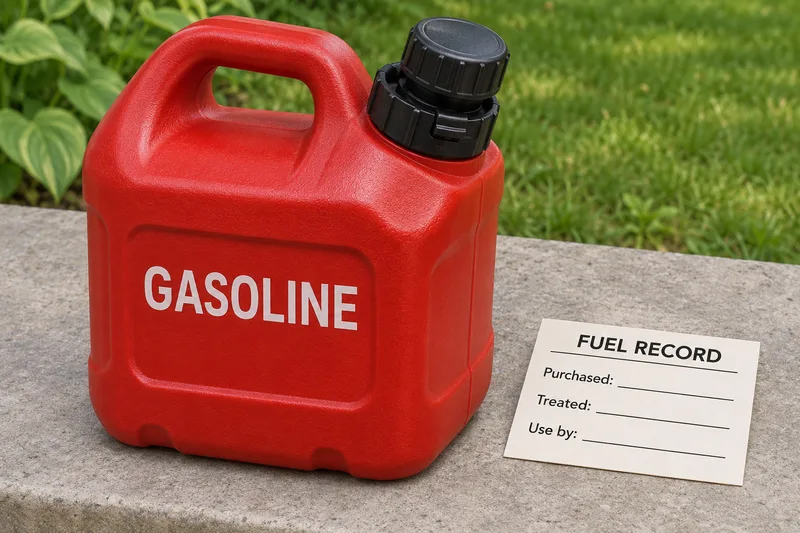
Store mower fuel by following two sets of instructions: the engine manual for fuel left in the mower, and the container and additive labels for fuel kept separately. Start with fresh, compatible gasoline, record when you bought it, and choose the storage procedure before the mower sits unused. Stabilizer is a preventive treatment for suitable fresh fuel, not a way to make an unidentified can of old gas fresh again.
1. Separate the fuel in the can from the fuel in the mower
A can on a shelf and gasoline inside a mower are two different storage questions. Treating the can does not prove that treated fuel reached the carburetor. Emptying a tank does not necessarily empty every fuel-system component. Read the engine's storage section as well as the mower's operator manual, and identify which procedure applies to your expected downtime.
MTD explains that aging gasoline can leave deposits in small carburetor passages and contribute to starting or running trouble. Its fresh-fuel guidance uses 30 days as a practical purchasing limit. Treat that as a planning prompt, not a precise clock that makes every fuel batch good on day 29 and bad on day 31; conditions and equipment instructions matter.
For a Southwest Missouri homeowner, the last regular mowing week is a useful time to review the fuel supply. Pebble Creek's lawn-care planning covers the transition from active mowing to winter preparation. Keep that lawn decision separate from the engine's storage requirements: a calendar date cannot tell you the condition of fuel already in your machine.
Write down the mower and engine model, fuel specification, fuel purchase date and expected next use. If you cannot identify the contents or age of a container, do not pour it into the mower to find out whether it works.
2. Choose the storage branch in the exact engine manual
Do not combine pieces of different manufacturers' instructions into a new procedure. Honda's mower guidance distinguishes shorter storage from inactivity beyond 90 days, when it calls for emptying the fuel system. Briggs & Stratton describes stabilized-fuel storage and an alternative removal procedure under stated conditions. Those differences are the reason this guide does not prescribe one tank level or one run time for every mower.
Find the applicable storage interval and follow that branch from beginning to end. If the mower and engine instructions appear to conflict, ask the manufacturer or servicing dealer to resolve the conflict. Save the answer with the model number so you are not relying on a general social-media tip next season.
Any engine operation required to circulate treated fuel must happen outdoors, away from enclosed spaces, under the operator manual's safety instructions. Do not run an engine in a garage to complete a storage step. Let it cool before handling fuel. If draining or access is beyond your experience, use qualified service instead of improvising a siphon or opening fuel lines.
| Situation | Decision | Record before storage |
|---|---|---|
| Fresh fuel; manual permits stabilized storage | Use a compatible additive exactly as labeled and complete the engine's circulation and storage steps. | Fuel amount, product, dose, treatment date and completed procedure. |
| Manual requires fuel removal for this interval | Follow its complete removal procedure or arrange service. | Date completed and the manual section used. |
| Fuel age, contents or condition uncertain | Set the container aside safely and obtain disposal guidance; additive is not a reset. | Known contents, approximate quantity and disposal appointment. |
| Instructions unavailable or conflicting | Identify the exact engine and ask its manufacturer or dealer. | Model, serial number, question and confirmed procedure. |
3. Use a gasoline container and choose its location carefully
Use a container intended and approved for gasoline, with its original functioning closure and safety components. A red color alone is not evidence of suitability. CPSC advises child-resistant containers, closed caps, and a cool, ventilated location away from ignition sources and children. Do not store gasoline in a house or basement, beside a heater or pilot light, or near electrical equipment that could ignite vapor.
At a filling station, put the portable container on the ground before filling it. Follow its fill limit and operating instructions; do not remove a flame-mitigation insert or alter the spout to make filling easier. An improvised bottle, open bucket or damaged can is not an acceptable storage solution.
Choose a manageable size based on how much compatible fuel you actually use. A smaller purchase can be easier to track and use promptly than a large reserve. Keep gasoline, two-cycle mixtures and other fuels unmistakably identified. The mower's fuel specification still controls; a suitable container does not make the wrong blend suitable for the engine.
The comparison below includes No-Spill model 1405 as an example with manufacturer-documented child resistance and a flame-mitigation device. Verify the exact current product, complete spout assembly and instructions rather than assuming every similar-looking search result has those features.
4. Measure treatment and keep a simple fuel record
Read the exact additive label before purchase. Match it to the engine's permitted fuel and storage method, then measure the actual fuel quantity and prescribed dose. Different products and concentrations are not interchangeable spoon-for-spoon. Do not add extra as insurance or mix treatments without explicit manufacturer guidance.
STA-BIL Storage's directions specify fresh fuel and a circulation step. Its advertised protection interval is not permission to exceed your engine manual's storage limit. Gold Eagle also explains that stabilizer does not restore gasoline that has already deteriorated. A treatment date therefore belongs beside the purchase date, not over it.
Copy this record into a notebook or a separate weather-resistant tag without covering the can's warnings. Keep the engine procedure beside the fuel record. This creates a useful spring handoff: whoever restarts the mower can see what was done rather than guessing from a bottle left nearby.
- Fuel purchased: date, fuel type and quantity; keep the receipt if useful.
- Container: identifying label and condition check.
- Treatment: exact product, measured fuel amount, label dose and date added.
- Equipment: mower and engine model; applicable storage manual section.
- Procedure completed: circulation, valve position or removal steps only as that manual directs.
- Review or use-by date: based on the applicable instructions, with a reminder before the planned next use.
5. Arrange disposal for old or unidentified fuel
Do not test questionable gasoline in an engine, blend it into a fresh batch to hide its age, or assume an additive will remove contamination. Keep it secured in an appropriate labeled container while obtaining disposal instructions. Do not pour it onto the ground, into a drain or into household trash.
For household fuel in the Springfield area, Recycle 417 lists the Household Chemical Collection Center at 1226 W. Nichols Street as accepting gasoline by appointment. Its program serves residents of Greene, Christian, Webster, Polk and Dallas counties, which makes it a useful starting point for Nixa and Ozark households as well as Springfield-area residents.
Call 417-864-2000 before traveling. Confirm current eligibility, the fuel and quantity you have, container requirements and safe transport instructions. Explain if the contents are mixed or uncertain. The listed household program excludes business waste; fuel from a commercial mowing operation needs an appropriate commercial disposal route rather than a household appointment.
Keep the appointment or disposal receipt with the record. Do not put a questionable can back into the active fuel supply while you wait, and do not reuse a damaged container just because it is now empty.
6. Recheck before the next start
Before returning the mower to work, review the record and the manual's return-to-service steps. Check for leakage, damaged fuel components and an uncertain fuel supply before attempting a start. Stop and arrange service if you find a leak. If the engine still will not start after the correct storage and restart procedure, fuel age is only one possible cause; repeated starting attempts or more additive are not a diagnosis.
Use the spring maintenance checklist for the wider inspection, and the deck-cleaning guide for a separate task that can be completed under its own shutdown instructions. This article focuses on fuel decisions; battery storage, blade condition and the lawn's winter needs each require different checks.
The two comparisons below are optional: a suitable gasoline container and a manual-permitted stabilizer. No exact-item firsthand testing is claimed. A sound container you already own may be sufficient, and a manual requiring fuel removal may give you no reason to buy an additive.
If you would rather plan mowing service than maintain a mower, review Pebble Creek's lawn-care service and current service area, then request an estimate for the property. Equipment repair or hazardous-waste collection is not included in that lawn-care offer.
Related Lawn Guide chapters
Useful gear for this topic
Optional fuel-storage comparisons
Start with the engine manual and the container you already own. Compare a replacement gasoline can only when needed, and a stabilizer only when the engine permits that storage method. These are specification comparisons, not claims of firsthand product use.
As an Amazon Associate, Pebble Creek earns from qualifying purchases. Your price is not increased. How we choose recommendations.
Gasoline containers: No-Spill 1405 comparison
Best for: Comparing a manageable gasoline container with documented child resistance and a flame-mitigation device. Verify the exact model and its complete closure assembly against the manufacturer's specifications.
Check gasoline suitability, capacity, current safety features, fill limit and spout instructions. Search results may contain replacement parts or different fuel containers. Do not remove safety components or assume a similar-looking can is equivalent. Store away from children and ignition sources; no firsthand testing or product certification by Pebble Creek is claimed.See current Amazon options ↗Gasoline fuel stabilizer approved for your mower
Best for: Comparing storage additives for a gasoline engine whose manual permits stabilized fuel. Compare fuel compatibility, measured dose, and intended storage interval rather than bottle size alone.
Check the engine manual and exact additive label first. Match the fuel type and measured dose; follow circulation instructions outdoors. An additive does not repair contaminated fuel. Battery mowers do not need this product, and some equipment requires a different storage procedure.See current Amazon options ↗Sources and further reading
- MTD: old gasoline and fuel stabilizers ↗
- Honda: mower fuel and storage recommendations ↗
- Briggs & Stratton: storing your equipment ↗
- CPSC: liquid-fuel container safety ↗
- No-Spill: model 1405 gasoline container specifications ↗
- STA-BIL Storage: product directions ↗
- Gold Eagle: what fuel stabilizer can and cannot do ↗
- Recycle 417: Household Chemical Collection Center, eligibility and accepted materials ↗
This chapter provides general educational information. Site conditions vary, and product labels and equipment manuals control whenever a product or machine is used.