
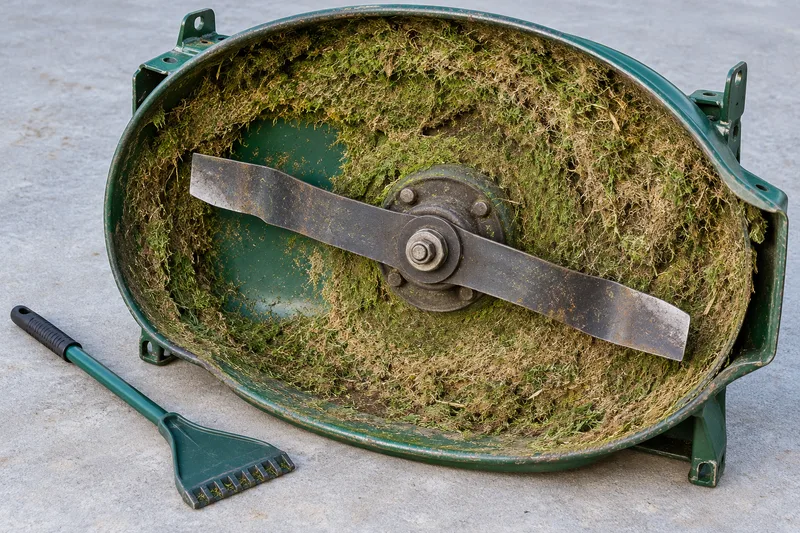
If your mower drops heavy grass clumps, look at both the lawn and the machine. Packed clippings beneath the deck can interfere with its work, but a clean deck will still struggle with a heavy load of wet or overgrown grass. This guide explains how to choose a cleaning method safely and what to change if the clumps return. There is no universal tipping direction, hose procedure or cleaning attachment that suits every mower.
Separate deck buildup from the mowing conditions
Start with a short record of the problem: was the grass damp, how tall was it before cutting, and did the clumps appear everywhere or mainly in dense patches? For a Southwest Missouri mowing routine, a rain-delayed visit or a dewy shaded strip is a reason to reassess the conditions before blaming the equipment.
Toro's deck-cleaning guidance explains that removing stuck clippings restores space for airflow and helps limit corrosion. That makes cleaning useful maintenance, but it does not establish that buildup caused every poor cut. Check the deck only after completing the shutdown and access steps below.
A practical comparison is the next suitable dry mow after cleaning. Record the same mowing settings and whether the clipping discharge improves. Do not deliberately mow wet ground as a test. If heavy clumps remain, your notes help distinguish a grass-load problem from an equipment problem without buying parts at random.
Shut down and isolate power before hands-on cleaning
Read the cleaning and maintenance sections of the manual that matches the model and serial number. Park securely on the specified surface, disengage the blades, stop the machine, wait for all moving parts to stop and allow hot components to cool. Follow the model's parking-brake and key-removal instructions.
Prevent an accidental restart before brushing, scraping or reaching near the deck. Husqvarna's petrol walk-behind guidance calls for disconnecting the ignition cable from the spark plug. EGO's cordless maintenance guidance calls for removing the disabling device and detachable battery. These examples explain why an off switch alone is not a complete isolation procedure; follow your machine's exact requirements.
Use only the manual's approved tipping, lifting, support or deck-removal method. Fuel and oil handling, machine weight and service access vary. Never work beneath an unsupported raised mower or rely on a jack alone. If safe access requires equipment or skills you do not have, arrange service.
Keep hands away from blade edges and pinch points, even when power is isolated. Wear the protection specified for the task. A long scraper is not permission to reach under an operating machine. If the blade needs removal to gain access, treat that as a separate service procedure with its own installation requirements.
Choose the cleaning method your mower permits
Look for an explicit method in the manual before connecting a hose. EGO's walk-behind maintenance guidance uses removal of buildup and a damp cloth, with no running water; its ride-on guidance identifies a different wash-port method. Even within one brand, the correct answer changes with the machine.
A factory washout port is a specific operating system, not an invitation to spray into any opening. Some approved routines run the blades while the operator stays in the operating position. Keep that entirely separate from hands-on cleaning. Use the complete model-specific sequence, including shutdown before attaching or removing equipment and the prescribed drying steps. Never reach under the deck during the wash cycle.
The Toro model 75210 manual, for example, provides its own washout and drying sequence and warns about a broken or missing fitting. It also prohibits pressure washing. Do not borrow that procedure for another deck, improvise a fitting or assume a household pressure washer is an acceptable substitute.
- EGO: ride-on wash ports differ from other mower cleaning methods ↗
- Toro model 75210 manual: cleaning and washout warnings ↗
| Method | Use it when | Check first |
|---|---|---|
| Brush and damp cloth | The manual specifies dry or lightly damp cleaning. | Power isolation, safe access and surfaces that must stay dry. |
| Deck scraper | The maker permits scraping and buildup is accessible safely. | Head material and shape, coating protection and blade clearance. |
| Factory washout port | Your exact deck has an approved washout system. | Correct coupling, intact fitting and the full operating/drying sequence. |
| Qualified service | Access, stubborn blockage or damage cannot be handled safely. | Model/serial number, symptoms and what cleaning has already been tried. |
Work through a cleaning and drying checklist
Once the mower is isolated and safely accessible, remove loose material before working on attached buildup. Use the approved brush or scraper without forcing it against the blade, wiring, belts, seals or other components. Do not pry on the deck's internal parts or use a cleaning tool to free a jammed blade.
Inspect what the cleaning exposes. A cracked blade, loose or damaged component, damaged guard or leaking fluid is a service issue rather than another scraping task. If grass is wound around a shaft or packed where removal risks damaging a component, stop and consult the manual or a technician.
Drying is part of the job. Use the maker's specified method, including its instructions for any permitted powered drying cycle. Do not start a partially reassembled mower or run a gasoline engine in a garage. Finish hands-on work and restore the required guards and operating configuration before any authorized running step.
- Before: record the model, permitted cleaning method and safe-access instructions.
- During: clear accessible buildup without gouging the deck coating or moving parts to create extra access.
- Check: inspect the chute, collection components and accessible deck surfaces as directed; do not remove a required guard to improve discharge.
- Dry: remove residual moisture by the approved method and keep water away from prohibited areas.
- Restore: account for tools and removed parts, and follow the manual's reassembly and restart checks.
- Record: note the cleaning date, any damage found and the result at the next suitable mow.
Keep the clumps from returning
MU Extension recommends mowing when the grass is dry and removing no more than one-third of its height at a time. It notes that wet or excessively tall grass can mat together. A clean deck cannot cancel those conditions. If a delayed cut would remove too much, use a staged catch-up plan appropriate to the grass instead of forcing the backlog through one pass.
Follow the manufacturer's cleaning interval rather than waiting until discharge is visibly blocked. The Toro manual cited here calls for deck cleaning after each use. Once the machine has cooled and is safely prepared, timely cleaning can be easier than leaving clippings to harden.
Use a simple two-entry log: 'Before cleaning: grass condition, approximate height removed, where clumps appeared. After cleaning: next dry mowing conditions and whether the problem changed.' This is an observation sheet, not a controlled equipment test. If different weather or growth makes the comparison unclear, say so.
If clumping continues on a clean, correctly assembled machine under suitable conditions, have its cutting setup checked. Do not remove safety components, fit an unverified blade or apply an improvised coating to hide the symptom. Blade condition, the approved bagging or mulching configuration and other machine issues may need separate attention.
Compare a scraper only if it fits the job
A suitable brush or tool you already own may be enough. If your manual permits scraping, compare a broad head for open curved surfaces with a narrower head for accessible corners. Check the head material, smooth edges, handle grip and whether the shape reaches the intended surface without putting your hands close to a blade. More leverage is not always better if it encourages prying or damages a coating.
The optional category link below is for deck-cleaning tools, not a guaranteed fit or a tested recommendation. Confirm the mower maker's cleaning restrictions before choosing one. A washout adapter is unnecessary unless the exact deck already has an approved system and the manufacturer identifies the correct coupling.
Pebble Creek's lawn-care approach is to keep mowing conditions and the maintenance routine working together. We provide recurring mowing in Nixa, Republic, Clever, Billings and South Springfield west of Highway 65; Ozark is projects only. Equipment repairs should go to the appropriate service provider. If you would rather arrange lawn care, check our service area and request an estimate.
Related Lawn Guide chapters
Useful gear for this topic
Compare a scraper for manufacturer-permitted deck cleaning
Use a suitable tool you already own first. This optional category search helps compare head shape, material and handle reach; it does not establish compatibility or require a purchase. Pebble Creek has not tested these search-result products.
As an Amazon Associate, Pebble Creek earns from qualifying purchases. Your price is not increased. How we choose recommendations.
Long-handle mower deck scraper
Best for: Comparing broad and narrow heads, non-damaging edges and comfortable handles for safely accessible buildup where the mower manual permits scraping.
Confirm the mower maker permits the tool and head material on the deck coating. Shut down, isolate power, wait for movement to stop and use the specified access and support method. Never reach beneath a running or unsupported mower. Do not pry against blades, wiring, belts, seals or guards. A longer handle does not make unsafe access acceptable; no universal fit or firsthand testing is claimed.See current Amazon options ↗Sources and further reading
- Toro YardCare: deck cleaning, airflow and pressure-washer cautions ↗
- Husqvarna: petrol walk-behind cleaning guidance ↗
- EGO: end-of-season maintenance and walk-behind cleaning ↗
- EGO: Z6 wash-port distinction ↗
- Toro: model 75210, serial 401000000 and up—cleaning instructions ↗
- MU Extension: Don't Bag It lawn care ↗
This chapter provides general educational information. Site conditions vary, and product labels and equipment manuals control whenever a product or machine is used.