
Before buying another bag, ask what problem you are trying to solve. Grass that looks pale, thin or brown might need nutrients—but it might be dry, cut too short, shaded or affected by a different problem. Start with four possible answers: feed as part of a suitable plan, wait, test the soil, or investigate the damage. Here is how to choose a useful next step without treating every disappointing patch as a fertilizer shortage.
1. Check what has already gone on the lawn
Find the last application date, product label, amount used and area treated. If a lawn-care company manages feeding, ask for its application record before adding anything yourself. A receipt for a bag is not the same as a record of how much reached your lawn. Include combination weed-and-feed products when making the list.
Use a simple note with four entries: date, product analysis, pounds applied and square feet treated. If those details are missing, mark them unknown rather than guessing. Your next step is to recover the history, not double up because you cannot remember. Check the product's minimum interval and annual limits before planning another treatment.
2. Look at moisture and growth before color
MU Extension identifies rolled leaves, lingering footprints and bluish-purple color as clues of wilting. Brown leaves can follow prolonged dry weather. Those observations warrant checking moisture and the watering plan; they do not establish a fertilizer deficiency. Wet ground is not automatically healthy ground either—record persistent puddles or soggy areas for further investigation.
For Southwest Missouri cool-season lawns, feeding and watering decisions need to fit the season and actual growth. Do not use extra nitrogen to force a heat-stressed lawn to look like a spring lawn. MU emphasizes taller mowing and an appropriate fall fertility program as part of developing drought resilience. Guide 3.1 covers the seasonal plan; this checklist is about whether another application is justified now.
3. Read the pattern of the problem
Take one photograph showing the whole lawn and another showing the affected grass closely. Note whether the change appeared after mowing, after a treatment, or gradually. A strip matching a mower pass, a patch beneath a tree and an evenly pale lawn are different observations—not three reasons to spread the same bag.
Our practical starting point for a property-care conversation is the work history and what can actually be seen. Record the last cut, any change in cutting height, recent traffic and where the problem starts and stops. That gives you and whoever evaluates the lawn something concrete to discuss. It is not a remote diagnosis or a claim that one pattern proves a particular disease.
Where the problem is patchy, spreading, recurring or unexplained, seek identification help before treating. Fertilizer cannot stand in for finding out what happened. Keep the dated photos so you can tell whether the affected area is expanding, rather than relying on how it looked from the driveway yesterday.
4. Know what a soil test can—and cannot—answer
A laboratory soil test helps evaluate pH and nutrients such as phosphorus and potassium. It can prevent buying something the soil already supplies. Nitrogen is different: MU explains that its instability and changing release make a routine soil test unsuitable for directly assessing lawn nitrogen needs. A report may still provide management-based nitrogen guidance; that is not a measured nitrogen shortage.
Do not interpret a report with adequate phosphorus as meaning the lawn never needs any fertilizer. Equally, do not interpret pale grass as permission to add phosphorus. Read the recommendation for your grass and explain recent treatments to the lab. For a separate lime decision, use guide 3.2; lime and nitrogen fertilizer are not interchangeable.
5. If testing is the next step, keep collection simple
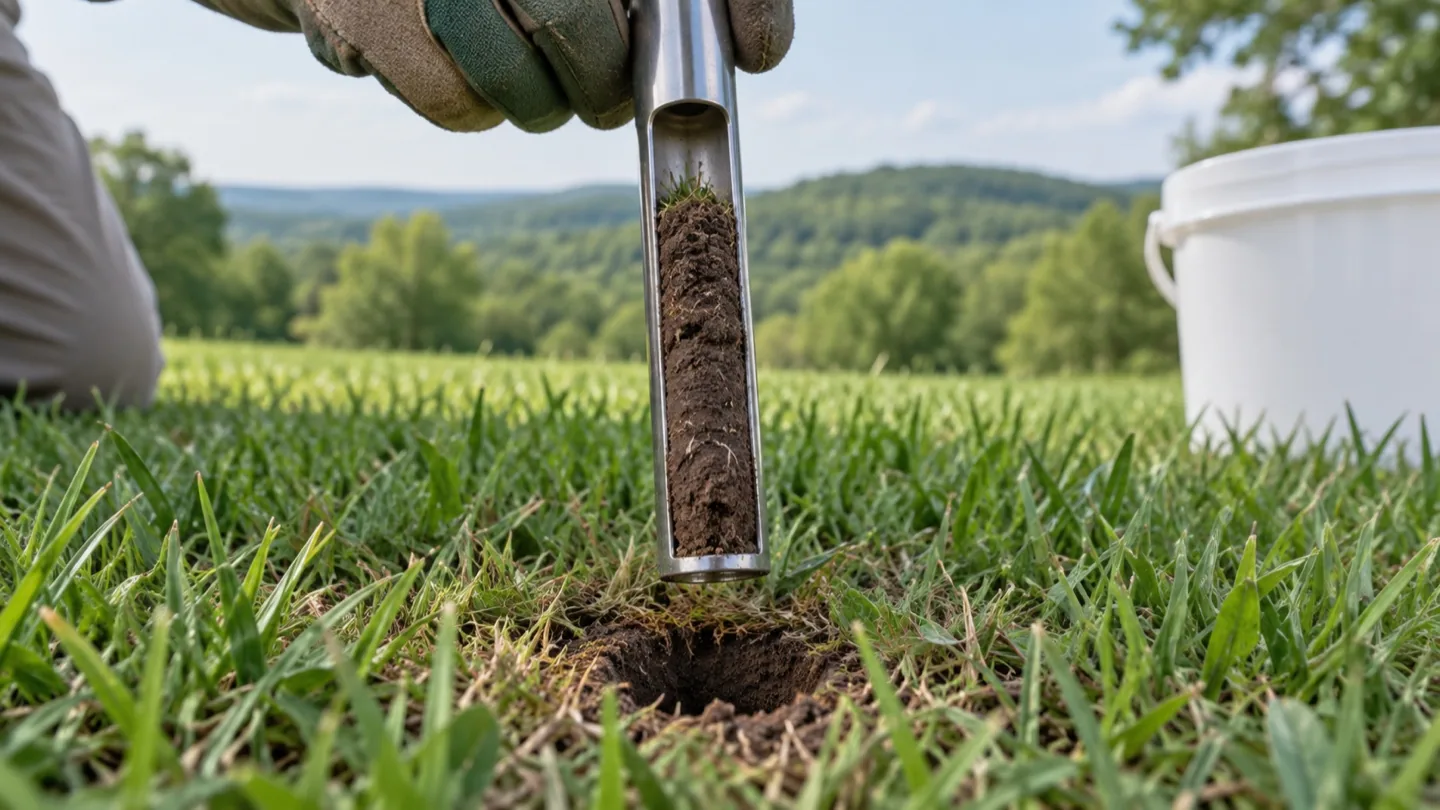
Ask the receiving laboratory for its lawn instructions before collecting. MU's lawn-specific guide calls for a 4-inch depth on established turf and 12 or more cores across a consistent area, mixed in a clean plastic bucket. Keep substantially different areas separate. A clean suitable shovel can work; buying a probe is optional. Remove plant material and follow the lab's drying, quantity and packaging directions.
Ozark homeowners can start with MU Extension in Christian County at 1701 W Jackson St, Suite B. Its linked office and services pages provide the current contact route. Confirm arrangements before visiting and ask about the MP555 lawn-and-garden form and sample boxes. Keep your sample name, collection date and treatment history with the report. No special equipment purchase is required just to ask for instructions.
6. Choose one next action
Use the checks above to decide what to do before shopping. Several answers can be true at once: you may need a soil test and a better record of irrigation, for example. A lawn can also be due for planned feeding without every brown patch being caused by hunger.
- FEED: a grass-appropriate plan calls for an application, the prior treatment record supports it, and conditions and the exact label permit it. Calculate the amount for the measured lawn; do not empty the bag automatically.
- WAIT: you cannot establish the last application, the minimum interval has not passed, or the lawn or conditions are unsuitable. Resolve that uncertainty before adding more.
- TEST: pH, phosphorus or potassium needs are unknown or the previous report no longer represents the area. Ask the lab for an established-lawn recommendation.
- INVESTIGATE: the problem is localized, changing quickly or unexplained. Bring photos and the mowing, watering and treatment history to Extension or a qualified turf professional.
7. Leave with a plan, not a bigger shopping list
Write down today's decision and what would change it. For example: 'No application today; obtain the last treatment record and ask Extension about the pale back section.' Or: 'Planned feeding is appropriate; measure turf and calculate the labeled quantity.' These are examples of useful records, not prescriptions for a particular property.
If you want help coordinating recurring lawn care, use our service and estimate links with those notes ready. Tell us which work you already have covered. For the next step in a justified fertilizer application, guide 3.4 explains the bag numbers and the arithmetic. The goal is a decision you can explain—not another bag applied on hope.
Related Lawn Guide chapters
Useful gear for this topic
Compare an optional soil-collection tool
A clean shovel you already own may be enough. If repeated sampling makes a probe useful, compare the collection features below. Ask Extension about its sample boxes before buying bags. This is a category comparison, not a firsthand product endorsement or a laboratory test kit.
As an Amazon Associate, Pebble Creek earns from qualifying purchases. Your price is not increased. How we choose recommendations.
Soil-sample probe
Best for: Comparing open-sided probes and T-handle designs by usable coring depth, ease of removing the sample, handle comfort and cleaning access. Choose a tool that can collect an even core at your laboratory's requested depth.
Verify dimensions and the manufacturer's ground-use instructions. A probe collects soil; it does not measure nutrients or pH. Avoid buried utilities and irrigation, never force it against rocks or hard ground, and follow the receiving lab's collection instructions. No firsthand use of these listings is claimed.See current Amazon options ↗Sources and further reading
- MU: Why a soil test does not directly assess lawn nitrogen needs ↗
- MU Extension: Soil Testing for Lawns ↗
- MU Extension: Home Lawn Watering Guide ↗
- MU Extension: Cool-season lawn maintenance calendar ↗
- MU Extension: Christian County office ↗
- MU Extension: Christian County soil-testing services ↗
- MU Extension: MP555 lawn-and-garden information form ↗
This chapter provides general educational information. Site conditions vary, and product labels and equipment manuals control whenever a product or machine is used.