
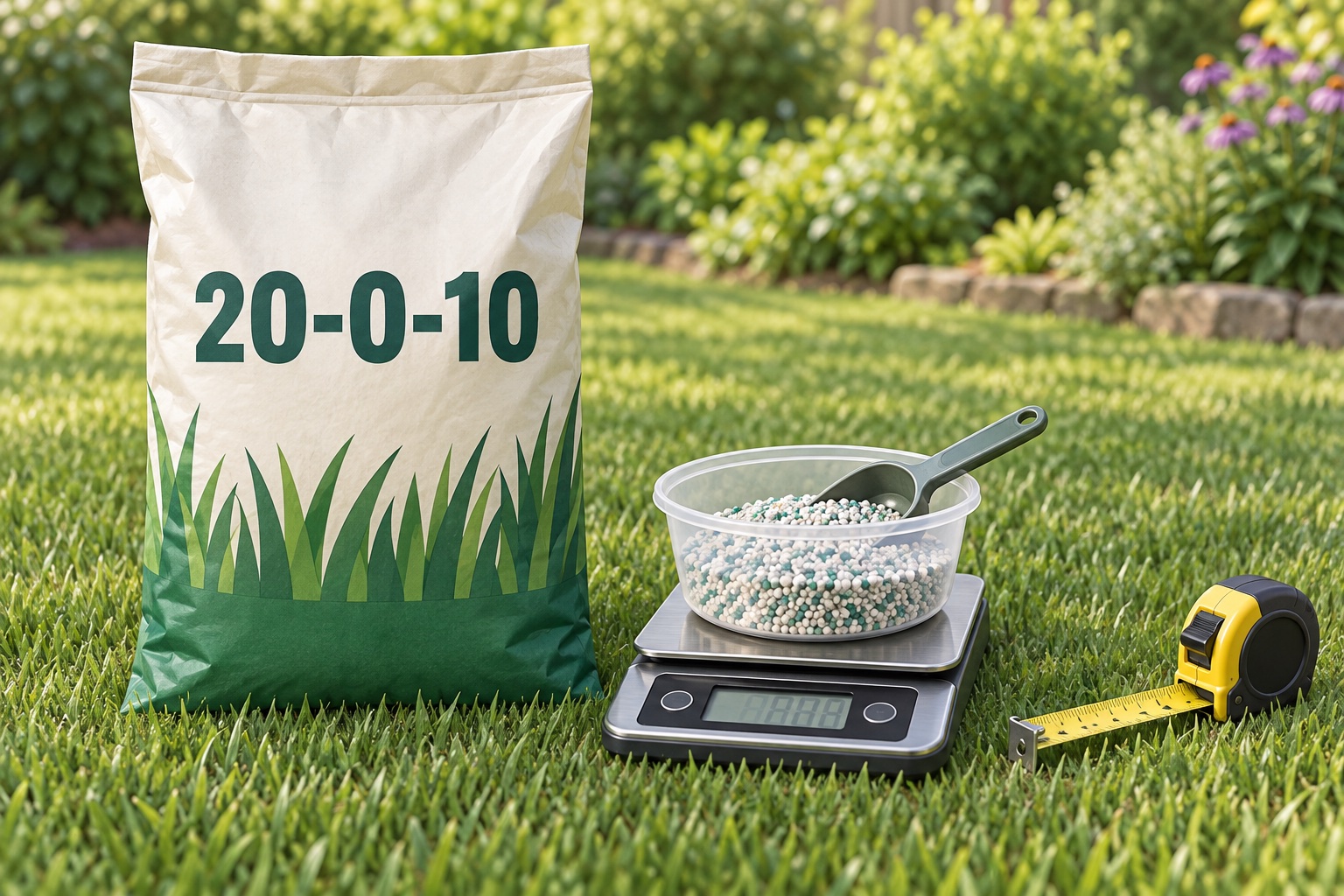
The three fertilizer numbers tell you concentration, not how many bags your yard needs. A 20-0-10 product contains 20% nitrogen, 0% available phosphate and 10% soluble potash by weight. To work out how much to spread, you also need the lawn's actual treatment area and an appropriate application rate. Below is a worked example you can follow with your own numbers—without confusing pounds of fertilizer with pounds of nutrient.
Read N-P-K without treating it as a quality score
The familiar N-P-K shorthand refers to nitrogen, phosphorus and potassium. On U.S. fertilizer labels, the guaranteed analysis expresses the second and third numbers as phosphate (P₂O₅) and potash (K₂O), not elemental phosphorus and potassium. Keep those units consistent with the recommendation you are using; ask the lab if the report uses different units.
In our hypothetical 40-pound bag of 20-0-10, there are 8 pounds of nitrogen, zero pounds of guaranteed phosphate and 4 pounds of potash. That does not mean all 40 pounds are nitrogen, or that the bag belongs on one lawn. The other weight includes the rest of the material making up the product.
A higher first number means more nitrogen per pound of product, not automatically a better fertilizer. These numbers also do not tell you whether the nitrogen is slow-release, whether the product includes a weed killer, or whether it fits your grass. Read the full label, not just the large numbers on the front.
Measure grass—not the whole property
Start with a sketch. Break the turf into rectangles, triangles or other manageable shapes, measure them, and add the areas. Exclude the house, drive, patio and beds. MU's Natural Lawn Care guide explains this area-first approach. A real-estate lot size can greatly overstate the ground you will actually fertilize.
Here is a made-up measurement example, not a Pebble Creek customer's property: a 50-by-40-foot front lawn is 2,000 square feet. A 60-by-50-foot back rectangle is 3,000 square feet, but it contains a 500-square-foot patio. Treatable grass totals 2,000 + 3,000 − 500 = 4,500 square feet.
If two sections receive different programs, calculate them separately. Save the sketch so next month's application, an overseeding estimate and a service conversation all start with the same areas. Note the units next to every measurement; feet and square feet are not interchangeable.
Choose the rate before doing the bag math
A soil report, grass-appropriate management plan and exact product label guide the rate. Determine whether a recommendation is for one application or the whole season. Do not put an annual allowance down at once. In Southwest Missouri, tall-fescue timing is not the same as zoysia timing; guide 3.1 covers that separate decision.
The following examples assume a justified single application of 0.5 pound of nitrogen per 1,000 square feet. That is a calculation assumption, not a recommendation for every lawn or every product. If your plan or label calls for something else, use that amount. If they conflict, ask for clarification rather than choosing the larger number.
If the label already gives pounds of product per 1,000 square feet, you can scale that product rate directly by your treatment area. Do not divide by nitrogen a second time. Products with herbicides have additional restrictions; nitrogen arithmetic never overrides them.
Worked example: 20-0-10 on 4,500 square feet
Convert the first number to a decimal: 20% = 0.20. Divide the desired nitrogen rate by that fraction. Then multiply by the number of 1,000-square-foot units in the treatment area. This is the nutrient-to-product method described in Penn State's turf fertilizer calculation guide.
For this example, 0.5 ÷ 0.20 = 2.5 pounds of product per 1,000 square feet. The lawn has 4,500 ÷ 1,000 = 4.5 units. Therefore 2.5 × 4.5 = 11.25 pounds of product for the whole treatment area—not 11.25 pounds of nitrogen.
Check backward: 11.25 × 0.20 = 2.25 pounds of nitrogen total; 2.25 ÷ 4.5 = 0.5 pound per 1,000 square feet. The same application also supplies 11.25 × 0.10 = 1.125 pounds of potash. Make sure that accompanying nutrient fits the plan too.
- Product pounds = desired nitrogen pounds per 1,000 sq ft ÷ nitrogen decimal × lawn square feet ÷ 1,000.
- Write the answer on your worksheet before filling the spreader: 11.25 lb of product total in this example.
- If two crossing passes are appropriate for your equipment, split the total between passes: 5.625 lb each here. Do not apply 11.25 lb on each pass.
Different bag, different amount
Suppose the same justified nitrogen target and 4,500-square-foot lawn use a hypothetical 10-0-5 instead. The calculation becomes 0.5 ÷ 0.10 × 4.5 = 22.5 pounds of product. It takes twice as much product because its nitrogen concentration is half as large. That is arithmetic, not a reason to prefer either bag.
Now consider the mistake of emptying the entire hypothetical 40-pound bag of 20-0-10 on that lawn. It supplies 8 ÷ 4.5 = about 1.78 pounds of nitrogen per 1,000 square feet—more than three times the example target. Finishing a bag is not an application goal.
Coverage claims depend on the manufacturer's labeled rate. Compare your calculation with that rate and the bag's directions. If your measured area or expected quantity differs sharply, stop and check the analysis, units and instructions. Do not improvise an extra pass to use up leftovers.
Weigh the amount and check the spreader
Use a suitable scale and a dedicated non-food container. Tare the empty container so you measure product weight, not product plus bucket. A scoop moves granules; its volume markings do not establish their weight. Two fertilizers can have different bulk densities, so an old cups-per-lawn habit is not a reliable substitute for weighing.
Calibrate the spreader for the exact material using its manual and the label. A setting copied from another brand, model or product may deliver a different rate. Plan the path, shut off flow at turns and avoid overlapping concentrated strips. Spread only the measured total across the intended area.
Handle and store material as its label directs. Clean spills, keep granules off pavement and out of drains, and follow the product's watering-in instructions. Do not wash stray fertilizer into the street. If the spreader empties much earlier than expected, stop and review the setup rather than refilling and continuing.
Keep a one-minute application record
Save the lawn sketch, a photo of the analysis and directions, the selected nutrient or product rate, your calculation, actual product weight, date and areas treated. Record who applied it. That makes it much easier to avoid duplicate applications when a homeowner and service provider both care for the same property.
Your finished note might read: 'Example only: 4,500 sq ft; 20-0-10; target 0.5 lb N/1,000; calculated 11.25 lb product; label checked.' Replace every value with the actual plan before using it. Keep a separate running seasonal total instead of treating each bag as a fresh start.
Still unsure whether the lawn needs feeding at all? Start with guide 3.3 below. For ongoing property care, our lawn-care and service-area pages explain the next conversation with Pebble Creek. Bring your treatment record so we can discuss the work already covered, rather than assuming every yellow patch needs more fertilizer.
Related Lawn Guide chapters
Useful gear for this topic
Compare tools for measuring and distributing the planned amount
These are optional category comparisons, not tested-product endorsements. A scoop transfers material; a suitable scale determines weight. Choose tools only after checking the lawn area, nutrient plan and exact label. Suitable equipment you own may be enough.
As an Amazon Associate, Pebble Creek earns from qualifying purchases. Your price is not increased. How we choose recommendations.
Dedicated granule-transfer scoop
Best for: Comparing scoop size, grip and pouring control for transferring dry fertilizer into a separate weighing container. Reuse a suitable dedicated scoop if you own one; volume marks are not a fertilizer weight measurement.
Follow the product label for handling and protection. Keep fertilizer tools out of food use, check material compatibility and weigh the actual granules with an appropriate scale. Scoop volume cannot replace pounds in the calculation. No firsthand testing of these listings is claimed.See current Amazon options ↗Walk-behind broadcast spreader
Best for: Comparing walk-behind spreaders by reliable shutoff, edge control and clear calibration instructions for the material and measured lawn—not hopper capacity alone.
Check the exact fertilizer label and spreader manual, calibrate for that material, and split the planned total between passes rather than repeating a full rate. Keep granules off pavement and away from drains. We do not claim to have tested these listings.See current Amazon options ↗Sources and further reading
- Penn State Extension: Understanding turf fertilizer analysis ↗
- Penn State Extension: Calculating fertilizer needed to treat turf ↗
- MU Extension: Natural Lawn Care—measuring and application control ↗
- MU Extension: Managing Lawns and Turfgrass ↗
- MU Extension: Cool-season lawn maintenance calendar ↗
- MU: Nutrient selection and keeping fertilizer out of waterways ↗
This chapter provides general educational information. Site conditions vary, and product labels and equipment manuals control whenever a product or machine is used.