
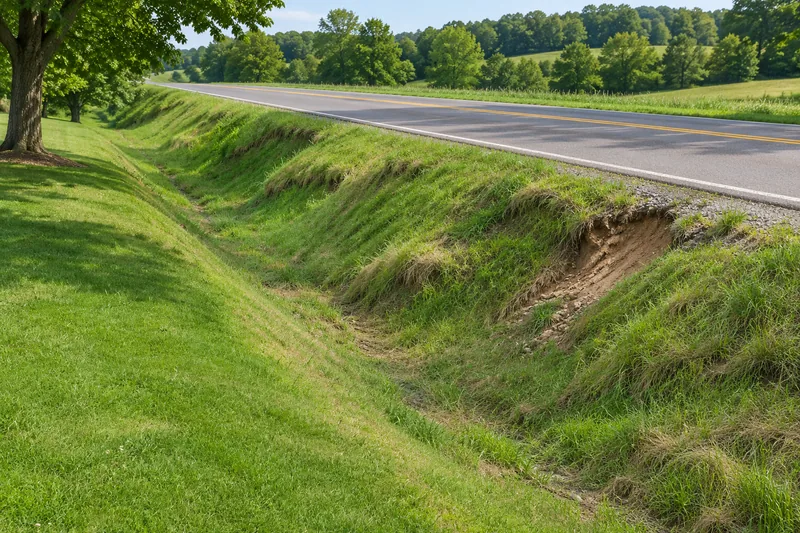
Leave a slope or ditch uncut when you cannot confirm a suitable machine, stable ground and a safe operating area. A mower that handles the main lawn may be unsuitable at its edges. Before starting, identify the places where traction, a hidden drop or passing traffic could turn a routine cut into a loss of control. This walk-through helps you record those limits and decide whether to wait, choose another method or request a site assessment.
1. Walk the accessible ground before bringing out the mower
Inspect from stable, accessible ground with the equipment off. Look along the whole planned route, including where you would turn and return to level ground. Check for ruts, holes, exposed roots, loose stones, drain openings and vegetation hiding a change in grade. Do not step onto a crumbling bank or into an unseen ditch to finish the inspection. If you cannot inspect an area safely, leave it out of the mowing plan.
OSHA identifies slopes, wet surfaces, culverts, embankments and water edges as rollover hazards. Its guidance calls for a terrain assessment and equipment-specific training. A familiar property still needs a fresh look after rain, erosion, excavation or a change of equipment. Record the actual condition you see rather than carrying forward last week's decision.
Pebble Creek offers onsite estimates for Southwest Missouri properties. When requesting one, identify the difficult area separately from the main lawn: the bank beside the drive, the ditch near the mailbox or the slope behind the building. Describe access and drainage, and take a photo only from a safe position. That gives us a specific area to discuss instead of treating every square foot as ordinary mowing.
| What you find | Why it changes the job | Next step |
|---|---|---|
| Wet grass, soft soil or fresh ruts | Traction and ground support are uncertain. | Postpone the affected area and reassess when conditions change. |
| A ditch, water edge or eroding bank | An edge can collapse or a wheel can drop. | Keep the rider away; arrange assessment of a suitable alternative. |
| A slope limit you cannot verify | Appearance does not establish machine suitability. | Locate the exact manual and obtain qualified guidance before mowing. |
| Traffic close to the working area | Vehicles and thrown debris create separate hazards. | Stop and resolve the roadside work plan with the responsible authority or qualified contractor. |
| Hidden ground or insecure footing | Changing tools does not remove a fall hazard. | Leave the area uncut until it can be assessed safely. |
2. Use the exact machine's slope instructions
Find the operator's manual for the model and configuration you actually have. Record the slope limit, required travel direction, attachment restrictions and instructions for turns. A recommendation for a lawn tractor does not automatically transfer to a zero-turn, stand-on or walk-behind. Scag's general safety page itself lists different limits for different equipment, which is a reason to check the model manual rather than borrow a single number from an article.
If a slope must be measured, follow the manufacturer's measurement method from a safe location. Do not drive onto an uncertain bank to discover whether the mower can climb it. A reading below a stated maximum does not resolve wet grass, holes, weak edges, restricted turning space or hazards below the slope. When the manual is missing or unclear, ask the manufacturer or an authorized dealer before using the machine there.
Check guards, interlocks, tires and the prescribed rollover-protection setup before work. For a mower equipped with ROPS, follow its instructions for the raised structure and seat belt; lowering the structure removes its protective function. Do not treat ROPS as permission to attempt a hazardous slope. Keep a machine with missing or damaged required safety equipment out of service.
3. Treat ditch edges as a separate no-go area
A strip of grass above a ditch can look level while the edge beneath it is weak. Scag warns against mowing near drop-offs, ditches and embankments because a wheel can go over or the edge can cave in. Leave a rider away from those hazards. Do not reach the deck over a bank to collect the last strip or use previous tire marks as proof of support.
There is no single setback in this guide that certifies every bank. The required exclusion area depends on the ground, depth, erosion, machine and manufacturer instructions. A qualified site assessment may require more distance than an example in a general safety sheet. Keep the uncertain strip out of the route until that boundary is established.
Wet grass adds a separate concern even where the edge is sound. CCOHS notes that mower tires can lose traction and slide on wet turf. Recheck shaded ground, damp leaves and drainage paths before proceeding. Waiting is a valid work decision; a tidy main lawn with an intentionally uncut hazardous edge is preferable to improvising a pass.
4. Keep road-edge mowing separate from ordinary lawn work
Before working beside a public road, establish who maintains the area and what access or work arrangements apply. Ask the responsible road authority when the boundary or permitted activity is unclear. If the job would put you or equipment in a traffic lane, on a narrow shoulder or behind a blind curve, stop and arrange qualified help. Do not improvise a lane closure or rely on motorists moving over.
MoDOT describes using protective follow trucks for its roadside mowing crews and warns that distracted drivers can miss even prominent lights and signs. A homeowner wearing a bright vest has not recreated that work setup. For vegetation blocking visibility on a state-maintained road, MoDOT provides a reporting route and the number 1-888-275-6636. Report the location instead of entering traffic to cut it yourself.
Thrown debris matters too. Keep mower discharge away from streets, vehicles and people, as CCOHS advises, and keep the specified guards installed. If the available route cannot protect others from the work, leave that section for a different plan. A brief gap between passing cars is not a complete assessment.
5. Reassess the site before switching to a trimmer
A smaller tool may allow a different method, but the operator still needs secure footing, visibility and room to control it. STIHL's trimmer instructions warn about wet or overgrown terrain, hidden obstacles and slopes, and require proper balance and control. If you would need to lean over a ditch, stand on an unstable bank or work from the roadway, changing from a mower to a trimmer has not solved the problem.
Use only the cutting attachment, guard, handle and harness combinations approved for that exact tool. Follow its bystander clearance and protective-equipment instructions. An approved brushcutting attachment is not interchangeable with any blade that fits the shaft. Stop when you cannot maintain the prescribed working position, keep others clear or see what the head could strike.
For a recurring difficult area, discuss a different maintenance approach with a qualified provider: equipment selected for the actual terrain, a separately assessed hand-tool task, or a landscape change where suitable. Confirm drainage and road-authority requirements before changing a ditch or right of way. An estimate should identify excluded areas and the proposed method; hiring someone does not make an unsuitable machine suitable.
6. Write down the boundary, method and reason to stop
Use the six entries below as a property note. Make the locations recognizable without walking into the hazard. For example, a hypothetical note could say: 'Front ditch beside driveway: ground hidden by tall growth; no riding mower; request assessment from stable driveway access.' It records an unresolved job rather than pretending a photograph establishes the slope angle or edge strength.
High-visibility clothing can help others notice a worker, but it cannot prevent a vehicle collision or mower rollover. Compare garments only after the job assessment identifies the required type and performance class. Check the manufacturer's label and fit over your normal layers. Keep reflective material visible and follow cleaning and replacement instructions. CCOHS explains the importance of fit, coverage and selection for the actual exposure; its Canadian classifications should not be substituted for the requirements of a Missouri worksite.
The optional vest comparison below helps you compare documented specifications, fit and garment construction. Pebble Creek has not tested the products in those search results. Choose an existing suitable garment if it already meets the plan. No purchase changes a no-go decision.
For local help, review our lawn-care service and Nixa service-area page, then describe the slope or ditch when requesting an estimate. Tell us which areas you want assessed and which you currently leave uncut. Agree on the work scope before the visit becomes a recurring mowing arrangement.
- CCOHS high-visibility apparel selection and fit ↗
- Pebble Creek lawn care ↗
- Lawn care in Nixa ↗
- Check our full service area ↗
- Request an onsite estimate ↗
- Area: identify the bank, ditch or road edge with a safe viewing point.
- Condition today: record moisture, visible erosion, hidden ground, obstacles and traffic exposure.
- Machine: record model, attachment and the relevant manual instructions; leave unresolved details open.
- Boundary: identify the excluded area and who will assess any uncertain edge or slope.
- Method: record mowing, postponement or a separately assessed alternative, with responsible person.
- Stop trigger: note the changes that require another assessment, such as rain, reduced visibility or people entering the area.
Related Lawn Guide chapters
Useful gear for this topic
Compare visibility garments after planning the work
Use a suitable garment you already own, or compare documented specifications and fit. This optional category comparison does not replace the site assessment, machine manual or roadside work plan.
As an Amazon Associate, Pebble Creek earns from qualifying purchases. Your price is not increased. How we choose recommendations.
High-visibility work vests
Best for: Comparing mesh and solid-fabric garments, fit over work layers, closures and documented visibility specifications after a task assessment identifies the required garment type and class.
Verify the exact manufacturer label, applicable standard, garment type and performance class for the job. Search results may include unrated clothing. Check fit, care and replacement instructions; keep visible material uncovered. A vest is not traffic control or rollover protection and does not make a hazardous road edge suitable for mowing. No firsthand product testing is claimed.See current Amazon options ↗Sources and further reading
- OSHA riding-mower rollover guidance ↗
- Scag operation and safety guidance ↗
- CCOHS riding lawn mowers ↗
- MoDOT roadside mowing and reporting guidance ↗
- STIHL FSA 45 manual: footing and working conditions ↗
- STIHL trimmer and brushcutter safety manuals ↗
- CCOHS high-visibility apparel selection and fit ↗
This chapter provides general educational information. Site conditions vary, and product labels and equipment manuals control whenever a product or machine is used.