
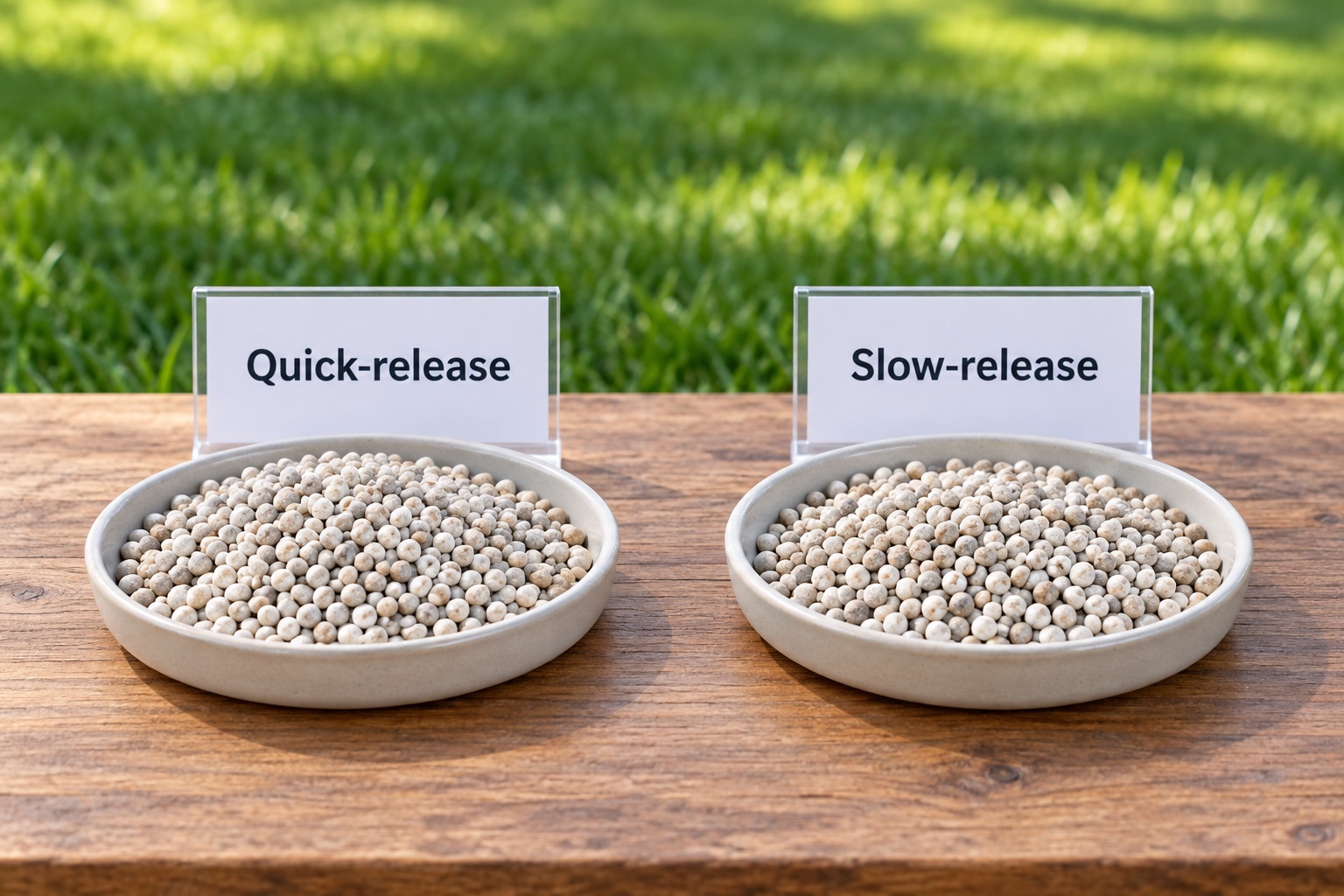
For an established tall-fescue lawn, a fertilizer containing some slow-release nitrogen can make steady feeding easier to manage. Quick-release nitrogen still has a place when the timing and measured rate fit the lawn. Neither is a fix for drought, drainage trouble or an unknown brown patch. The useful question is not which bag greens grass fastest: it is which release pattern fits your lawn's condition and the follow-up care you can actually provide.
1. Compare nitrogen sources, not the shape of the product
Quick-release nitrogen becomes available relatively promptly after application and moisture. Uncoated urea and ammonium sulfate are familiar examples. That availability can support a quicker response, but a large dose can also push more leaf growth than you want to mow. A dark-green flush is not proof of a better long-term plan.
Slow-release sources spread availability out through coatings or chemical and biological processes. Examples include polymer-coated urea, urea-formaldehyde materials and many natural organic sources. Their behavior is not identical: temperature, moisture and, for some sources, soil microbes influence release. A coating is not a guarantee that every lawn gets the same number of feeding days.
Granular does not mean slow-release, and liquid does not always mean quick-release. Some liquid products contain slowly available nitrogen. Likewise, synthetic fertilizer can be slow-release; organic is not a synonym for harmless. Read the nitrogen-source information rather than deciding from the bag's color, granule shape or front-panel branding.
2. Use this decision table before comparing bags
Start with the situation, then check the label and nutrient plan. These are selection principles for established cool-season turf—not permission to fertilize or a rate prescription.
| Your situation | Consider | Check before applying |
|---|---|---|
| Healthy, actively growing lawn; you want a manageable feeding program | A product with a meaningful slow-release portion or a blend | Current nutrient need, application interval and watering directions |
| A justified application calls for a prompt response, with careful follow-up available | Quick-release nitrogen within the measured plan | Avoid a growth surge; account for previous applications |
| Cool late-fall conditions and a remaining, justified nitrogen need | Ask whether soluble nitrogen better fits the timing | MU's late-fall guidance, actual growth, ground conditions and label |
| Wilted, dormant, saturated or unexplained patchy lawn | Neither—pause the fertilizer decision | Investigate moisture, drainage, damage or disease first |
3. Read the fine print on a blended fertilizer
Many lawn products combine quick- and slow-release sources. That can provide some nearer-term availability while retaining a slower portion. The three large N-P-K numbers do not tell you this split. Look below them for the guaranteed analysis and any footnote explaining slowly available nitrogen, water-insoluble nitrogen or coated sources.
Here is a made-up label example, not a product recommendation: a fertilizer has 24% total nitrogen by product weight, including 12% slowly available nitrogen by product weight. In that example, 12 divided by 24 means half of its nitrogen is slowly available. It does not mean half the entire bag is slow-release nitrogen. If a label instead states a percentage 'of total nitrogen,' use that wording directly—do not divide it again.
Water-insoluble nitrogen is one label clue, not the only possible slow-release form. If the source information is missing from a sales listing, find the manufacturer's current label or ask for it before buying. Do not assume an unreadable label contains the blend you want. Guide 3.4 handles pounds of product and lawn-area math separately.
4. Let Missouri conditions change the decision
In Southwest Missouri, the same tall-fescue yard can move from vigorous spring growth to summer stress and back into fall growth. MU Extension warns against encouraging excessive spring and summer growth and identifies fall as the main fertilization period for cool-season lawns. A slower source does not turn a poor application day into a good one.
MU also notes that soluble nitrogen can be used more efficiently in late fall. That is why 'always buy the slowest product' is not a complete rule. A cold-weather application should be based on remaining need and suitable conditions, not an attempt to empty the last bag before winter. Do not transfer a tall-fescue plan directly to a warm-season zoysia or bermudagrass lawn.
Before either type goes down, check the previous treatment date, soil moisture and forecast. Do not fertilize frozen or saturated ground or immediately ahead of runoff-producing rain. For a dry, stressed lawn, address the moisture situation first. Follow the exact product's watering directions; a promised shower is not reliable irrigation and a downpour is not controlled watering-in.
5. Match the feeding plan to mowing and watering
Slower availability can help reduce abrupt growth changes, but it does not eliminate mowing, irrigation or application records. Quick-release programs commonly call for closer management of smaller, repeated applications. Either approach can be overdone if the homeowner and a service provider apply separate treatments without comparing notes.
For Pebble Creek lawn-care coordination, tell us the application date, product name and treated area before the next visit. A photo of the label is more useful than 'the green bag.' Also tell us which areas were recently seeded and whether another company handles fertilization. This is a practical way to align the work, not a claim that we have tested every product on the market.
If you cannot mow more often during a growth surge, say that before choosing the program. Ask the applicator what response to expect, what watering is required and when the lawn should be reassessed. Do not add another quick-release treatment simply because the first application has not produced the color you hoped for.
6. Compare the whole label, not a winner badge
A release type answers only one purchasing question. The product must also fit the grass, the nutrient plan, the measured area and any reseeding restrictions. A natural organic fertilizer may contain phosphorus that an established lawn does not need. A weed-and-feed product adds herbicide directions and limitations that plain fertilizer does not have.
Compare the cost of the amount your lawn actually requires, the number of planned applications and your ability to apply it evenly. We are not naming a universal best bag here. A cheaper bag with the wrong analysis or an unnecessary treatment is not a saving, and a more expensive slow-release product is not automatically the right choice.
The optional comparisons below focus on reading release information and controlling a small-area application. A hand spreader is useful only if it handles the chosen material and you can maintain a consistent pattern. For a larger lawn, existing suitable walk-behind equipment may make more sense. The product's rate and the tool's calibration instructions still govern.
7. Leave yourself a one-line decision
Write the decision before you shop: 'The lawn needs ___; the last application was ___; the release source is ___; I can provide ___ watering and mowing; I will reassess on ___.' If you cannot fill in the need or treatment history, return to guide 3.3 before buying.
Save the label and application record, then observe growth rather than grading the lawn only by color. If you need help with recurring care, use the lawn-care and service-area links or include those notes in an estimate request. The next guide looks specifically at fall feeding decisions in Nixa; this comparison is about release behavior, not a second annual fertilizer calendar.
Related Lawn Guide chapters
Useful gear for this topic
Compare release information and small-area control
These are optional category comparisons, not field-tested winners. Read the manufacturer's current label before selecting a fertilizer. A search result or a slow-release claim alone does not establish that your lawn needs the product.
As an Amazon Associate, Pebble Creek earns from qualifying purchases. Your price is not increased. How we choose recommendations.
Lawn fertilizer matched to your nutrient plan
Best for: Comparing the actual nitrogen sources, slowly available portion, application interval and watering directions. Check the whole nutrient analysis rather than choosing by the quickest promised color change.
Match the exact label to your grass, soil report and previous applications. Check phosphorus content, added herbicides and reseeding restrictions. Slow-release does not mean safe at any rate or on stressed turf; search results may contain unsuitable mixtures. No exact item is claimed to be tested by Pebble Creek.See current Amazon options ↗Handheld fertilizer spreader for a small lawn
Best for: Comparing manageable loaded weight, reliable shutoff, flow adjustment and calibration instructions for a small, measured treatment area. Reuse suitable equipment you own.
Verify that the exact tool handles your fertilizer, follow the manual and label, and calibrate the application. An uneven walking or cranking pace can cause uneven coverage. Keep granules off pavement and away from drains. No firsthand testing of these listings is claimed.See current Amazon options ↗Sources and further reading
- MU Extension: Cool-season grasses lawn maintenance calendar ↗
- Penn State Extension: Turfgrass fertilization—nitrogen sources and labels ↗
- Purdue Extension: Fertilizing established cool-season lawns ↗
- MU Integrated Pest Management: Fall fertilization of home lawns ↗
- MU Integrated Pest Management: The case for taking an incomplete ↗
- University of Minnesota: September 2023 home lawn care newsletter ↗
This chapter provides general educational information. Site conditions vary, and product labels and equipment manuals control whenever a product or machine is used.