
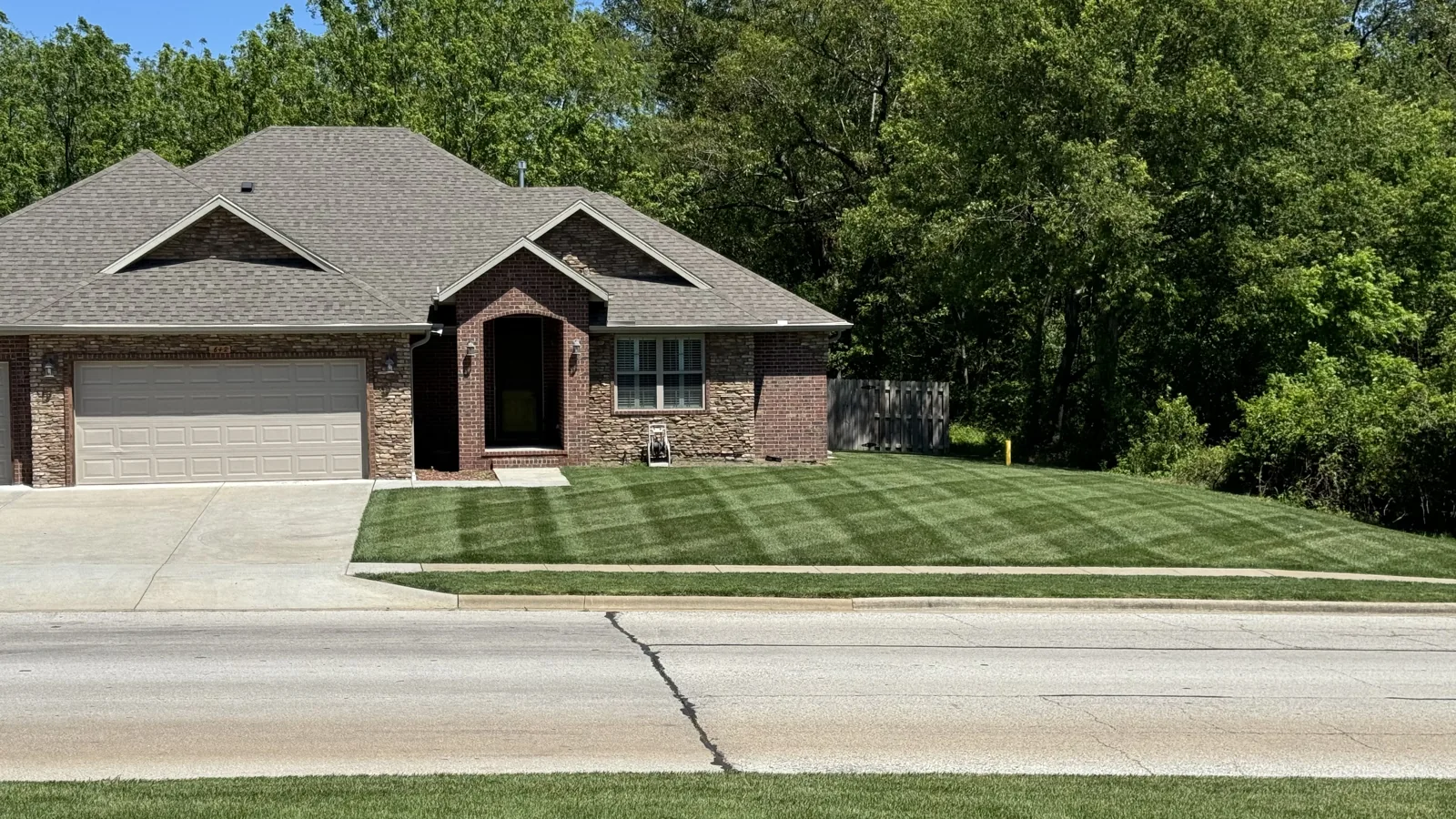
Yes—mowing tall fescue at a suitable taller height can make it harder for some weeds to establish. No—it is not a treatment that makes existing weeds disappear. For a Southwest Missouri homeowner, the useful question is not simply 'Should I raise the mower?' It is 'Am I cutting healthy grass too short, or is something else leaving room for weeds?' Start with the grass, then inspect where the weeds are growing.
1. Taller grass helps by protecting the canopy
MU Extension explains that a taller, denser grass canopy reduces the light reaching the soil surface and gives turf a competitive advantage over weed seedlings. Its weed-prevention guidance suggests about 3½–4 inches for tall fescue. This is a practical starting point for established fescue, not a promise of a weed-free yard or a setting for every grass species.
Density matters as much as height. A few long blades standing over bare soil do not form a closed canopy. Purdue lists higher mowing among several cultural practices that can reduce crabgrass, alongside appropriate fertility, irrigation and relief of compaction. Raising the deck helps address a mowing problem; it cannot fill every gap by itself.
Do not confuse taller mowing with leaving the lawn untouched. Keep a suitable finished height while mowing often enough for the current growth. For choosing the height itself, use our related tall-fescue mowing-height guide below; this article focuses on whether mowing is the missing part of your weed plan.
2. Established weeds need a separate decision
Crabgrass prevention and removal are different jobs. Purdue distinguishes measures that discourage establishment from treatments aimed at plants that have already emerged. If you can already point to a large clump, raising the mower is not evidence that the clump has been controlled. Identify it before choosing the next step; not every coarse grass in fescue is crabgrass.
Creeping Charlie is another useful example. University of Minnesota Extension describes a perennial that spreads across the ground and roots along its stems. Cutting the tops does not remove that network. Small patches can be removed by hand, but removal may need repeating and roots and shoots must be addressed. A higher cut supports the surrounding lawn without replacing a weed-specific plan.
You also get to decide what outcome you want. A few tolerated plants are different from a spreading patch that is replacing the lawn. Photograph the patch close up and from a few steps back. Record whether your goal is preventing new weeds, managing an existing infestation or simply keeping a mixed lawn tidy. Those are different requests.
3. Read the pattern before buying a treatment
The location of weeds is a clue, not a diagnosis. University of Maryland Extension recommends identifying the weed and addressing poor growing conditions; otherwise weeds can remain a recurring problem. Use the following checklist to choose what to investigate, rather than assuming every patch needs the same product.
Compare the problem area with nearby healthier grass. Note shade, foot traffic, standing water and exposed soil. Do not diagnose soil pH or nutrient needs from a weed alone. A recurring issue deserves an inspection or soil test where appropriate, not a sequence of guessed fertilizer and weed-control purchases.
| What you see | First check | What taller mowing cannot do |
|---|---|---|
| A short strip along pavement | Compare its finished height with the middle of the lawn; check trimming. | Replace grass repeatedly scalped at the edge. |
| Weeds scattered through bare or thin turf | Look for missing grass and a realistic repair or overseeding plan. | Create a dense stand where grass is absent. |
| A spreading mat in a damp, shaded corner | Identify the plant and investigate light and drainage. | Remove established roots or correct the site. |
| A few weeds in otherwise dense turf | Identify them and decide whether spot removal or tolerance fits your goal. | Guarantee zero weeds or justify treating the whole yard. |
4. Use this five-point height check on the next cut
This is a simple observation routine, not a controlled weed trial. Choose five repeatable places: the open lawn, a sidewalk edge, beside the driveway, a shaded spot and the area where weeds concern you. Take measurements before mowing and again after the blades stand upright. Use the same places next time so you can compare like with like.
Set an inch-marked ruler beside standing grass, starting at the soil surface without pressing the turf flat. Record several ordinary grass blades, not the tallest weed or seed stalk. You do not need a specialty purchase if a readable ruler already does the job. A mower's numbered lever is a setting, not proof of the actual height left behind.
MU's maintenance calendar advises removing no more than one-third of the leaf in a single mowing. For example, a 3½-inch target reaches that limit at 5¼ inches before cutting: 5¼ minus 3½ equals 1¾ inches, one-third of 5¼. That calculation helps set the next inspection; it is not permission to mow dormant grass or soft, saturated ground.
- Write down the date, grass type, intended height and before/after measurements.
- Note any edge that finishes noticeably shorter than the main lawn.
- Photograph the same weed patch without changing camera distance each visit.
- Make mower adjustments only with equipment safely stopped and according to its manual. Never reach under an operating mower.
- If the lawn has already outgrown the target, use the related overgrown-lawn guide rather than cutting it down all at once.
5. Do not undo the mower setting with the trimmer
MU's natural-lawn-care guidance warns that close trimming beside curbs, sidewalks and driveways can scalp turf and encourage weeds. A neat pavement line does not require shaving the adjoining grass to the soil. Check the finished edge, not just the attractive stripes in the center.
For a Pebble Creek mowing request, tell us which edge or patch concerns you and include a wider photo. Ask for the intended finished height and point out where another person uses a trimmer between visits. That keeps the conversation specific: 'Please check this short strip by the driveway' is more actionable than 'the weeds are getting worse.'
Keep lawn mowing and weed treatment separate in the agreed scope. Do not assume a recurring mowing visit includes herbicide application or guarantees weed elimination. If another provider handles treatment, share the product and application instructions relevant to the next mowing visit.
6. Judge the next step by what is still wrong
After the next few normal mowing visits, review the measurements and photographs. The immediate check is whether the lawn is being left at the agreed height without repeatedly short edges. Existing perennial weeds still being visible does not, by itself, mean the mowing adjustment failed. Equally, a tidy-looking cut does not prove the underlying weed issue is solved.
If weeds occupy missing turf, plan how to restore coverage at a suitable time. If they repeatedly return in the same wet or shaded area, investigate that location. If the plant cannot be identified confidently, take clear photographs and a sample as directed to local Extension or a qualified turf professional before selecting a treatment.
If an herbicide is considered, follow the exact product label for the weed, grass species, application conditions and restrictions around seeding and mowing. Taller mowing is one part of prevention—not a substitute for those instructions. Start with a measured cut and a clear diagnosis, then pay for the work the lawn actually needs.
Related Lawn Guide chapters
Useful gear for this topic
Compare an optional ruler for the height check
Use a readable ruler you already own first. If you need one, compare clear inch markings and a format that is easy to hold beside standing grass. This is a category comparison, not a field-tested endorsement or a weed treatment.
As an Amazon Associate, Pebble Creek earns from qualifying purchases. Your price is not increased. How we choose recommendations.
Grass-height measuring ruler
Best for: Comparing ordinary inch-marked rulers and dedicated turf gauges for recording before-and-after grass height at the same locations.
Check units, scale range and how the tool is meant to be read. Measure from the soil without compressing the grass; do not mistake a deck-leveling tool for a standing-grass measurement. Keep clear of moving equipment and follow the mower manual for adjustments. No firsthand testing of these listings is claimed.See current Amazon options ↗Sources and further reading
- MU Extension: Mow high to keep weeds under control ↗
- Purdue Turfgrass Science: Large crabgrass—cultural and other controls ↗
- University of Minnesota Extension: Ground ivy (creeping Charlie) ↗
- University of Maryland Extension: Common home lawn weeds ↗
- MU Extension: Natural lawn care ↗
- MU Extension: Cool-season grasses lawn maintenance calendar ↗
This chapter provides general educational information. Site conditions vary, and product labels and equipment manuals control whenever a product or machine is used.