
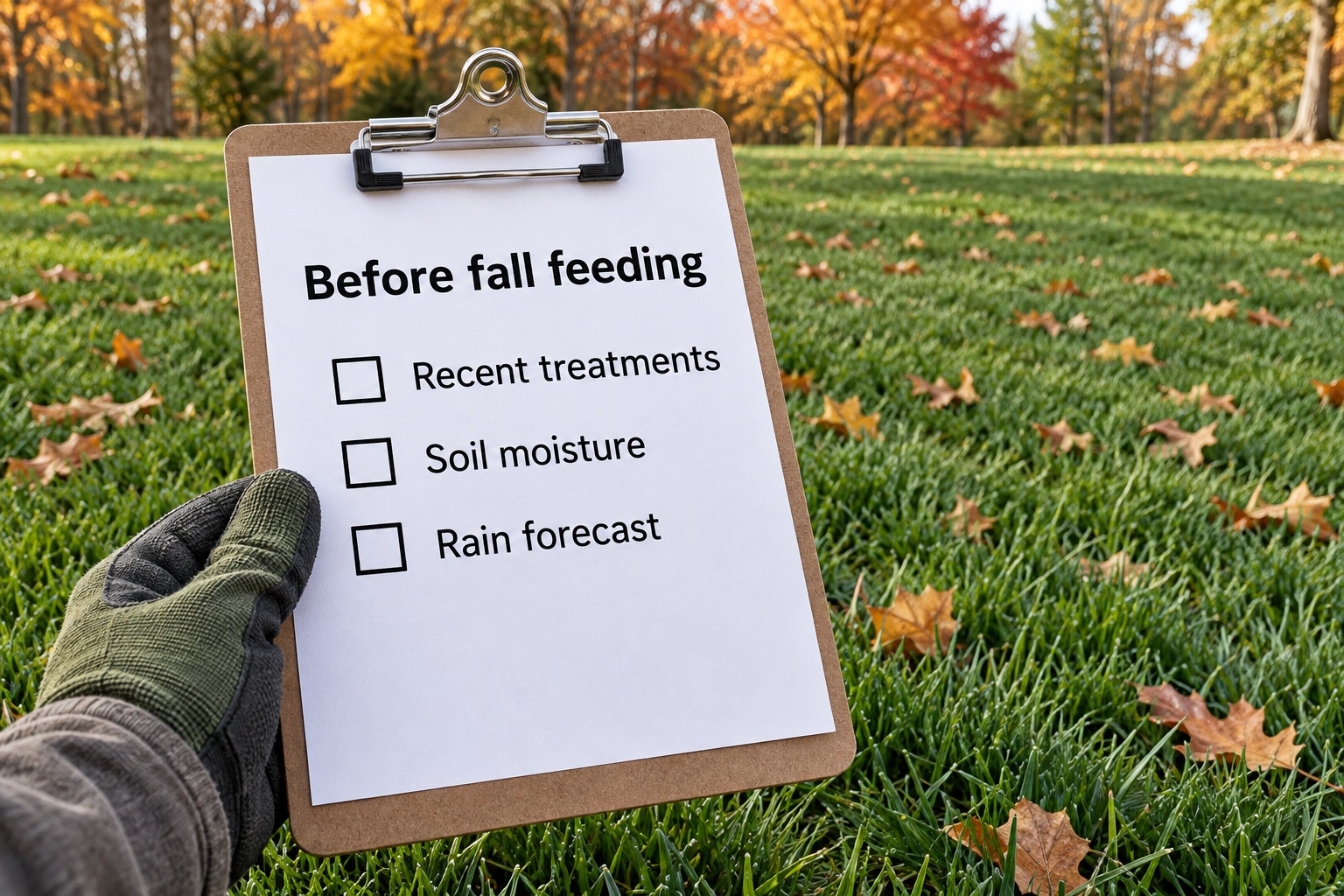
For an established tall-fescue lawn in Nixa, fall is an important feeding season—but a date on the calendar is not a reason to spread fertilizer today. First confirm that the lawn needs another application, is in suitable growing condition and can receive the product as directed. If the ground is soaked, the grass is drought-stressed or the last treatment is unknown, waiting is the useful decision. Work through these checks before opening the bag.
1. Start with the last application, not the season on the bag
Find the last fertilizer record: application date, exact product, amount and area treated. Include work done by another company, a family member or a seed-and-fertilizer combination. 'We fed it sometime last month' is a reason to check the receipt or ask the applicator before adding more.
Compare that record with the current label's application interval and your remaining nutrient plan. A different brand or a bag marked fall or winterizer does not reset the interval. Soil results help identify phosphorus, potassium and lime needs; routine lawn soil testing is not a moment-by-moment nitrogen gauge. Use the test together with treatment history and a turf-specific plan.
If you know another application is appropriate but need help converting it into pounds of product, use guide 3.4 below. This guide decides whether the conditions are right today; it does not prescribe the same dose for every Nixa yard.
2. Walk through these go-or-wait checks in order
Stop at the first unresolved check. Do not average a good forecast against a bad soil condition: all of the required conditions need to fit. Treat an unexplained damaged patch separately from healthy turf.
| Check | Continue only when… | Otherwise… |
|---|---|---|
| Recent feeding | You know what was applied and the next treatment fits the label and plan. | Wait for the record; do not stack treatments. |
| Grass condition | The grass type and growth stage fit a fall feeding plan. | Identify the grass or investigate stress first. |
| Ground condition | Soil is moist enough to support growth, not saturated or frozen. | Wait for recovery, drainage or thaw; reassess. |
| Weather and water | Heavy rain is not imminent and you can follow the watering directions. | Choose another day; do not rely on a storm. |
| Product and equipment | The exact label, measured area and calibrated spreader all agree. | Resolve the mismatch before loading fertilizer. |
3. Check the grass and soil where you will actually work
MU Extension distinguishes fall feeding of cool-season grass from applying fertilizer to dormant turf in winter. Early in fall, resumed growth after summer stress helps show that the lawn is ready for normal care. Later, leaf growth can slow while the grass remains green; that is not automatically the same as winter dormancy. MU's calendar allows later fall feeding under suitable conditions. Do not use 'I have stopped mowing' as the only test.
This is a tall-fescue decision process, not a fall nitrogen schedule for zoysia or bermudagrass. If the lawn is mixed, identify the areas before treating them together. A green color alone does not prove a nutrient shortage, and a brown area does not tell you whether the cause is dryness, disease or something else.
Look beneath the surface in more than one place: the sunny strip, shaded lawn and any low spot. A brief shower can wet leaves without resolving dry soil. Conversely, standing water or soil that squishes underfoot is a reason to wait. Do not push a loaded spreader through soft ground or try to correct poor drainage with fertilizer.
4. Read the forecast and the label together
Check the forecast for the actual Nixa property shortly before the planned application. A percentage chance of rain does not tell you whether that water will arrive gently, miss the yard or run off in a downpour. Postpone when heavy rain is forecast. Do not apply on frozen ground or dormant, weather-stressed turf.
Then read the exact product's directions for leaf moisture, watering-in, mowing, protective equipment and people or pets returning to the area. Plain fertilizer and a fertilizer containing weed-control ingredients may have different requirements. If you cannot provide the required water or keep the area clear for the stated time, change the work date rather than improvising.
An approaching cold spell is not a reason to double the rate or squeeze several missed treatments into one weekend. Late-season nutrient sources behave differently as conditions cool; guide 3.5 explains that choice. Keep the decision tied to remaining need, grass activity and the label, not a goal of finishing every bag before winter.
5. Make new seed and existing treatments part of the decision
If the yard was recently overseeded, pull out the seed and starter-product records too. Fertilizer included with seed counts toward the program. Do not automatically follow it with a second complete fertilizer, and do not assume a fall weed-and-feed is compatible with young seedlings. Verify any herbicide's seeding restrictions on its own label.
Here are two hypothetical examples, not Pebble Creek customer jobs. A healthy established lawn received its planned treatment recently: another cool weekend does not create a new need, so check the interval and wait if it is too soon. A different lawn has a justified treatment due but a soggy back corner: reassess that area after drainage instead of treating the whole property as equally ready.
Where conditions or treatment history differ, mark the areas in your notes. A single address does not require one identical treatment across every square foot.
6. Get local help when a check stays unresolved
Nixa homeowners can contact MU Extension in Christian County about soil testing and turf diagnosis. Its current office listing is 1701 W Jackson Street, Suite B, Ozark, with phone 417-581-3558. The county service page lists soil testing and plant-disease diagnosis. Call before taking a sample to confirm current hours, preparation, fees and the right kind of sample for the question.
For a nutrient question, bring the soil report and recent product labels. For a spreading brown patch, ask what diagnostic material they need instead of assuming an ordinary soil sample will identify a disease. The linked county resources below were checked for this guide; no lab turnaround or outcome is promised.
Nixa's city boundary does not give its grass different biology from neighboring towns. The local value here is a property-level checklist and a reachable county resource—not a claim that every yard has the same soil.
7. Leave a clear record for the next visit
Once the checks pass, measure only the intended turf area and calibrate the equipment for the actual material. Follow label directions and keep granules away from pavement and drains; sweep stray material back into an appropriate treated turf area rather than washing it into runoff. A broadcast spreader is not a reason to treat beds or narrow areas it cannot control.
For Pebble Creek mowing coordination in Nixa, share the planned treatment date, recent seeding and any label restrictions before the next visit. Tell us if a separate applicator is involved. That keeps the mowing conversation tied to the actual work without implying that every membership includes fertilization.
Save one short record: 'Fed / waited / referred; date; product and amount if used; treated area; watering instructions; reason; next check.' If you waited, write what must change—soil drying, missing records, suitable weather or a diagnosis. Then use the lawn-care and service-area links to discuss the care you want handled.
Related Lawn Guide chapters
- 3.1: A Practical Fertilizer Schedule for Missouri Cool-Season Lawns
- 3.4: What Do Fertilizer Numbers Mean? Calculate the Right Amount for Your Lawn
- 3.5: Slow-Release vs. Quick-Release Lawn Fertilizer: Which Fits Your Lawn?
- 3.3: Does Your Lawn Actually Need Fertilizer? What to Check Before Buying Another Bag
Useful gear for this topic
Compare supplies only after the go-or-wait check
These are optional product-category comparisons, not products Pebble Creek claims to have tested. A fall label is not proof your lawn needs another application. Reuse suitable equipment and follow the exact fertilizer label and spreader manual.
As an Amazon Associate, Pebble Creek earns from qualifying purchases. Your price is not increased. How we choose recommendations.
Lawn fertilizer matched to your nutrient plan
Best for: Comparing nutrient analysis, nitrogen sources, treatment intervals and watering directions against an established cool-season lawn's remaining plan—not choosing by winterizer branding.
Check grass type, past treatments and any added herbicide or seeding restriction. Search results include mixtures that may not fit your lawn. Do not fertilize stressed or saturated turf just because the season matches the package; no specific item is endorsed or claimed to be field-tested.See current Amazon options ↗Walk-behind broadcast spreader
Best for: Comparing reliable shutoff, edge control and material-specific calibration guidance for a measured treatment area. Existing suitable equipment may be enough.
Match the exact tool and fertilizer instructions, calibrate the amount, and keep granules away from hard surfaces and drains. A hopper-size claim or generic setting does not establish the correct application rate. No firsthand testing of these listings is claimed.See current Amazon options ↗Sources and further reading
- MU Extension: Cool-season lawn calendar ↗
- MU Extension: Managing lawns—growth and late-season fertilization ↗
- MU Extension: Soil testing for lawns ↗
- University of Maryland Extension: Established-lawn care and runoff precautions (Missouri timing follows MU) ↗
- MU Extension in Christian County: Current office location and contact ↗
- MU Extension in Christian County: Soil testing and diagnostic services ↗
This chapter provides general educational information. Site conditions vary, and product labels and equipment manuals control whenever a product or machine is used.