
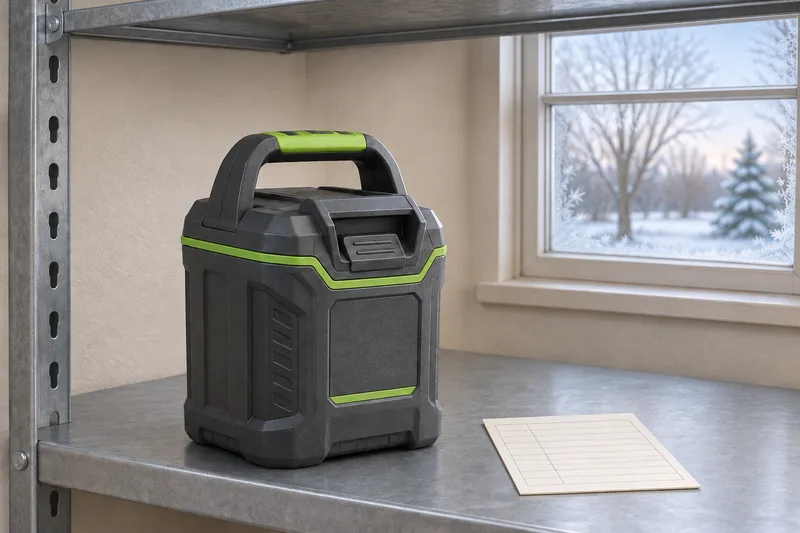
Start winter battery storage by identifying the battery chemistry and exact model. Then follow that battery's instructions for charge level, temperature, removal and check intervals. A cordless mower's removable lithium pack, a gasoline rider's lead-acid starter battery and a built-in electric-rider battery can require different procedures. A short written record makes those differences much easier to manage when mowing starts again.
1. Identify the battery before choosing a storage routine
Read the battery label and the mower manual. Record the battery model, chemistry, voltage and charger model. Photograph the label while it is easy to reach. If the label is damaged or the battery has been replaced, have the manufacturer or dealer identify the installed equipment before choosing a charging or storage method.
Removable lithium-ion packs usually have their own instructions alongside the mower manual. Lead-acid starter batteries need a procedure appropriate to their construction, such as flooded or AGM. Built-in batteries may have a machine-specific disconnect sequence and monitoring schedule. Use the procedure for the installed system, and leave removal of a service-only battery to qualified personnel.
At Pebble Creek, our Southwest Missouri lawn-care planning includes the change from regular mowing to winter preparation. Homeowners can use that same transition as a reminder to inventory equipment. A pack still shared with a leaf blower belongs on an active-use schedule until that work finishes. Record which batteries are actually entering storage instead of assuming every pack stops working on the last mowing day.
The broader battery-versus-gas guide helps with equipment choices. Here, the task is to preserve the equipment you already have through its inactive period.
2. Copy the charge and temperature instructions for your model
Manufacturers publish different storage targets. Use the examples below to see what information to find, then check the current manual covering your exact model and serial range. The EGO reference covers BA1120, BA1400, BA2240, BA2800 and BA4200 packs and their listed FC versions. Other EGO models need their own instructions.
STIHL's U.S. storage guide also distinguishes removable batteries from integrated-battery tools and directs owners to the individual manuals. Read the complete applicable section. A broad permitted temperature range can differ from the narrower range recommended for longest life.
Write storage temperature and charging temperature on separate lines. A pack that can sit safely at a particular temperature may still need to reach a different temperature before charging. For the EGO models listed here, the manual gives a charging range of 41–104°F. Follow the charger indicators and allow a cold pack to reach its permitted charging temperature naturally.
- EGO operator manual for the listed 56V packs ↗
- STIHL U.S. battery storage guidance ↗
- Interstate battery storage FAQ ↗
| Battery reference | Storage guidance in that reference | What to record |
|---|---|---|
| EGO BA1120/BA1400/BA2240/BA2800/BA4200 | For storage over 30 days, 30–50% charge and dry conditions below 80°F. The specification lists 50–80°F as optimum storage temperature. The manual also describes automatic self-maintenance and a six-month recharge step. | Exact model, indicator reading, storage temperature and manual's next check or charge date. |
| STIHL U.S. removable-battery guidance | For maximum life, 40–80% charge and 50–68°F. Its integrated-battery tool guidance gives a different charge range. | Confirm whether the battery is removable and use the matching model instructions. |
| Lead-acid battery storage | Interstate advises a full charge before storage and checks every 45–60 days. A discharged lead-acid battery is more vulnerable to freezing. | Battery construction, approved charger, charge check and next review date. |
3. Choose a dry location with protected contacts
Choose a secure location within the battery manufacturer's temperature limits, away from direct sunlight, moisture, children and pets. Check the conditions at the actual shelf or storage position. An unheated shed or garage can track outdoor temperatures, so a room name alone tells you little about the battery's overnight conditions.
Use a stable surface or properly installed, compatible holder that keeps the pack from falling. Keep screws, keys, hand tools and other conductive items away from exposed terminals. Follow the pack's instructions for any terminal cover or protection. Keep the battery label and status indicator accessible for later checks.
For a removable pack, complete the mower's shutdown procedure and remove the pack as directed. Store it separately when the manual requires that. Follow the manufacturer's cleaning method and let the exterior dry before storage. Avoid spraying liquid into battery openings or probing contacts with metal objects.
Read the charger's placement and ventilation instructions before setting up a charging location. Use the approved charger and keep its airflow paths clear. An enclosed storage cabinet or sealed box needs a specifically approved charging arrangement before it can serve that purpose. A generic battery bag or rack cannot establish that approval.
4. Keep a winter check log
Make one entry for each battery, even when several packs look identical. Put the record nearby without covering labels, contacts or ventilation openings. If someone else uses a stored pack during winter, have them update the record and follow its storage procedure again when returning it.
Set reminders from the manual's interval. Some packs manage their own storage charge, while other batteries require periodic charging or inspection. Read the documented indicator behavior before interpreting a changed light or charge reading. If the behavior falls outside that explanation, ask the manufacturer to assess it before further use.
For a lead-acid starter battery, match any maintainer to the voltage and battery chemistry and follow both sets of instructions. Use qualified service if you are unsure about cable removal, testing or charging. Sealed batteries need their specified maintenance procedure. Keep service work and electrolyte handling within the manufacturer's instructions and your ability.
- Identity and location — mower model, battery model, chemistry and storage position.
- Initial condition — date inspected, visible condition and charge indication.
- Storage target — charge range, temperature range and removal instructions from the manual.
- Charger — approved model and permitted charging temperature.
- Next check — date, required observation and manufacturer-directed action.
- Return to use — inspection date, charging completed as directed and any unresolved fault.
5. Stop and get guidance for a damaged battery
Inspect for swelling, cracks, leakage, damaged terminals, unusual odor, excessive heat or popping sounds. NFPA advises stopping use when signs of battery damage appear and having repairs performed by a qualified professional. Keep a damaged pack out of the charging routine and contact its manufacturer for handling instructions.
If there is smoke, fire or an immediate fire risk, move people away and call 911. Avoid handling or carrying a failing battery through the building. For a stable but damaged pack, describe its condition to the manufacturer or receiving facility before arranging transport.
EPA directs lithium-ion batteries to separate battery collection or household hazardous-waste programs. Household trash and curbside recycling can expose them to damage during processing. For Nixa, Ozark, Springfield and Republic residents, the linked battery locator provides a starting point. Confirm the exact battery type, size and condition with the receiving site before making a trip.
The locator warns that damaged or defective batteries require special handling and must be kept out of its ordinary collection boxes. Ask about commercial-waste eligibility if the battery comes from a business. Follow the receiving facility's packaging and terminal-protection directions for the battery it has agreed to accept.
6. Prepare for spring and compare storage holders carefully
Before the next mowing session, read the log, inspect the battery and charger, and complete the manual's return-to-service steps. Charge under the prescribed conditions. If a fault indicator persists, use the manufacturer's troubleshooting procedure or service support. Keep a pack with unresolved damage or charging faults out of operation.
A battery holder can organize an otherwise suitable storage location. Compare its exact pack compatibility, retention method, load capacity and mounting requirements. A holder marketed for STIHL AP packs may have a different shape from one for AK packs, EGO packs or a rider's starter battery. Check the model list and installation instructions before buying.
The optional catalog comparison below focuses on holders for STIHL AP packs. It is relevant only when that is the system you own. A suitable shelf may already meet your needs. Pebble Creek has no documented firsthand test of the products in those search results.
Use our spring mower checklist for the rest of the machine. If you are planning lawn service for the coming season, check Pebble Creek's lawn-care page and current service area, then request an estimate for your property.
Related Lawn Guide chapters
Useful gear for this topic
Optional battery storage comparison
Use a suitable shelf you already have, or compare a holder matched to your exact pack. Choose the storage location and follow the battery manual before selecting an organizer.
As an Amazon Associate, Pebble Creek earns from qualifying purchases. Your price is not increased. How we choose recommendations.
Storage holders for STIHL AP battery packs
Best for: Organizing compatible removable AP-series packs in a dry location that already meets the battery manual's storage limits. Compare retention, mounting requirements and documented pack fit.
Confirm the exact battery model, holder load rating, included hardware and wall fixing instructions. AP and AK systems differ. Keep contacts protected from metal objects and packs secure against falls. A storage holder provides no charging approval, temperature control or fire-containment certification. Search results may include other systems. No firsthand product testing is claimed.See current Amazon options ↗Sources and further reading
- EGO operator manual for the listed 56V packs ↗
- STIHL U.S. battery storage guidance ↗
- Interstate battery storage FAQ ↗
- U.S. Fire Administration battery charging and disposal guidance ↗
- NFPA lithium-ion battery safety ↗
- EPA lithium-ion battery storage and recycling questions ↗
- Find a battery collection site and check its acceptance rules ↗
This chapter provides general educational information. Site conditions vary, and product labels and equipment manuals control whenever a product or machine is used.